ImpactSustainability5 MIN READ

JSW Energy's Q2 Profit Climbs 38% to ₹1,141 Crore as It Lines Up ₹5,000 Crore of Bonds to Fund Its Clean Power Expansion

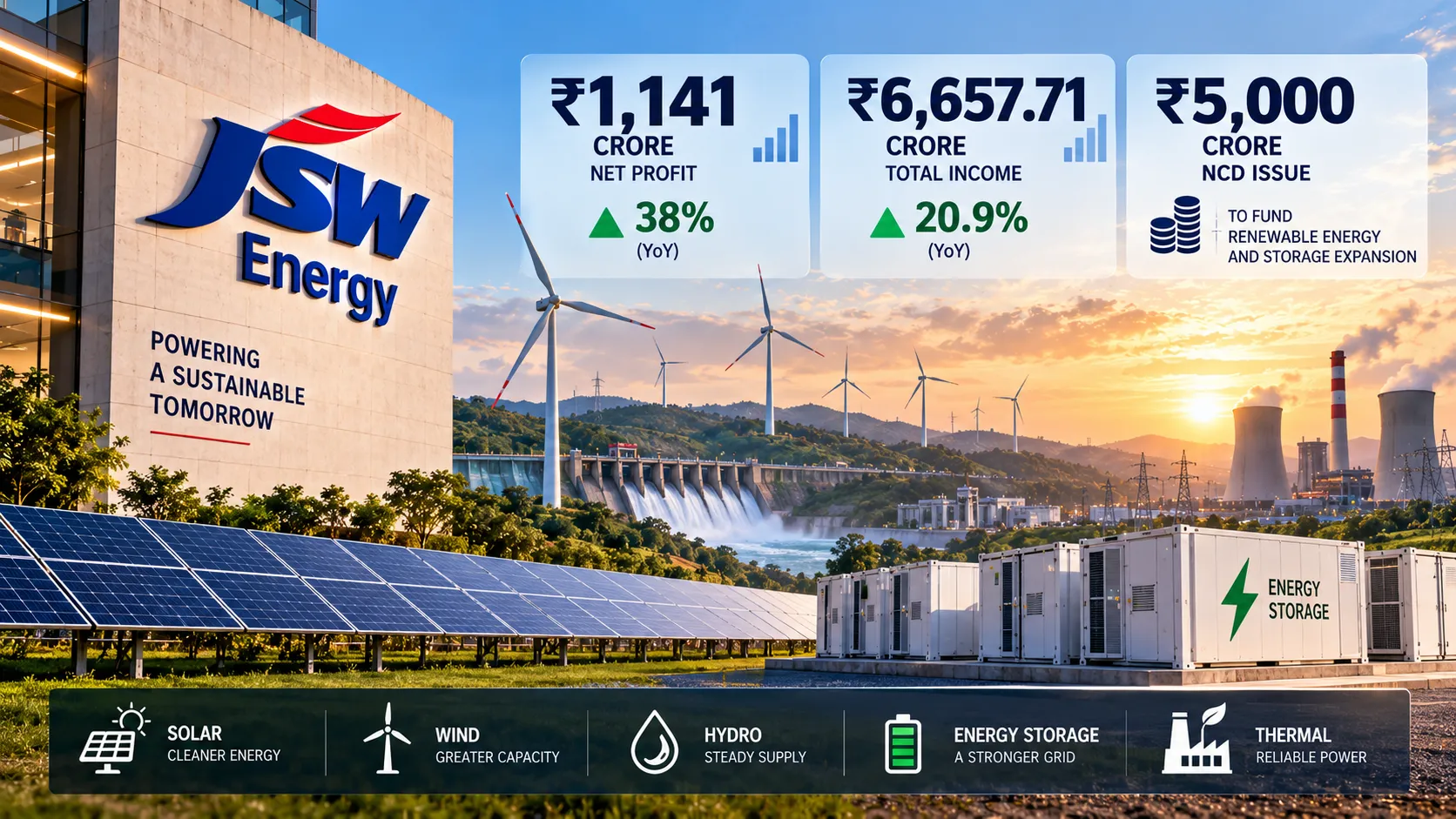
JSW Energy reported consolidated net profit of ₹1,141 crore for the September quarter, up more than 38% from ₹824 crore, as total income rose to ₹6,657.71 crore from ₹5,361 crore. The board approved raising up to ₹5,000 crore through privately placed non-convertible debentures as the Sajjan Jindal-led company expands renewable, storage and thermal capacity.

By Prathista Lazar · Author29 October 2026New
JSW Energy's Q2 Profit Climbs 38% to ₹1,141 Crore as It Lines Up ₹5,000 Crore of Bonds to Fund Its Clean Power Expansion

JSW Energy, one of India's fastest-growing power producers, has reported a sharp rise in quarterly profit and lined up fresh borrowing to fund its expansion into renewable energy and storage.

The company reported consolidated net profit of ₹1,141 crore for the July-September quarter, up more than 38% from ₹824 crore a year earlier, according to Upstox on Thursday, October 29. Total income rose to ₹6,657.71 crore from ₹5,361 crore.

The board also approved raising up to ₹5,000 crore through privately placed non-convertible debentures (NCDs), a form of corporate bond.

Why profit rose

The September quarter is typically strong for hydro and wind generation in India, as monsoon rains fill reservoirs and seasonal winds peak. JSW Energy's growing renewable portfolio benefits from these conditions.

The company has also been adding capacity through new projects and acquisitions, increasing its total generation and revenue. Higher electricity demand across India, driven by economic growth, rising temperatures and the spread of air conditioning, has supported power prices and plant utilisation.

A rapid expansion

JSW Energy, part of the Sajjan Jindal-led JSW Group, has set ambitious targets to expand its generation capacity significantly over the coming years, with a large share coming from renewable energy and energy storage. The company has invested in wind, solar, hydro, pumped storage and battery storage projects, while retaining thermal power plants that provide reliable baseload supply.

It has also grown through acquisitions, buying operating renewable assets and thermal plants to scale up quickly.

Financing the transition

The ₹5,000 crore NCD issue highlights the scale of capital needed for India's energy transition. Building renewable energy plants, storage facilities and transmission connections requires large upfront investment, typically financed through a mix of equity and debt.

Non-convertible debentures allow companies to raise long-term debt from institutional investors such as insurance companies, mutual funds and pension funds. India's corporate bond market has been growing, and renewable energy companies have become significant issuers as they seek to fund expansion.

The government estimates that India needs about $220 billion of clean energy investment between 2027 and 2030 to meet its targets, much of which will need to come from private companies and financial markets.

The storage opportunity

Energy storage has become a critical part of India's power strategy. Solar power is abundant during the day but unavailable at night, and wind is variable. Storage systems, including batteries and pumped hydro, allow renewable energy to be stored and released when needed, improving grid reliability.

The government has introduced viability gap funding for battery storage projects and has required some renewable tenders to include storage. JSW Energy has positioned itself to benefit from this shift, with investments in both battery and pumped hydro storage.
f934b8ac-08c4-4cdb-b34e-9dcc80407bd9.png

Thermal still matters

Despite the push for renewables, coal-fired power remains the backbone of India's electricity system, providing reliable supply during peak demand periods and when renewable output is low. JSW Energy's thermal plants provide stable cash flows that help fund its renewable expansion.

Balancing thermal and renewable capacity is a challenge for Indian power companies, as they navigate climate commitments, energy security and rising demand.


“India's energy transition will be financed as much in the bond market as in the boardroom.”
— TIGI Impact Desk

Sector context

India's power sector has attracted strong investor interest as electricity demand grows and the government pushes for clean energy. Companies such as Tata Power, Adani Green Energy, NTPC Green Energy, ReNew and JSW Energy are competing to build renewable capacity, while state-owned companies continue to expand thermal and nuclear capacity.

The sector faces challenges, including delays in land acquisition and transmission connectivity, financial stress at state electricity distribution companies, which are the main buyers of power, and competition that has driven down tariffs in renewable auctions.

What it means for investors

JSW Energy's results show the earnings potential of a diversified power portfolio during a period of strong demand. Its aggressive expansion plans offer growth, but also bring execution and financing risks, as the company takes on significant debt to fund new projects.

Investors will watch the company's progress in commissioning new capacity, the returns on its investments and its debt levels.

The renewable push

JSW Energy has set ambitious targets to expand its generation capacity, with a strong focus on renewable energy and storage. The company has been adding wind and solar projects, acquiring assets and developing pumped hydro and battery storage. Its growth strategy reflects India's broader goal of reaching 500 GW of non-fossil fuel capacity by 2030.

Acquisitions have played a significant role in JSW Energy's expansion. The company has bought renewable energy portfolios and thermal power plants to accelerate growth, and integrating these assets efficiently will be important for its profitability.

The NCD issue

The proposal to raise up to ₹5,000 crore through non-convertible debentures (NCDs) shows the scale of capital required for JSW Energy's expansion. NCDs are a form of debt that companies issue to investors, typically paying a fixed interest rate. Power companies rely heavily on debt to finance new projects, because generation assets require large upfront investment and produce steady cash flows over decades.

Investors will watch the company's debt levels and interest costs closely, particularly in a period of elevated global interest rates. Strong profit growth helps support the company's ability to service its debt.

The role of the JSW Group

JSW Energy is part of the JSW Group, one of India's largest conglomerates, with businesses in steel, cement, infrastructure, paints and electric vehicles. The group's steel operations are large consumers of power, providing a captive source of demand. The group has also announced plans in electric vehicles and batteries, which could create synergies with JSW Energy's storage business.

What comes next

JSW Energy will proceed with its NCD issue and continue to build out its renewable and storage pipeline. Its performance in the coming quarters will depend on seasonal generation patterns, power demand and the pace of new capacity additions. The upcoming Bharat Renewable Energy Summit in New Delhi in November, where the government aims to attract investment in clean energy, may provide further opportunities for companies like JSW Energy. Investors will also watch the pace at which JSW Energy commissions new renewable and storage projects, the progress of its acquisitions and the terms on which it raises debt. The company's ability to deliver projects on time and within budget will be central to meeting its ambitious capacity targets.

TagsJSW EnergyQ2 resultsrenewable energypower sectorSajjan JindalParth Jindalnon-convertible debenturesenergy storagebattery storagepumped hydrowind energysolar energythermal powerenergy transitionIndia power demandgreen hydrogenJSW Grouppower stocksclean energy financinginvestors

Reader reviews

Sign in to rate and review this article.
Loading reviews…