KEC International, the infrastructure engineering company of the RPG Group, has won orders worth ₹2,872 crore from Power Grid Corporation of India to build high-voltage transmission lines that will carry renewable energy from Gujarat to the national grid.
The company said on 26 October that the turnkey orders, for the design, supply and installation of 765 kV transmission lines, represent the largest-ever order win for its domestic transmission and distribution business. The lines will help evacuate 8.5 gigawatts of renewable energy generated in Gujarat.
The win takes KEC's order intake for the financial year so far past ₹13,500 crore, including about ₹9,500 crore from its transmission and distribution segment. Days earlier, on 23 October, the company had announced orders worth ₹1,006 crore across transmission, civil construction and cables.
Grid Expansion Becomes Critical
Chief executive Vimal Kejriwal said the orders significantly expanded the company's domestic transmission order book, pointing to growing demand for transmission infrastructure as renewable energy capacity expands.
India has added solar and wind capacity at a rapid pace, with Gujarat and Rajasthan emerging as two of the most important states for large renewable projects because of their abundant land, sunshine and wind resources. But much of this capacity is located far from the cities and industrial centres where electricity is consumed, requiring extensive high-voltage transmission networks.
Transmission has become one of the most significant constraints on India's energy transition. Renewable projects can be built in 18 to 24 months, but transmission lines often take longer because of land acquisition, right-of-way issues, environmental clearances and the scale of construction. Delays in transmission can leave completed renewable projects unable to deliver power, a problem known as stranded capacity.
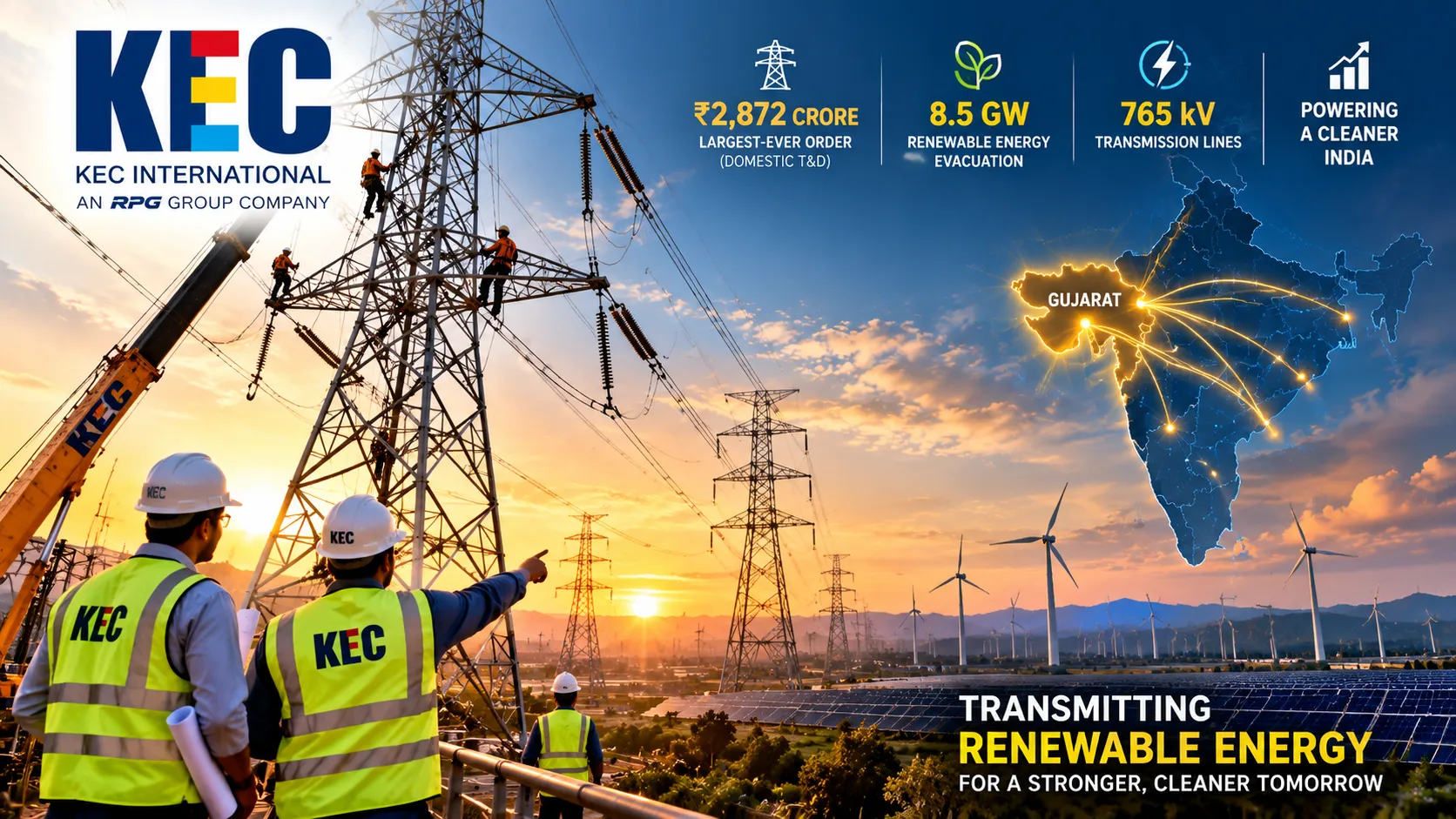
The 765 kV Backbone
Lines operating at 765 kilovolts are the highest-voltage alternating current lines in India's grid, capable of carrying large volumes of power over long distances with relatively low losses. They form the backbone of the inter-state transmission system that moves electricity between regions.
Power Grid Corporation of India, the state-owned central transmission utility, is responsible for building and operating much of this network. It has been awarding large contracts to engineering companies to build the lines and substations needed to integrate the government's target of 500 GW of non-fossil fuel capacity by 2030.
A Boom for Transmission Contractors
The push to expand the grid has created a wave of orders for transmission contractors. Companies such as KEC International, Kalpataru Projects International, Tata Projects and others have reported strong order inflows from Power Grid and private transmission developers.
The Central Electricity Authority's national transmission plans envisage substantial investment in new lines and substations over the coming years. Rating agency ICRA has projected power sector capital expenditure of ₹29–30 lakh crore over five to six years, with a significant share directed towards transmission.
Recent orders across the sector illustrate the scale of activity. Jyoti Structures has won contracts for high-voltage direct current packages in Rajasthan, Bajel Projects has secured transmission orders in Gujarat and Mumbai, and other contractors have reported large wins linked to renewable energy evacuation.
Lessons From Grid Stress
The importance of robust transmission was underscored by a grid disturbance in Gujarat's Khavda renewable energy zone in May 2026. An investigation by a regional power committee linked the incident to the behaviour of inverter-based renewable generation under weak grid conditions, with about 8,963 MW of renewable generation lost during the event.
Such incidents highlight that integrating large volumes of solar and wind power requires not only more transmission lines but also stronger grids, better grid codes and technologies that help maintain stability.
KEC's Business Profile
KEC International is one of India's largest power transmission engineering, procurement and construction companies, with operations in more than 100 countries. Beyond transmission, it has diversified into civil infrastructure, railways, cables and conductors, oil and gas pipelines, and renewable energy projects.
The company has also worked to improve its profitability after a period of pressure from rising commodity prices and execution challenges on some contracts. Strong order inflows provide revenue visibility for coming years, but execution will be key to translating orders into profits.
Investor Reaction
KEC's shares rose following the announcement, as investors welcomed the large order win. Reported intraday gains varied, with shares trading about 2 per cent higher on the National Stock Exchange around midday after rising more sharply earlier in the session.
Transmission and power equipment stocks have been among the beneficiaries of India's energy transition, as investors anticipate a sustained period of grid investment.
Execution Is the Real Test
For engineering contractors, winning orders is only the first step. Transmission projects involve acquiring right of way across farmland and forests, managing complex logistics for towers and conductors, and coordinating hundreds of workers across long, often remote routes. Delays caused by land disputes, weather or supply shortages can erode margins on fixed-price contracts.
Supply chain constraints have also emerged as a concern. Demand for transformers, conductors, insulators and other equipment has surged globally as countries expand their grids, leading to longer lead times and higher prices. Indian manufacturers have expanded capacity, but tight supply could affect project timelines. KEC's experience across domestic and international markets and its own cables and conductors business may help it manage these challenges, but timely execution of a record order book will be the key test of its ability to convert strong demand into sustained profit growth.
For Gujarat, the new lines will be essential to realising the full potential of large renewable zones, including the vast Khavda renewable energy park in Kutch, which is being developed as one of the largest renewable energy installations in the world. Ensuring that power generated in such remote areas can reach demand centres reliably is central to the state's and the country's clean energy plans.
Why It Matters
Transmission infrastructure is the often-overlooked enabler of the clean energy transition. Without adequate grid capacity, the gigawatts of solar and wind power being built across India cannot reach consumers. Investment in high-voltage lines like those KEC will build is essential to meeting the country's climate commitments and energy security goals.
For KEC International, the record order strengthens its position in a growing market. For India, it is another step towards a grid capable of carrying the renewable energy on which its future power system will depend.