Global supply chains have endured a pandemic, wars, trade disputes, shipping disruptions and energy shocks over the past six years. Senior executives say the risks are still rising.
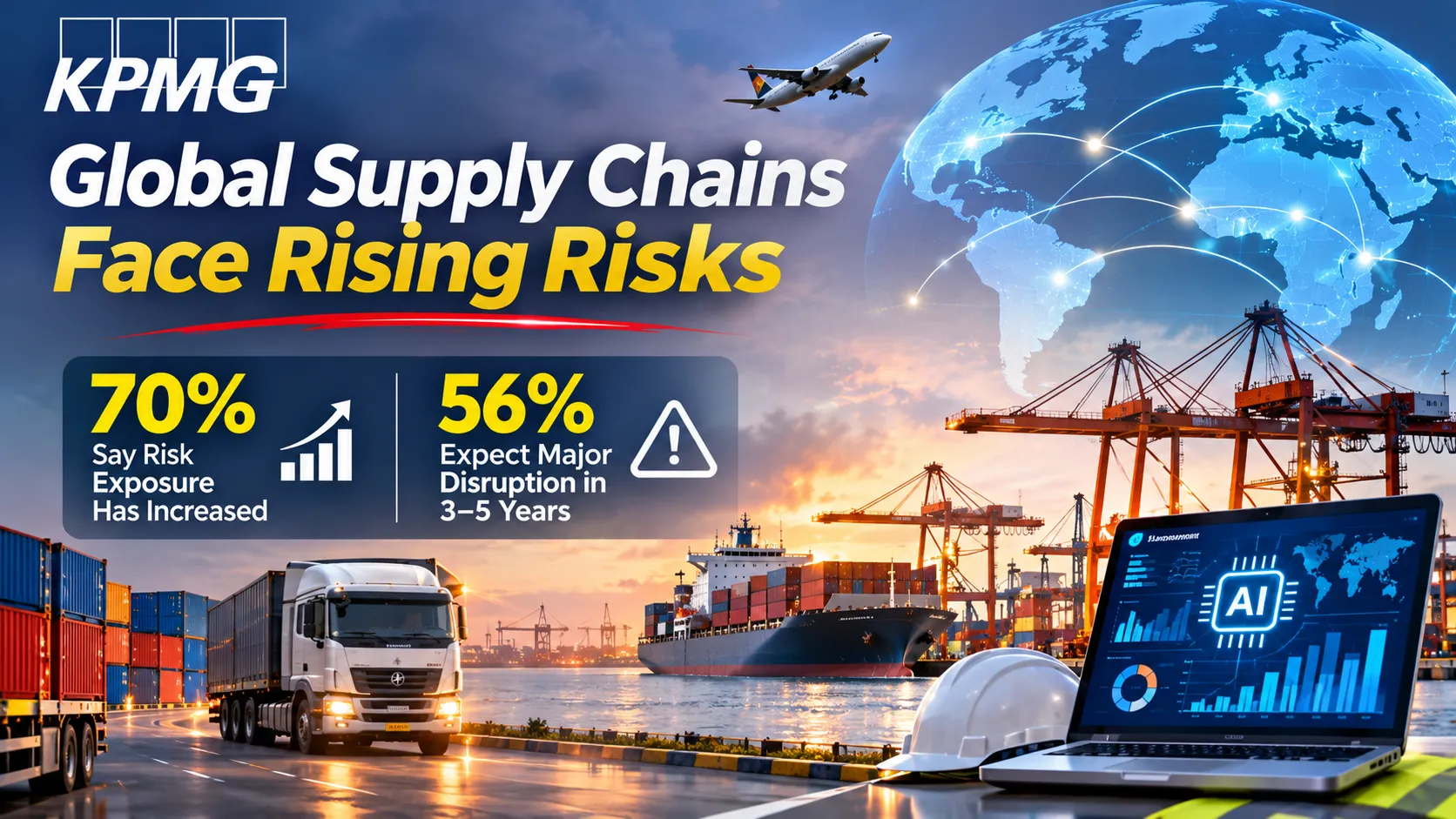
Nearly 70% of business leaders surveyed by KPMG International say their organisation's risk exposure has increased over the past two years, according to a new report, "Building a shock-resilient supply chain". It was released on November 4 at KPMG in India's 17th ENRich conclave on energy and natural resources. Some 56% expect external disruptions, from geopolitics, energy, cyber threats, trade and climate, to cause severe operational disruption or significantly hit costs and performance over the next three to five years.
Who was surveyed
The report is based on a pulse survey of 109 senior executives and business leaders, conducted by Ipsos for KPMG International's Energy, Natural Resources and Chemicals practice. Respondents came from markets including India, the United States, China, Germany, Japan and Saudi Arabia. They work in sectors such as automotive, consumer and retail, industrial manufacturing, infrastructure and transportation, and energy. The fieldwork reflects views gathered in September 2026.
AI: the double-edged sword
The most striking finding concerns artificial intelligence. Executives see AI as both their biggest threat and their most important tool.
Some 64% rank technology and AI disruption as the risk likely to have the greatest impact over the next two years, ahead of geopolitical conflict (58%) and macroeconomic uncertainty (48%). Nearly half (46%) say technology and digital dependencies are now the stage of the supply chain most exposed to disruption. That reflects how deeply companies now rely on software, cloud platforms, data and digital connections to run their operations.
Yet AI also tops the list of defences. Asked about their resilience priorities for the next three to five years, 49% of respondents said they were prioritising AI and predictive analytics, ahead of scenario planning and stress testing (44%), alternative sourcing strategies (39%) and efficiency and cost optimisation (31%).
The paradox reflects a reality many companies face. AI introduces new vulnerabilities, from cyber attacks and system failures to dependence on a few technology providers. It also offers powerful ways to anticipate disruptions, model scenarios and respond faster.
The Hormuz stress test
The report uses the 2026 disruption to traffic through the Strait of Hormuz as a real-world stress test. The narrow waterway between Iran and Oman carries a large share of the world's seaborne oil and a significant volume of liquefied natural gas.
KPMG draws several lessons from the episode. First, diversifying suppliers is not enough if those suppliers depend on the same maritime chokepoint: a company that buys energy or materials from several countries may still be exposed if all of them ship through the same strait. Second, contracts do not create ships or insurance capacity. When a chokepoint is disrupted, vessels and coverage become scarce regardless of what agreements say. Third, the financial consequences, including higher freight rates, currency moves and financing costs, can amplify the physical disruption.
For India, which imports most of its crude oil and a large share of its gas, and much of it from the Gulf, the lessons are particularly relevant. Indian markets have felt the effects through higher oil prices, pressure on the rupee and volatility in energy-linked stocks.
Energy security moves up the agenda
Despite the turbulence, only 28% of respondents said energy security and resilience is a significant strategic priority for senior leadership. That suggests many organisations still treat energy as an operational input rather than a strategic risk.
Other exposure points identified in the survey included delivered costs and price volatility (39%) and shipping and logistics (33%).
Confidence remains relatively high nonetheless. Some 70% of respondents said they were confident or very confident of maintaining critical operations during a major external disruption. Supply chain experts say that confidence should be tested against the reality that the most damaging shocks often come from unexpected directions.
From supply chain function to boardroom
KPMG's leaders argue that the nature of risk has changed. "Resilience is no longer just a supply chain function; it has become a board-level imperative shaped by energy-linked disruption and a broader set of interconnected risks," said Anish De, global head of energy, natural resources and chemicals at KPMG International. He pointed to risks spanning technology, financial stability, operations and global value chains.
Regina Mayor, KPMG International's global head of clients and markets, highlighted how multiple risks are converging and reinforcing one another, making them harder to manage in isolation.
The report argues that the most serious threats now arise outside company boundaries, in geopolitics, energy markets, technology infrastructure and climate. Companies should therefore focus on understanding their own exposure, preparing in advance and responding quickly. It recommends a tiered approach ranging from regular risk assessment and controls to reallocating capital where necessary.
The emphasis on technology dependence is notable. Many companies have spent years diversifying their suppliers of physical goods, yet remain reliant on a small number of software platforms, cloud providers and data networks. A cyber attack, outage or policy change affecting one of those providers can ripple across thousands of businesses at once, making digital resilience as important as physical resilience.
What it means for Indian businesses
The findings carry direct implications for Indian companies. India is trying to capture a larger share of global manufacturing as multinationals diversify supply chains away from concentration in any single country. That opportunity depends on Indian suppliers proving they are reliable partners in an unstable world.
For Indian logistics operators and manufacturers, the practical takeaway is to map shared routes and dependencies rather than simply adding more suppliers. Companies should identify which inputs, shipping lanes, ports, energy sources and digital systems they rely on in common, and stress-test operations against disruptions at each point.
AI-driven tools for demand forecasting, inventory optimisation and risk monitoring are increasingly accessible, and Indian IT and analytics firms are well placed to provide them to both domestic and global clients.
The report's central message is that resilience has become a source of competitive advantage. In a world where shocks are frequent and interconnected, the companies that can see disruptions coming, absorb them and recover quickly will win customers and market share from those that cannot.