Meta is using artificial intelligence to find teenagers who lie about their age on Instagram, and it is now doing so worldwide, as social media companies face mounting pressure from governments, parents and courts to protect young users.
The company announced on Monday, November 9, that it is expanding its AI age-estimation technology globally to place more teens in Teen Account protections on Instagram, according to a post on Meta's newsroom. Meta said "millions more teens across the world who use Instagram" will receive these protections, even if they had misstated their age.
The technology is also being rolled out on Facebook, and similar technology will launch on Threads later this year, according to Meta.
How it works
Meta uses AI to identify accounts it suspects belong to teenagers, even when the account holder has entered an adult birthday, and automatically places them in Teen Account protections, according to the company. Meta said the technology has placed more teens in age-appropriate protections since it was first introduced, which is why it is expanding the approach.
Meta has not published full details of how the AI estimates age, but such systems typically analyse signals such as the content users interact with, the accounts they follow and other behavioural patterns.
What Teen Accounts do
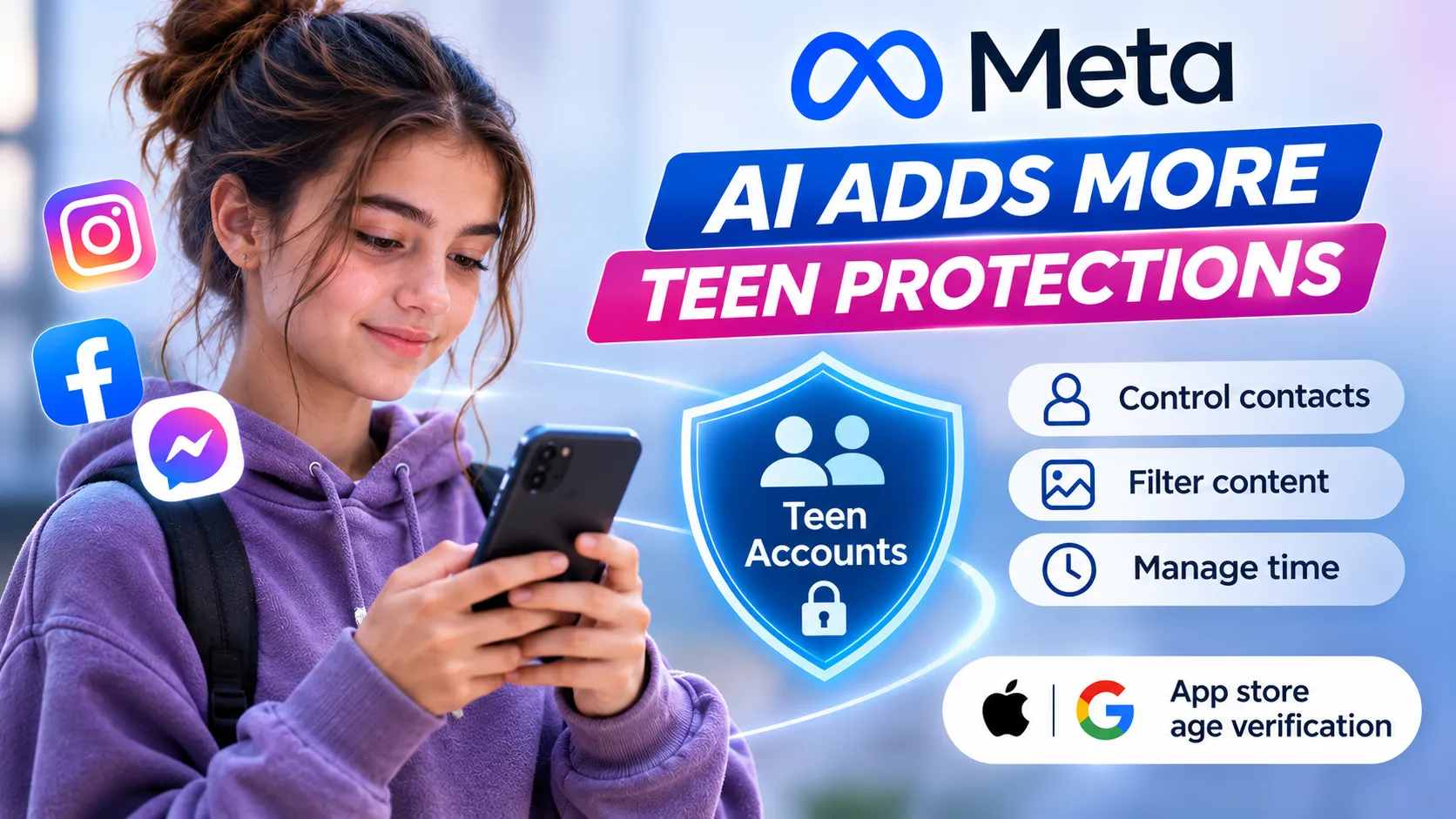
Teen Accounts include built-in protections on Instagram, Facebook and Messenger that automatically limit who can contact teens, the content they see and the time they spend on the apps, according to Meta. Teens aged 13 to 17 are placed in these settings by default, and younger teens need parental permission to change some of them.
Apple's age signal
In Australia, Meta has begun using Apple's age-range signal as an additional method to understand users' ages, according to the company. A parent can choose to have the app store confirm the age of a device's user and assign an age range, which Apple then passes to developers such as Meta when the teen downloads an app. Meta said its own age estimation can serve as a backstop, correcting mistakes and feeding them back to the app store.
Australia has introduced strict rules on social media use by children, which have pushed platforms to strengthen age assurance.
The push for app store verification
Meta has long argued that the responsibility for verifying users' ages should lie with app stores, operated by Apple and Google, rather than with individual apps. It supports legislation requiring age verification and parental consent at the app store level.
Because app store age signals are currently optional, Meta said, "teens will receive inconsistent protections across the many apps they use." It argued that a single verified signal shared with all apps would be more effective and better for privacy than having each platform verify ages separately.
Meta also called on TikTok and YouTube to adopt the same practices, according to its announcement.
Legal pressure
The expansion comes as Meta faces intense legal and regulatory pressure over the impact of its platforms on young people. Meta referred to an agreement with 52 bipartisan attorneys general across US states, territories and the District of Columbia, according to its announcement. Yahoo Finance reported that Meta was expanding its AI age checks "as lawsuits mount."
Social media companies have faced lawsuits in the United States alleging that their platforms harm young people's mental health, and governments in Europe, Australia and elsewhere have introduced or proposed rules to protect children online.
Meta said it is investing in stronger technology to proactively catch accounts that may belong to children under 13, who are not allowed on its platforms, and to identify accounts belonging to teens aged 13 to 17.
Parental outreach
In the United States, parents will begin seeing an in-feed video on Instagram this month explaining Meta's approach, according to the company. Meta has also published a resource for parents by Larry Magid, president and chief executive of ConnectSafely, an online safety organisation, explaining its multi-layered approach to age assurance.
The privacy trade-off
Age estimation raises questions about privacy and accuracy. AI systems can make mistakes, placing adults in teen protections or failing to identify some teens. Critics also worry about the amount of data platforms analyse to estimate age. Meta argues that its approach, combined with app store signals, balances safety and privacy.
What it means for India
India is one of Instagram's largest markets, with hundreds of millions of users, many of them young. The global expansion means Indian teens who misstate their age are also likely to be placed in Teen Account protections. India's Digital Personal Data Protection Act requires verifiable parental consent for processing the personal data of children under 18, and the rules under the Act are shaping how platforms handle young users' data.
For Indian parents, the protections offer additional safeguards, although digital literacy and parental involvement remain important.
The industry response
Meta's call for TikTok and YouTube to follow suit puts pressure on its rivals. TikTok, which is banned in India, and YouTube, which is hugely popular with Indian teens, have their own age assurance and teen safety measures. As regulators push for stronger protections, platforms may converge on similar approaches, possibly with app store verification as a common foundation.
A growing global trend
Governments around the world are tightening rules on children's use of social media. Australia has introduced a minimum age for social media accounts, the United Kingdom's Online Safety Act requires platforms to protect children from harmful content, and the European Union's Digital Services Act imposes obligations on large platforms regarding minors. Several US states have passed laws requiring age verification or parental consent.
These rules are pushing platforms to invest in age assurance technologies, including AI estimation, identity verification and app store signals.
Meta's announcement also reflects growing scrutiny of how social media affects teenagers' mental health, sleep and wellbeing. Researchers and health authorities have raised concerns about excessive use and exposure to harmful content, prompting platforms to introduce features such as time limits, sleep modes and content restrictions for younger users.
What comes next
Meta will continue rolling out the technology on Facebook and launch it on Threads later this year. Regulators and child safety advocates will watch whether the AI accurately identifies teens and whether the protections make a meaningful difference. The debate over who should verify ages, apps or app stores, is likely to intensify as more governments introduce rules on children's online safety.