Microsoft says its artificial intelligence system can diagnose complex medical cases far more accurately than generalist doctors, a result its AI chief Mustafa Suleyman described as a step towards "medical superintelligence."
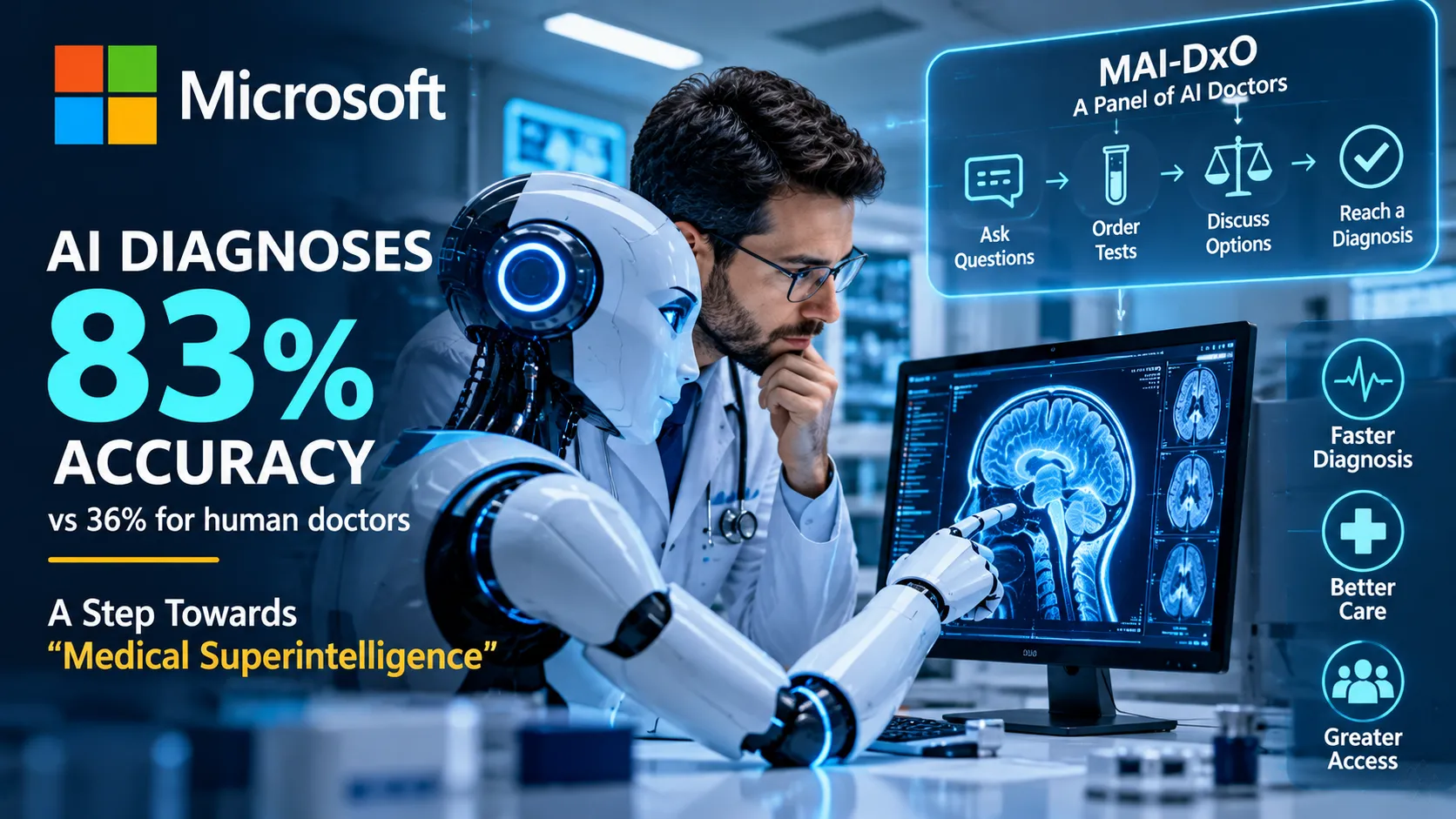
In a simulation study published on Thursday, October 22, in the journal Science, Microsoft's AI diagnostic system, MAI-DxO, correctly diagnosed 83% of complex cases drawn from the New England Journal of Medicine, TechCrunch reported. Primary care doctors and general internists working alone with reference materials got 36% right.
The comparison has an important caveat. Complex cases of this kind are usually handled by specialists or teams of physicians, who were not part of the study. Nonetheless, the results add to growing evidence that AI systems can perform sophisticated clinical reasoning.
How MAI-DxO works
MAI-DxO, or DxO, is designed to mimic a panel of doctors. It coordinates several AI agents that question the patient, order tests and debate possible diagnoses before reaching a conclusion. This approach, known as orchestration, aims to replicate the way experienced clinicians work through difficult cases step by step.
Microsoft tested DxO with AI models from several companies, including OpenAI, Google, Anthropic, Meta and DeepSeek. Its best results came with OpenAI's GPT-5 and GPT-5.5.
The findings show that the underlying model matters a great deal. On complex cases, GPT-5 on its own, with a basic prompt, achieved 78.9% accuracy at a cost of about $8,400 per case in simulated tests and procedures. Adding DxO cut costs by about $3,000 while raising accuracy by about four percentage points. With GPT-5.5, released in April 2026, DxO raised accuracy on complex cases from 72% to nearly 87% at slightly lower cost.
For a weaker model, Google's Gemini 2.5 Flash, accuracy rose from 46.4% alone to nearly 69% with DxO. But the gap between weaker and stronger models was still larger than DxO's boost. On emergency department cases, the gains were smaller, with both setups scoring about 85% using GPT-5.5.
"True believers"
Suleyman, who co-founded DeepMind, the AI lab Google acquired in 2014, and joined Microsoft in 2024 to lead its consumer AI efforts, made clear his ambitions for healthcare. "We're just true believers," he said. He predicted that healthcare AI models would be "an order of magnitude better in capability within the next 24 to 36 months."
Dominic King, vice-president of health at Microsoft AI, who previously worked with Suleyman at DeepMind Health, said: "There is something very substantial and exciting here." He argued that AI could help address a fundamental problem: "The biggest challenge in healthcare delivery at the moment is the growing mismatch between demand and supply."
From simulation to the clinic
Simulation studies are only a first step. Microsoft announced a partnership with Beth Israel Deaconess Medical Center in Boston to evaluate DxO's clinical reasoning against human doctors in real emergency and urgent care settings. It is also working with Mayo Clinic on a healthcare foundation model, planned for release next year.
Google, Microsoft's main rival in medical AI, published a related study of its AMIE diagnostic AI with Beth Israel in The Lancet, underlining the competition between technology giants to lead in clinical AI.
Microsoft already sells AI tools to clinicians for dictation and radiology, and its Nuance unit provides speech recognition widely used by doctors.