Anyone who has tried to book a private dining room for a birthday, a team dinner or a corporate event knows how slow the process can be. Enquiries go back and forth by email, menus arrive as PDFs, deposits are taken manually, and confirming details can take days. A startup co-founded by Sarah Klingman is betting that artificial intelligence can make that process far simpler.
Mostest, an AI-powered event booking platform, has raised a $4 million seed round led by Capital Q Ventures, NEXUS Luxury Collection and T-Squared Social, according to reports on Wednesday, October 28. The company was founded in 2022 by Klingman and Aaron Kennedy.
The problem Mostest is solving
Booking group events and private spaces is one of the least digitised parts of the hospitality industry. While diners can reserve a table for two in seconds using apps such as OpenTable or Resy, larger and more complex bookings typically involve direct conversations with venue staff. Prices often depend on the date, group size, menu and minimum spend, and availability is rarely visible online.
For venues, managing these enquiries is time-consuming. Event managers spend hours answering questions, preparing proposals and following up with potential customers, many of whom never book. For customers, comparing options across several venues can be frustrating.
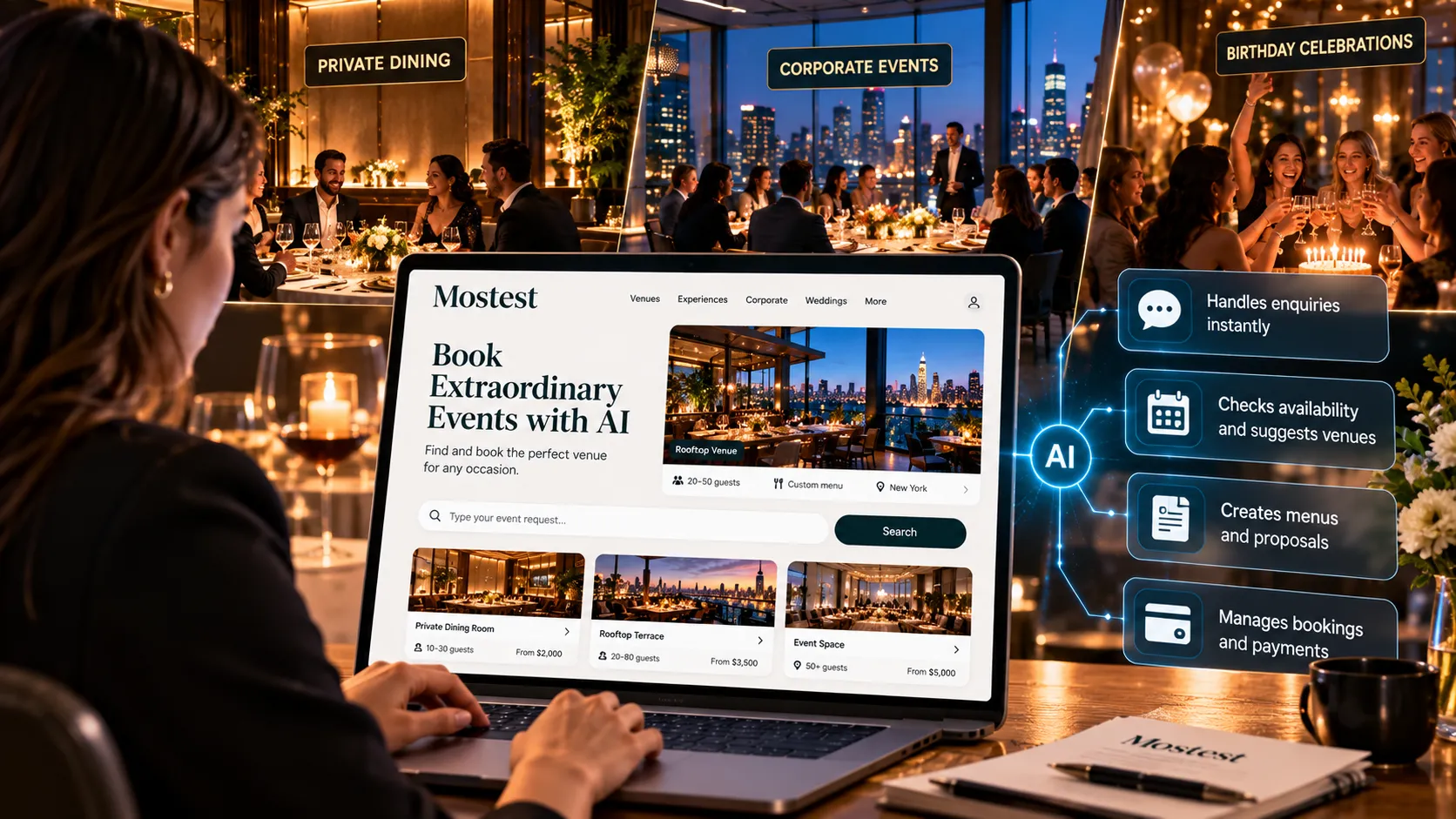
Mostest aims to address both sides by using AI to handle enquiries, present options and manage bookings, allowing customers to find and book venues more quickly and helping venues convert more enquiries into revenue.
Strategic investors
The make-up of the investor group is notable. Alongside Capital Q Ventures, the round was led by NEXUS Luxury Collection, which is connected to the luxury hospitality sector, and T-Squared Social, a hospitality and entertainment venue group. Investors with direct experience in running venues can provide valuable insight into customer needs, as well as potential partnerships and distribution.
Strategic backing from industry players is common in hospitality technology, where winning the trust of venue operators is essential. A booking platform is only as useful as the venues it can offer, and operators are often cautious about adopting new systems.
The events market
The private events market is large and fragmented. It includes restaurants with private dining rooms, bars, hotels, rooftop spaces, galleries and dedicated event venues, hosting everything from birthday parties and weddings to corporate dinners, product launches and team celebrations.
Corporate events in particular represent a significant source of revenue for venues, and companies are increasingly looking for easier ways to organise team gatherings and client entertainment. After the disruption of the pandemic years, demand for in-person events has recovered strongly, and many companies have increased spending on offsites and gatherings to bring hybrid teams together.
Why AI fits
Event booking involves many variables and conversations, which makes it well suited to AI. Large language models can understand customer requests written in natural language, such as a request for a private room for 20 people with a vegetarian menu and a budget, match them with suitable venues and answer follow-up questions. AI can also help venues respond instantly to enquiries at any time of day, rather than relying on staff availability.
However, the hospitality industry depends heavily on personal service and relationships, and venues will want to maintain control over how their spaces are sold. Platforms that combine automation with human oversight are more likely to win adoption.
Women founders in hospitality technology
Klingman is part of a growing group of women founders building technology companies in hospitality, travel and events. Women have long held leadership roles in hospitality and event management, but they have been under-represented among founders of venture-backed technology startups in the sector.
Funding for women-led startups remains a small share of total venture capital globally. Data from industry trackers has consistently shown that companies founded solely by women receive only a low single-digit percentage of venture funding, while mixed-gender founding teams, such as Mostest's, receive a larger share. Each funding round for women-founded and co-founded companies adds to the number of role models and track records in the sector.
Competition
Mostest faces competition from established restaurant reservation platforms, which are expanding into group and event bookings, as well as from event venue marketplaces and venue management software providers. Large booking platforms have the advantage of existing relationships with thousands of restaurants, while specialist event platforms focus on specific segments of the market.
To succeed, Mostest will need to offer a clearly better experience for both customers and venues, and to build a network of venues large enough to attract customers.
The relevance for India
India's events and hospitality market is growing rapidly, driven by weddings, corporate events and a vibrant restaurant scene in major cities. Booking group events in India also often relies on phone calls and messaging apps such as WhatsApp. Startups in India have begun applying technology to restaurant reservations, venue discovery and wedding planning, and the use of AI in event booking is likely to attract interest there too.
Building a marketplace
Event booking platforms face the classic challenge of two-sided marketplaces: attracting enough venues to interest customers, and enough customers to interest venues. Strategic investors from the hospitality sector can help solve the supply side by bringing their own venues onto the platform, providing an initial base from which to grow. Building density in specific cities before expanding is a common strategy for such platforms.
What comes next
Mostest will use its seed funding to develop its platform and expand its network of venues. Its progress will be watched as a test of whether AI can transform one of the most manual corners of hospitality. For Klingman and Kennedy, the backing of hospitality insiders provides both capital and credibility as they seek to grow the business.
Corporate events and the return to the office
As companies bring employees back to offices and invest in team gatherings, the demand for organised group events has risen. Corporate customers often book repeatedly and with larger budgets, making them attractive for venues and platforms. Mostest's success in serving corporate clients could be an important driver of its growth.
For women founders in hospitality technology and beyond, Mostest's progress will offer another example of how industry knowledge, strategic investors and AI can come together to tackle long-standing problems in traditional sectors. Its growth over the next year will show whether the model can scale across cities and venue types.