India has spent the past decade building digital rails for payments, identity and health records. On Sunday, it turned the same playbook towards one of its most fragmented industries. At a World Tourism Day event at Bharat Mandapam in New Delhi, Union Minister for Tourism and Culture Gajendra Singh Shekhawat launched the National Digital Tourism Stack, a shared digital public infrastructure being built with the Open Network for Digital Commerce (ONDC) and supported by the International Centre for DPI Innovation and Advancement (ICDIA).
The target is concrete. According to officials, the stack aims to bring 23,000 tourism experiences and homestays on board and make them discoverable, trustworthy and bookable by the end of 2028. Reports of the ministry's plan break that figure into roughly 14,000 experiences and 9,000 homestays. Alongside the stack, the minister launched the National Mission for Alternative Destinations, branded Dekho Apna Desh 2.0, and the ministry exchanged memoranda of understanding with five private partners: Airbnb India, FlixBus India, Glance Digital Experience of the InMobi Group, the Eicher Group Foundation and MakeMyTrip.
Why a 'stack' and why now
The logic of the announcement will be familiar to anyone who has followed India's digital public infrastructure story. Rather than build a single government booking portal, the ministry is laying down common protocols that any participating platform can plug into. In the ministry's own words, the shared infrastructure "will enable tourism providers to make their offerings available across the participating platforms, supported by capabilities such as verified identities and supplier credentials, search and discovery, payments, ratings and grievance redressal."
That design choice matters for small operators. A family running a four-room homestay in Ziro, a licensed guide in Hampi or a craft cooperative offering a weaving workshop in Kutch has typically faced a choice between staying invisible online and paying commissions to large aggregators. An interoperable network, in principle, lets the same listing appear on multiple consumer apps without being locked into any one of them. That is the same promise ONDC has made to small retailers in e-commerce, with mixed but steadily improving results.
Tourism Secretary Bhuvnesh Kumar summarised the ambition as "One ticket, One pass", a single layer that would replace today's patchwork of separate websites for monuments, transport, accommodation and local experiences. The rollout is phased. Officials indicated that October to December 2026 will be devoted to preparation and development, a pilot with the first batch of providers is planned for January to June 2027, and nationwide scaling is expected between July 2027 and December 2028. The programme is designed as a collaborative effort between the Centre, states, Union territories and industry.
The economic stakes
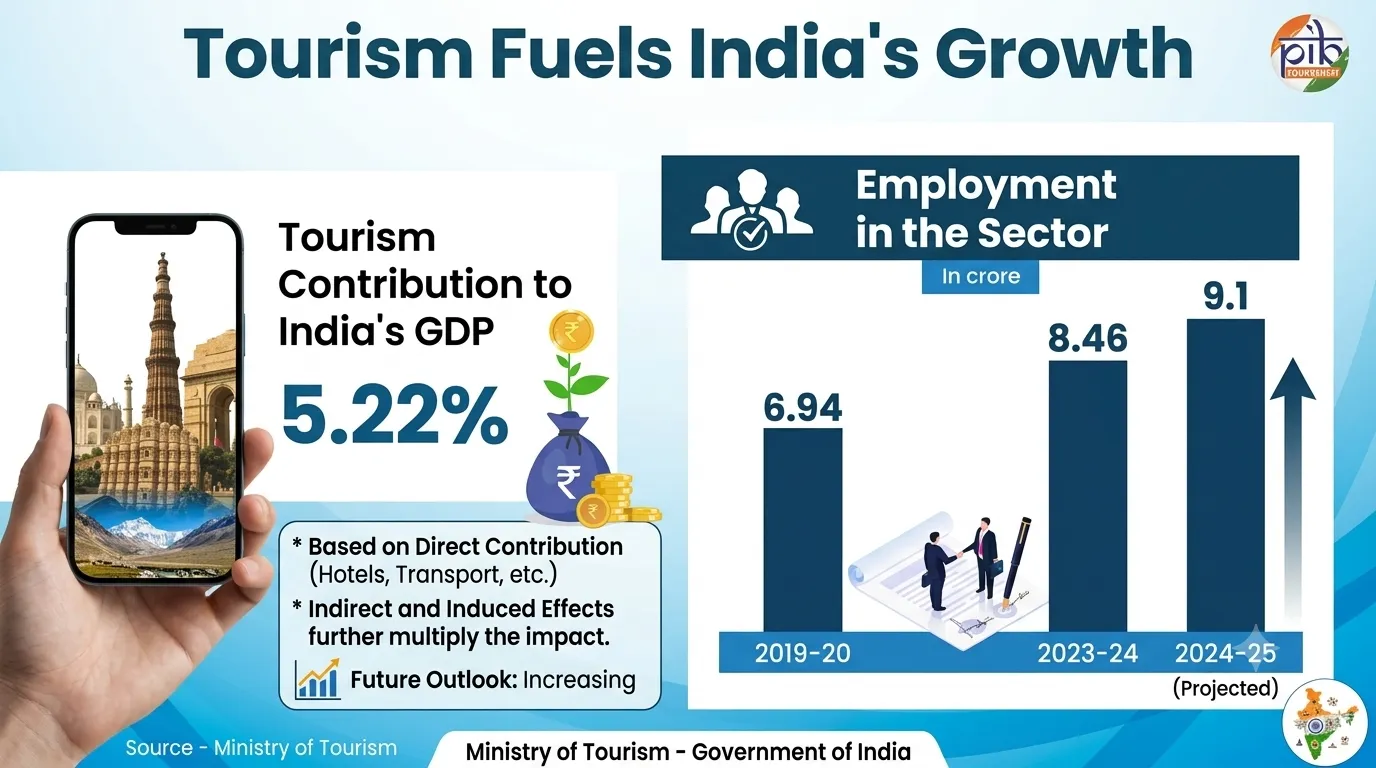
The ministry is not starting from a small base. Tourism contributed 5.22 per cent of India's GDP in 2023-24, according to the latest Tourism Satellite Account figures, and supported an estimated 84.6 million jobs, up from 69.4 million in 2019-20. Speaking at the event, Shekhawat set a longer horizon: "Our goal is for the tourism sector to contribute 10 per cent to India's economy by 2047, aligning with the global benchmark." He acknowledged that India had "lagged significantly" in digital tourism infrastructure and predicted a "massive jump" in the country's position when the next global rankings are published.
The government already runs a digital registry of tourism businesses. As of 23 September 2026, the NIDHI+ platform listed 63,740 accommodation units, 54 convention centres, 215 food business operators, 1,450 online travel aggregators and 15,531 tourism service providers. The e-Visa facility is available to nationals of 172 countries through 88 international ports. The new stack is meant to turn those records from a static database into a live, transactable network.
Spreading the crowds
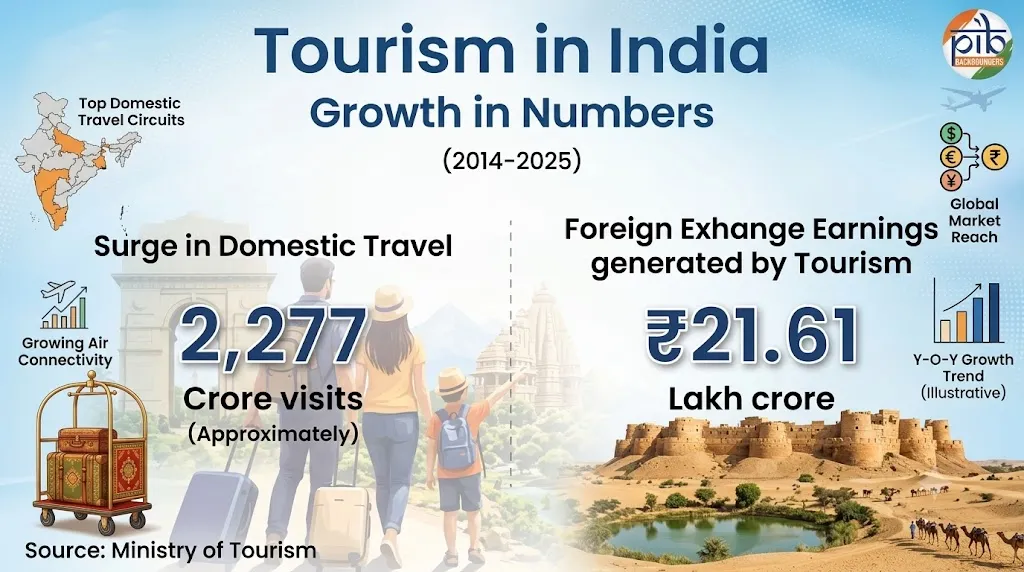
The second launch, Dekho Apna Desh 2.0, addresses a problem that every Indian traveller recognises: a handful of destinations absorb a disproportionate share of visitors, while many places that are ready for tourists see very few. The first Dekho Apna Desh campaign, launched in 2020, was largely a promotional drive. The new version is framed as a mission for "alternative destinations", focused on locations that already have the infrastructure to receive visitors but are under-marketed.
Shekhawat made the distributional argument explicit. "The next phase of India's tourism journey must ensure that growth reaches beyond popular destinations, creating opportunities for local communities, entrepreneurs, women and youth while making tourism more balanced, inclusive and sustainable," he said. For hill states and heritage towns that have struggled with overcrowding in peak seasons, a better spread of demand would ease pressure on water, waste systems and local roads as well as on prices.
What the private partners bring
The five MoUs map neatly onto the gaps the stack is trying to close. Airbnb's partnership centres on homestay development and host training, an area where many rural operators need help with pricing, photography, safety standards and guest communication. FlixBus, the intercity coach operator, will promote destinations along its routes, reflecting the reality that most Indian domestic tourists still travel by road. Glance, the lock-screen content platform owned by InMobi, brings reach into hundreds of millions of Android devices for destination content and responsible-travel messaging.
The Eicher Group Foundation's involvement focuses on heritage-based, sustainable tourism in the Himalayas, a region where the company's Royal Enfield motorcycles already draw a large community of riders. MakeMyTrip, India's largest online travel company, will work on promoting villages and local shopping. The mix suggests the ministry wants both demand-side reach and supply-side capacity building, rather than a pure technology tie-up.
The execution test
The experience of ONDC in retail offers both encouragement and caution. The network has shown that open protocols can lower costs for small sellers, but adoption has depended heavily on the willingness of buyer-side apps to promote ONDC inventory and on the quality of seller onboarding. Tourism adds its own complications. Homestays vary widely in standards, many experience providers are informal businesses, and grievance redressal in travel has to work quickly because a failed booking can leave someone stranded far from home.
Verified identities and supplier credentials, which the ministry has placed at the core of the stack, will be critical. So will coordination with states, which hold most of the regulatory levers on homestay registration, guide licensing and local permits. A stack that lists 23,000 providers but cannot guarantee that the listed homestay exists, is safe and honours its bookings would erode rather than build trust.
What to watch
For travellers, the first visible change is unlikely before the 2027 pilot, when an initial set of experiences and homestays is expected to go live on participating apps. For entrepreneurs, the more immediate opportunity lies in onboarding and enablement: helping small operators digitise inventory, manage availability and meet the credentialing requirements. For investors in travel technology, the stack could lower customer acquisition costs for new consumer platforms, much as open payment rails did for fintech after 2016.
The global theme for this year's World Tourism Day, "Digital Agenda and Artificial Intelligence to Redesign Tourism", framed Sunday's launches. India's bet is that the most valuable digital tool is not a single app but shared plumbing that lets thousands of small businesses be found. If the pilot shows that a homestay in the North-East can be booked as easily as a train seat, the country will have added another sector to its digital public infrastructure story. If not, the stack risks joining the long list of well-designed portals that never reached the operators they were built for. The next 15 months of preparation and piloting will decide which.