India's government has called on farmers to begin practising natural farming on at least a portion of their land, as it seeks to improve soil health, reduce input costs and meet growing demand for safer, more sustainable food.
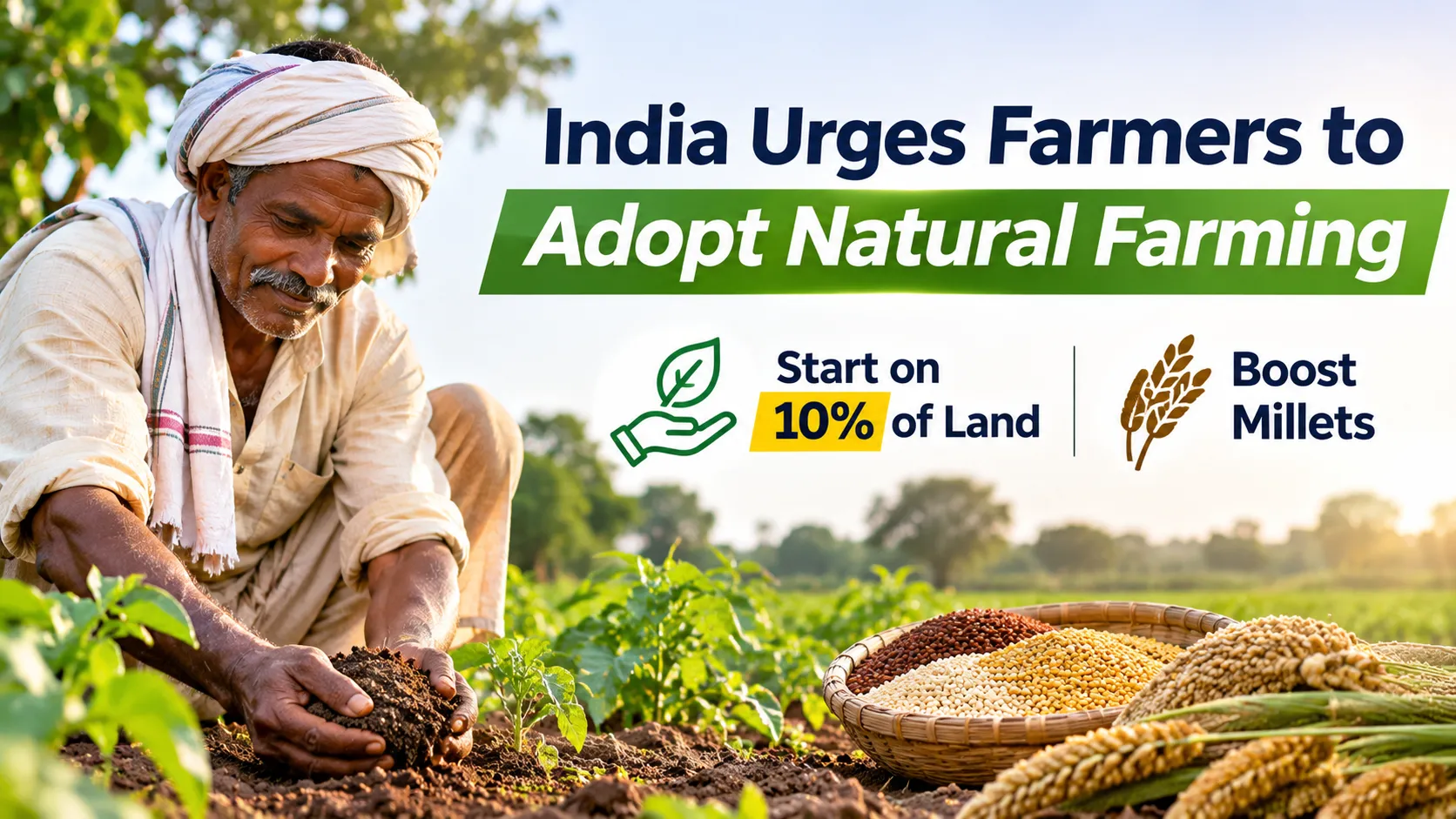
Speaking at the Bharat Food & Agro @ 2047 conclave at Bharat Mandapam in New Delhi on November 21, Minister of State for Agriculture Bhagirath Choudhary urged farmers to start natural farming on at least 10% of their cultivated land. He also highlighted the importance of millets and residue-free agricultural production.
The appeal reflects a policy push to move Indian agriculture towards more sustainable practices, while recognising that a sudden, complete shift would be risky for farmers' incomes.
What is natural farming
Natural farming is an approach that avoids synthetic fertilisers and pesticides. Instead, it relies on on-farm inputs such as cow dung and urine-based preparations, mulching, crop diversity and natural soil processes to maintain fertility and manage pests.
It differs from certified organic farming in some respects. Organic farming often uses purchased organic inputs and requires certification for products to be sold as organic. Natural farming, by contrast, emphasises low-cost inputs made on the farm and aims to minimise external purchases.
Supporters argue that natural farming can reduce farmers' costs, improve soil health, increase biodiversity and produce healthier food. Critics and some agricultural scientists caution that yields can fall, particularly during the transition, and that the evidence on long-term productivity is mixed.
The National Mission on Natural Farming
The government has backed natural farming through a dedicated National Mission on Natural Farming, approved in 2024. The mission aims to promote natural farming across a large number of farmers and hectares through training, demonstration and support for local input production.
States such as Andhra Pradesh, Himachal Pradesh and Gujarat have run large natural farming programmes. Andhra Pradesh's community-managed natural farming initiative has been one of the largest such programmes in the world and has attracted international attention.
The suggestion to start with 10% of cultivated land is a pragmatic approach. It allows farmers to experiment and learn without risking their entire income, and to scale up if they see benefits.
Why soil health is a concern
Decades of intensive farming, heavy use of chemical fertilisers and pesticides, and declining organic matter have degraded soils in many parts of India. The Green Revolution of the 1960s and 1970s dramatically increased food production, but it also led to over-reliance on chemical inputs, particularly in states such as Punjab and Haryana.
Imbalanced fertiliser use, especially heavy use of urea, has contributed to nutrient imbalances in soils. India also spends large sums subsidising fertilisers, much of which is imported or produced using imported raw materials. Reducing dependence on chemical fertilisers could ease the fiscal burden and improve the country's resilience to global price shocks.
Pesticide residues in food have also become a concern for consumers and for exporters, since many importing countries set strict limits on residues.
The millet push
The minister's emphasis on millets builds on a long-running government campaign. India led the United Nations' declaration of 2023 as the International Year of Millets, and the government has rebranded millets as "Shree Anna" to promote their consumption.
Millets, including sorghum, pearl millet, finger millet and several minor millets, are nutritious and require less water than rice and wheat. They are well suited to dryland farming and are more resilient to heat and drought, making them important for climate adaptation.
Demand for millet-based foods has grown among urban consumers seeking healthier diets. Food companies and startups have launched millet-based snacks, breakfast cereals, flours and ready-to-eat products.
Residue-free production and exports
Residue-free production refers to farming practices that keep pesticide residues in food below detectable or permitted levels. This is increasingly important for India's agricultural exports, as markets such as the European Union apply strict residue limits and have rejected shipments that exceed them.
Improving residue management could help Indian exporters access premium markets and command higher prices. It also responds to growing domestic consumer awareness of food safety.
Business opportunities
The shift towards natural and residue-free farming creates opportunities across the agrifood value chain. Agritech startups are developing tools for soil testing, crop advisory and traceability. Food companies are building brands around natural, organic and millet-based products. Farmer producer organisations are aggregating produce and connecting farmers to premium markets.
Investors have shown interest in companies that can verify sustainable practices and connect them to consumer demand. Traceability, which allows consumers to see how and where food was produced, is becoming an important differentiator.
Challenges
Scaling natural farming faces several challenges. Farmers need training, support during the transition and confidence that yields and incomes will not fall significantly. Market linkages are essential, because farmers need buyers willing to pay for natural produce. Certification and verification systems are needed to build consumer trust.
Food security is also a consideration. India must feed a population of more than 1.4 billion people, and any large-scale shift in farming practices must avoid jeopardising overall production.
The road to 2047
The Bharat Food & Agro @ 2047 conclave was framed around the vision of a developed India by 2047. Agriculture will play a central role in that vision, not only as a source of food but as a source of livelihoods for a large share of the population.
For The Impactful Global Indian's readers, the push for natural farming and millets highlights the intersection of sustainability, health and economic opportunity in India's agriculture. Whether the 10% approach gains traction will depend on support for farmers, market demand and evidence of benefits on the ground.
The role of states
Agriculture is primarily a state subject in India, so the success of natural farming will depend heavily on state governments. States with strong extension networks, farmer producer organisations and dedicated programmes have made the most progress. Andhra Pradesh's experience shows that community-based approaches, where farmers train other farmers, can help scale adoption. Other states are watching to see whether yields and incomes hold up over several seasons before committing larger areas to natural farming. Clear, independently collected data on yields, costs and incomes will be essential for building farmer confidence and guiding policy.