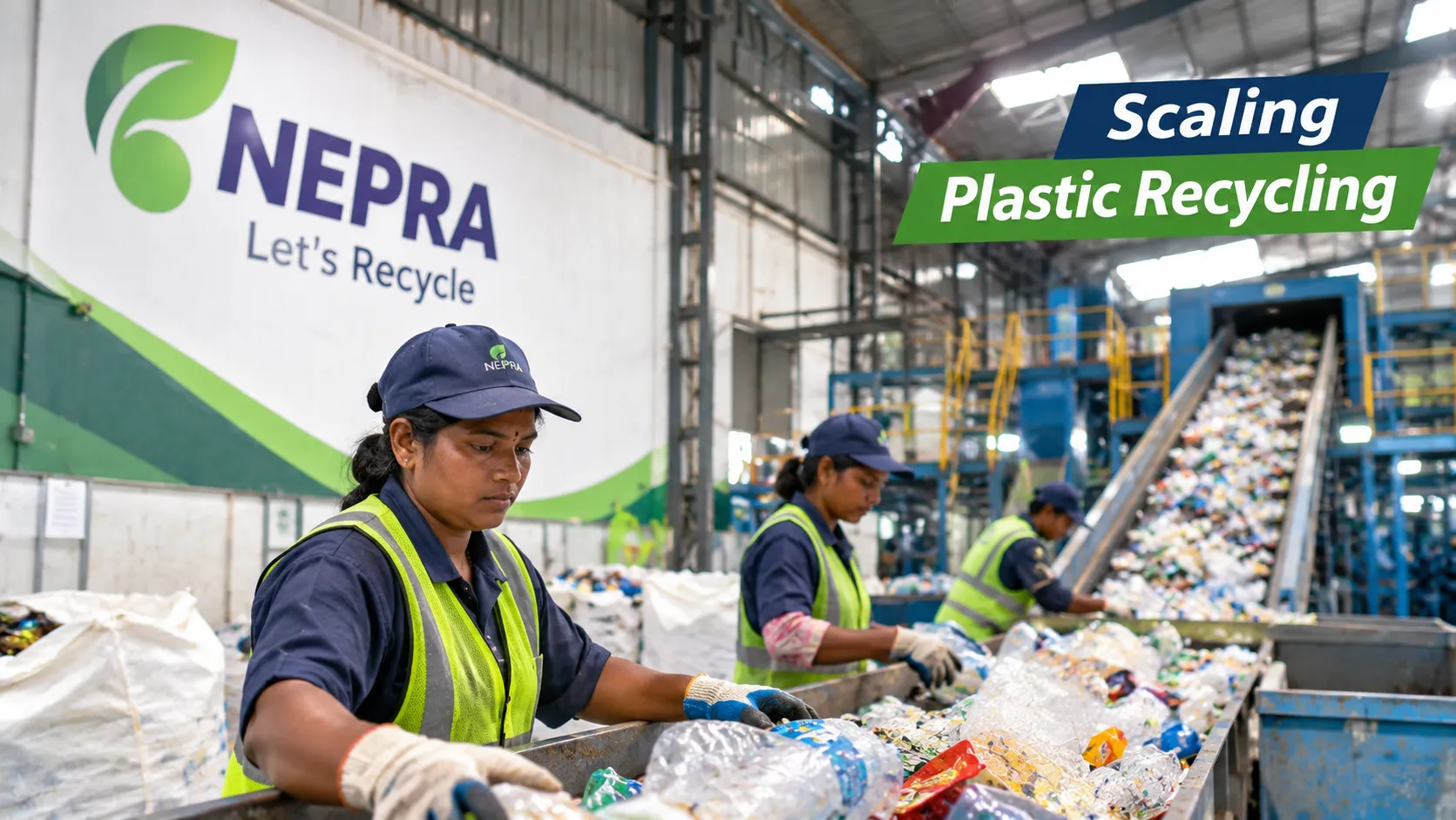
India generates millions of tonnes of plastic waste every year, much of which ends up in landfills, rivers and open dumps. One of the country's oldest waste management companies has just secured fresh capital to recycle far more of it.
NEPRA, an Ahmedabad-based waste management company operating under the brand "NEPRA – Let's Recycle," has raised ₹110 crore, or about $11.7 million, in equity, Inc42 reported on Thursday, November 19. The round was led by the Private Infrastructure Development Group (PIDG), a London-based infrastructure development and finance organisation, through its project development arm, InfraCo.
The investment is PIDG's first equity investment in Asia's waste management and recycling sector, according to Inc42. Existing investors include Aavishkaar Capital, Circulate Capital, Blue Earth Capital and Asha Impact.
Doubling capacity
NEPRA plans to use the funding to develop new material recovery facilities, expand plastic recycling capacity, strengthen existing operations and meet working capital needs, according to Inc42.
The company aims to increase its waste processing capacity from about 900 tonnes per day to 1,880 tonnes per day, more than doubling it. It plans to nearly triple its plastic recycling capacity from 6,200 tonnes per year to 18,000 tonnes per year.
How NEPRA works
Founded in 2006, NEPRA collects, segregates, processes and recycles waste. It operates facilities in Ahmedabad, Indore, Pune and Bengaluru, and runs a plastic recycling plant in Sanand, Gujarat, which converts plastic waste into recycled granules that manufacturers can use to make new products.
Waste that cannot be recycled is processed into refuse-derived fuel (RDF), which is used by cement manufacturers as an alternative to coal, according to Inc42. This reduces the amount of waste sent to landfills and helps cement companies lower their fossil fuel consumption.
NEPRA's collection network includes more than 1,500 registered waste pickers, who form the backbone of India's informal recycling economy.
The EPR opportunity
NEPRA works with brand owners to help them meet their extended producer responsibility (EPR) obligations through traceable recycling processes, according to Inc42.
Under India's Plastic Waste Management Rules, producers, importers and brand owners that use plastic packaging are required to ensure that an equivalent amount of plastic is collected and recycled or processed. These EPR rules have created a growing market for recycling companies that can provide verifiable recycling credits to consumer goods companies.
The rules have also introduced requirements for minimum recycled content in plastic packaging, increasing demand for high-quality recycled plastic.
Why infrastructure investors are interested
PIDG typically invests in infrastructure projects in developing countries, particularly in sectors such as energy, water and transport. Its entry into Asian waste management reflects a growing recognition that waste is an infrastructure challenge requiring long-term capital.
Building material recovery facilities and recycling plants requires significant upfront investment, and returns depend on stable supply of waste, efficient operations and reliable demand for recycled materials. Development finance institutions and impact investors are often better suited than conventional venture capital to fund such projects.

The waste picker economy
India's informal waste pickers play a crucial role in recycling, collecting and sorting a large share of recyclable materials. However, they often work in difficult and unsafe conditions, with low and unstable incomes and little social protection.
Companies like NEPRA that formally register waste pickers can offer more stable work, fair prices and better conditions, while improving the quality and traceability of recycled materials. Integrating informal workers into formal supply chains is considered one of the most important social dimensions of India's circular economy.
A growing sector
NEPRA's funding is part of a wave of investment in India's recycling and circular economy sector. Bengaluru-based Recove Ventures has raised ₹56.3 crore and plans to invest more than ₹2,000 crore across several states over the next decade, while Hyderabad-based Recykal raised a $23 million bridge round, with Sachin Tendulkar later joining its investors, according to Inc42. Delhi-based Karo Sambhav raised ₹56 crore from Rainmatter in June to recover critical materials from end-of-life products.
Investor interest has been driven by tightening regulations, corporate sustainability commitments and growing awareness of the environmental costs of plastic pollution.
The environmental impact
Plastic pollution has serious environmental and health consequences. Plastic waste clogs drains, contributing to urban flooding, pollutes rivers and oceans, harms wildlife and releases toxic substances when burned. Recycling reduces the need for virgin plastic made from fossil fuels, lowering greenhouse gas emissions.
Converting non-recyclable waste into fuel for cement kilns also reduces landfill use and methane emissions from decomposing waste.
The challenges
Recycling businesses face challenges, including fluctuating prices for recycled materials, competition from cheaper virgin plastic when oil prices are low, contamination of waste streams and the difficulty of recycling certain types of plastic, such as multi-layered packaging. Enforcement of EPR rules also varies across states.
Why PIDG's entry matters
PIDG's decision to make its first Asian waste equity investment in India could encourage other development finance institutions and infrastructure funds to look at the sector. Large investors often wait for a credible first deal before committing capital to a new asset class, and a well-structured investment can serve as a template.
Development finance institutions also bring more than money. They typically insist on high environmental, social and governance standards, which can strengthen a company's operations, worker protections and reporting, making it more attractive to future investors and corporate customers.
The cement connection
India is the world's second-largest cement producer, and the industry is under pressure to reduce its carbon emissions. Replacing coal with refuse-derived fuel in cement kilns is one of the most practical ways to do so, because kilns operate at very high temperatures that can safely burn mixed waste.
Cement companies have set targets to increase their use of alternative fuels, creating a steady source of demand for waste processors like NEPRA. This link between waste management and heavy industry helps make recycling businesses more financially sustainable.
What it means for brands
For consumer goods companies, partnerships with recyclers such as NEPRA are becoming essential. EPR obligations are increasingly audited, and brands face reputational risk if their plastic packaging is found polluting rivers and beaches. Traceable recycling gives them evidence that they are meeting their commitments.
Global brands with sustainability pledges also need reliable supplies of recycled plastic to meet their own targets for recycled content, which could support prices for high-quality recycled material.
What comes next
NEPRA will use the funding to build new facilities and expand recycling capacity across its cities. Its progress will be watched as an indicator of whether India's recycling sector can scale to match the size of its waste challenge.