
Bridgit Mendler, the former Disney Channel actress who reinvented herself as a space entrepreneur, has led her company to one of the largest venture rounds of the year in the space sector, as investors pour money into the infrastructure needed to support the rapid growth of satellites in orbit.
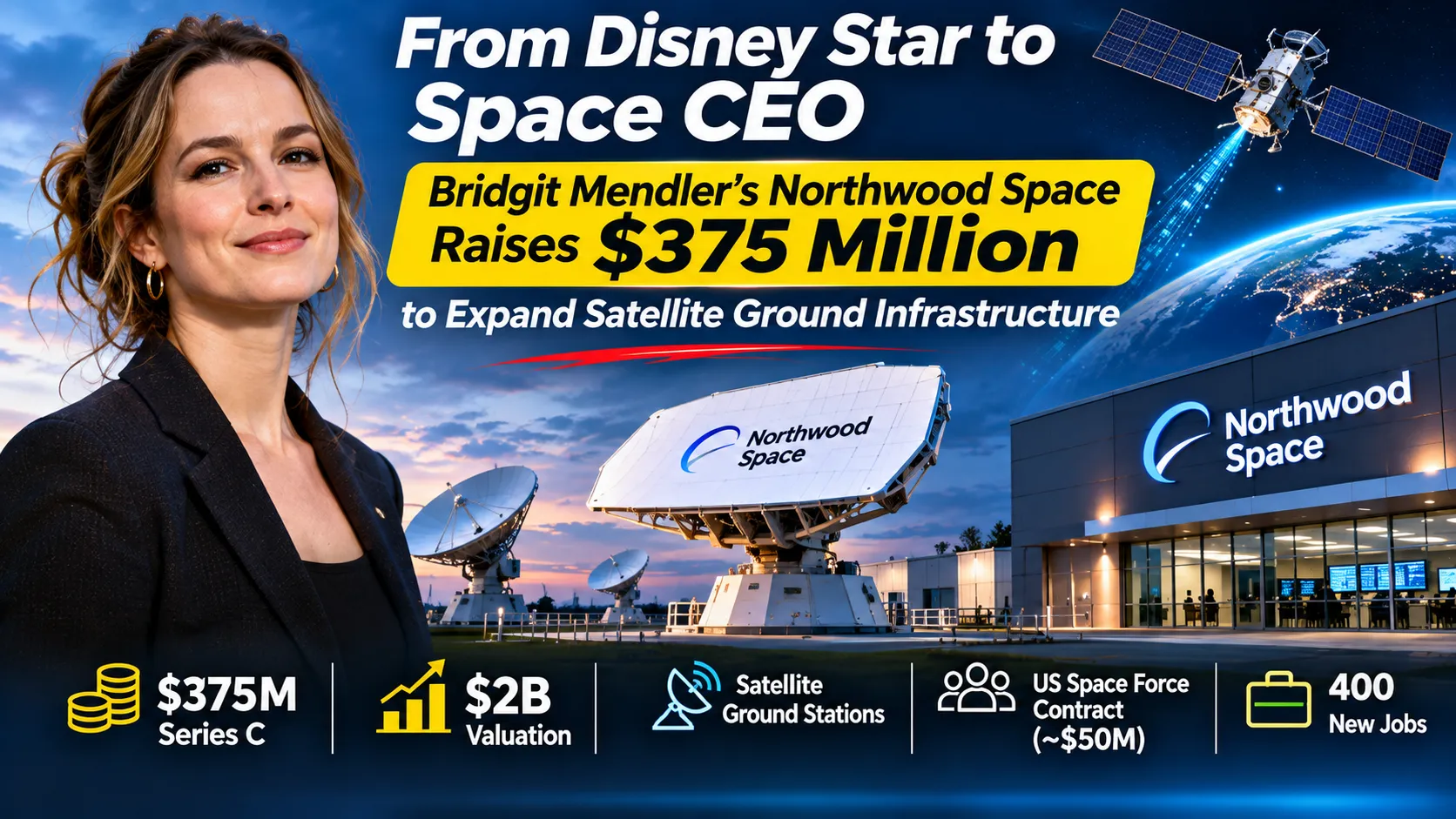
Northwood Space, which builds ground stations that allow satellites to communicate with Earth, raised $375 million in a Series C funding round co-led by Andreessen Horowitz (a16z) and DFJ Growth, at a valuation of $2 billion, TechCrunch reported on Monday, November 2. Other investors include Washington Harbour Partners, which led the company's previous round, Alpine Space Ventures, StepStone and In-Q-Tel, the venture arm associated with the US intelligence community, according to Inc.
The round follows a $100 million Series B in January 2026, also co-led by Andreessen Horowitz. The latest funding includes a financing agreement with HSBC, according to TechCrunch.
"The world is hungry for more data movement through space," Mendler said, according to Inc.
From Disney to deep tech
Mendler is best known to many people for her role in the Disney Channel series *Good Luck Charlie* and for her music career. She later left entertainment to pursue an academic and technical path, studying at the Massachusetts Institute of Technology and Harvard Law School, and worked in the Satellite Division Policy Branch of the International Bureau of the Federal Communications Commission, according to Inc.
She co-founded Northwood in 2022 with her husband, Griffin Cleverly, and Shaurya Luthra, and serves as chief executive. Her journey from child star to the chief executive of a $2 billion space company makes her one of the most unusual founders in the technology industry, and one of a small number of women leading a high-valued space startup.
The ground segment bottleneck
Most attention in the space industry goes to rockets and satellites, but every satellite needs a way to send data back to Earth and receive commands. This is the job of ground stations, networks of antennas around the world that track satellites as they pass overhead.
As the number of satellites in orbit has exploded, driven by constellations such as SpaceX's Starlink and a growing number of Earth observation, communications and defence satellites, ground infrastructure has become a bottleneck. Traditional ground stations use large, expensive dish antennas that can track only one satellite at a time.
"The thousands of satellites launched each year need access to ground networks," said Tom Stroup, president of the Satellite Industry Association, according to Inc.
Northwood's technology
Northwood builds antennas, software and other technologies that allow satellites to communicate with the ground. Its products include Portal, a multi-beam phased array antenna for tracking and controlling satellites, which can communicate with several satellites at once, and Prism, a high-throughput dish antenna nearly eight feet across for downloading data from spacecraft, according to Inc. Northwood tested its first production-ready Portal system in July 2025.
The company offers ground systems as a service, allowing satellite operators to launch services without building their own ground infrastructure, a model that can reduce costs and speed up deployment.
Government contracts
Northwood has won a contract worth nearly $50 million with the US Space Force to help upgrade the nation's "satellite control network," according to TechCrunch. The network is used to communicate with and control military and government satellites, and much of its infrastructure is ageing.


