
ImpactSustainability5 MIN READ

Norway Halts New Grid Bookings for Data Centres as AI Demand Threatens to Overwhelm One of Europe's Greenest Power Systems

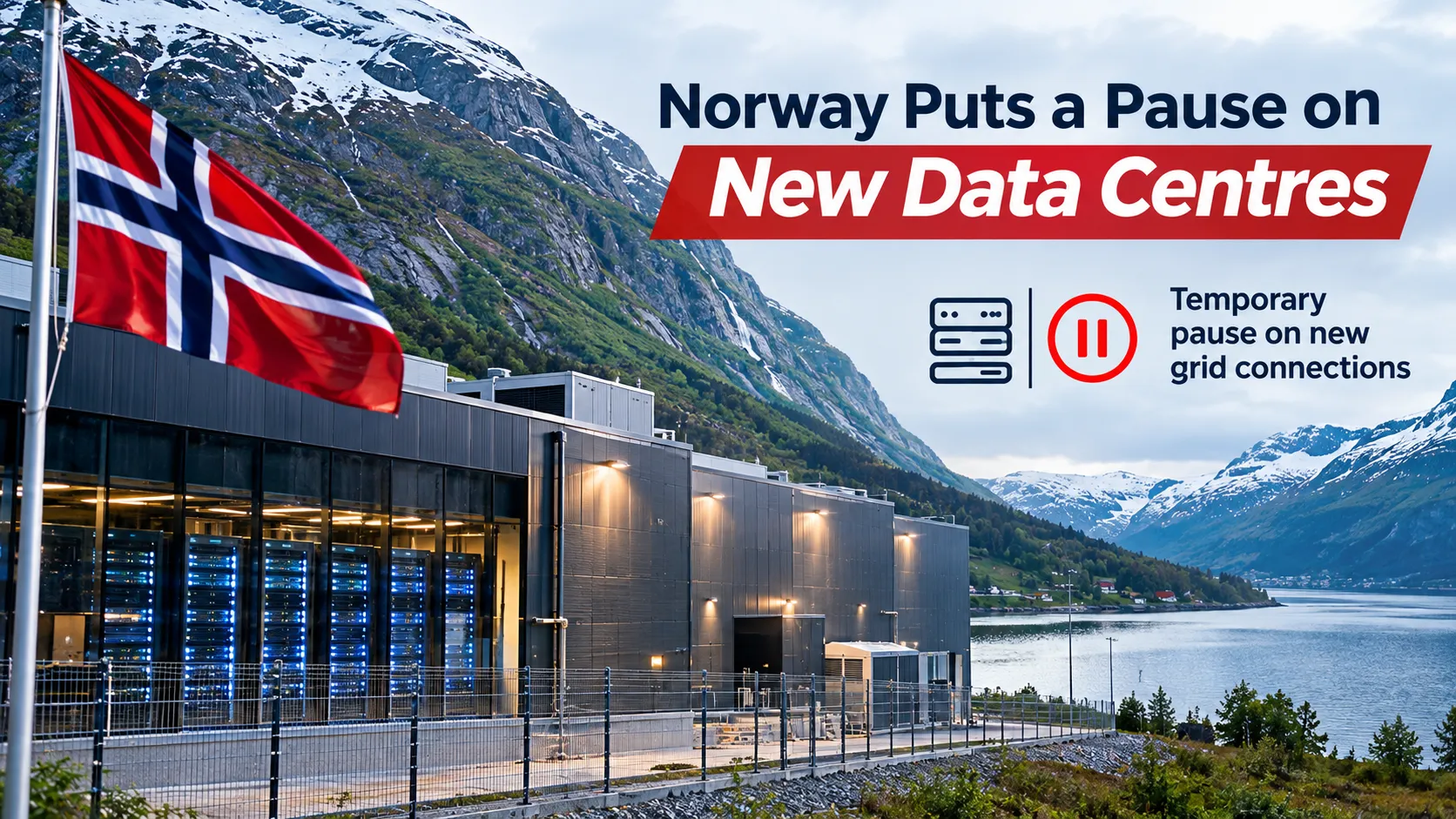
Norway's grid operator Statnett has temporarily stopped accepting new grid capacity reservations for data centres until no later than August 1, 2027, after requests reached 32,100 MW, well above the country's peak demand of about 25,000 MW. Within an hour, the government unveiled plans for licensing, priority for critical services and tighter rules for global cloud and crypto operators.

By Prathista Lazar · Author12 November 2026New
Norway Halts New Grid Bookings for Data Centres as AI Demand Threatens to Overwhelm One of Europe's Greenest Power Systems

Norway, whose abundant hydropower and cool climate have made it a magnet for data centres, has hit the brakes on the industry's expansion, in one of the clearest signs yet that the AI boom is straining power grids even in countries with surplus clean energy.

Statnett, Norway's state-owned grid operator, said on Monday, November 9, that it was temporarily suspending new grid connection reservations for data centres, according to Capacity Media and Tech Startups. The pause is expected to end no later than August 1, 2027.

Statnett described the move as a system security measure. It said it needs new technical requirements covering how data centres behave during grid faults, how quickly their electricity demand can change and the risk of oscillations that could destabilise the grid, according to Capacity Media.

The numbers behind the pause

The scale of demand explains the decision. According to Statnett figures reported by Capacity Media, about 800 megawatts of data centre load is already connected, 4,200 MW is reserved, 9,100 MW is in the queue and a further 18,000 MW has been requested, for a total of 32,100 MW. Norway's peak national electricity consumption is just over 25,000 MW.

Connected, reserved and queued capacity alone amounts to about 56% of Norway's peak consumption. Energy minister Terje Aasland said Statnett had received applications for about 26,000 MW of new electricity consumption this year, three-quarters of it from data centres, according to Capacity Media.

Norwegian data centres consumed 3.2 terawatt-hours of electricity last year, four times the level of three years earlier, according to a Menon Economics report cited by the publication.

Existing connections are unaffected. Facilities whose technical requirements have already been approved can still connect, and some smaller sites and projects close to commissioning may be considered.

The government steps in

Less than an hour after Statnett's announcement, the government set out plans to regulate the industry more tightly, according to Capacity Media. Proposals include requiring operators to obtain a licence to establish and run a data centre, with conditions attached; new rules for grid connections; and possible state ownership of strategically important sites.

The government said it would prioritise data centres serving defence, police and emergency preparedness, health services and critical infrastructure such as mobile networks and the financial system. National AI needs will be supported, but access to land and power will be restricted for global cloud companies and cryptocurrency firms, according to Reuters reporting cited by Capacity Media. Cryptocurrency operations will not be considered socially beneficial.

The aim, Torgeir Micaelsen, minister of digitalisation and public governance, told a press conference, is to "get the data centres we actually need." He said the plan was about developing the industry rather than winding it down.

Who pays for the grid

The government also said new data centres should pay the grid costs they create, and that it wants to discuss how industry can help fund new electricity generation, including gas power with carbon capture and offshore wind. The main principles of the new framework are due by autumn 2027.

Statnett's new technical requirements will go out for consultation and must be approved by the energy regulator, RME. An open question is whether licensing will apply to projects that already hold grid reservations.

Why Norway attracted data centres

Norway has been one of Europe's most attractive locations for data centres. Almost all of its electricity comes from hydropower, which is renewable, cheap and reliable. Its cool climate reduces the energy needed to cool servers, and it has ample land and stable politics.

“Norway is rationing its clean power for the data centres it truly needs, not for every AI project that knocks.”
— TIGI Sustainability Desk

These advantages have drawn global technology companies and AI infrastructure developers. Nscale's 230 MW campus in Narvik will supply more than 30,000 Nvidia Rubin GPUs to Microsoft in 2027, according to Capacity Media. Foreign companies own more than 90% of Norway's data centre capacity, according to the Norwegian Board of Technology.

But the scale of AI demand has raised concerns. Norway remains a net exporter of electricity, but the Norwegian Water Resources and Energy Directorate has warned that continued growth in demand could lead to a power deficit and higher prices for households and industry.

A Nordic pattern

Norway is not alone. Denmark's grid operator Energinet paused new connection agreements in March, and a four-tier priority system in force since October 12 places most data centres last unless they serve critical societal functions, according to Capacity Media. Sweden had 6,984 MW of data centre applications in its transmission queue on September 1, and its grid operator is considering temporary restrictions. Finland has proposed a four-tier system that would move projects above 10 MW further back in the queue.

More than 100 European groups have called for a moratorium on large-scale data centres, and StackPath counts 22 live or proposed restrictions across 10 countries, according to the publication.

92a78e0f-4555-4394-b31c-51f5480e9d33.png

The global squeeze

The Norwegian decision comes as data centre construction faces growing resistance in the United States. UBS estimates that about 30% of expected 2028 US data centre capacity additions are at risk after Democrats made gains in the November 3 midterm elections, partly on promises to address data centres' impact on power bills.

Meta president Dina Powell McCormick said new US builds will be harder and that Meta is looking at other countries, adding that "every hyperscaler" is asking whether to build outside the US, according to The Wall Street Journal as cited by Capacity Media. Norway's move suggests that alternative locations may also be harder to secure.

The sustainability question

The debate in Norway highlights a central tension in the energy transition. Clean electricity is a finite resource, and AI data centres compete for it with electrification of transport, heating and industry, all of which are needed to cut carbon emissions. Allocating renewable power to data centres serving global cloud customers may leave less for domestic decarbonisation.

By prioritising data centres that serve critical national functions, Norway is attempting to ensure that its clean energy supports its own social and economic needs.

What it means for India

India's data centre industry is growing rapidly, with companies such as Bharti Airtel, Reliance, Adani and global cloud providers investing heavily. As global restrictions tighten in Europe and the United States, some investment could shift to markets such as India. But India faces its own constraints on power supply, water and land, and its policymakers will be watching how other countries balance the benefits of data centres against their demands on infrastructure.

What comes next

Statnett will consult on its new technical requirements, and the government will develop its licensing framework over the coming year. Data centre developers with projects in the queue face uncertainty until the rules are clear. The outcome will offer a model, or a warning, for other countries grappling with how to accommodate the explosive growth of AI computing.

TagsNorwayStatnettdata centresAI infrastructurepower gridrenewable energyhydropowerenergy securityTerje AaslandTorgeir Micaelsendata centre licensingcryptocurrency miningNordic data centresDenmarkSwedenFinlandhyperscalersNscalesustainabilityinvestors

Reader reviews

Sign in to rate and review this article.
Loading reviews…

