Most cancer treatments are designed to attack a disease that has already taken hold. Nouscom, a Swiss biotechnology company, is pursuing a more ambitious goal: preventing cancer from developing in the first place in people who carry an inherited risk. It has just raised substantial capital to put that idea to its most important test.
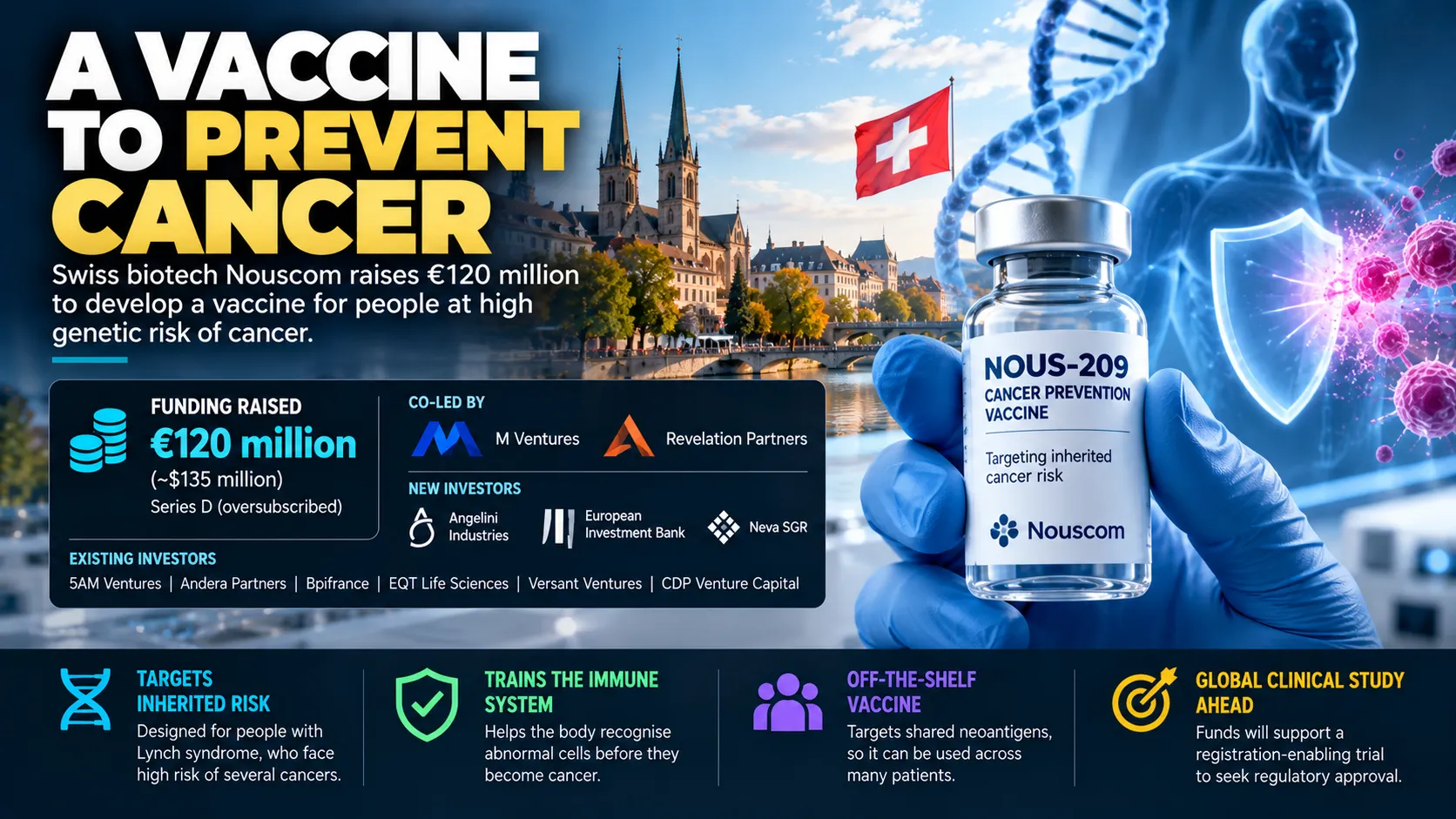
The Basel-based company announced on October 19 that it has raised €120 million, or about $135 million, in an oversubscribed Series D financing. The round was co-led by M Ventures, the corporate venture arm of German science and technology group Merck KGaA, and Revelation Partners.
New investors include Italian pharmaceutical group Angelini Industries, the European Investment Bank through its Aurea co-investment facility, and Italian investor Neva SGR. Existing investors, including 5AM Ventures, Andera Partners, Bpifrance, EQT Life Sciences, Versant Ventures and CDP Venture Capital, also participated. The company's valuation and total funding raised were not disclosed.
A vaccine for people at inherited risk
Nouscom's lead product is NOUS-209, an experimental immunotherapy designed to prevent cancer in people with Lynch syndrome. The funds will support a global registration-enabling clinical study, the kind of large trial needed to seek regulatory approval.
Lynch syndrome is an inherited condition caused by mutations in genes responsible for repairing errors in DNA. People with the syndrome have significantly elevated risks of developing colorectal cancer, as well as cancers of the endometrium, stomach, ovaries, urinary tract and other organs, often at younger ages than the general population. It is one of the most common hereditary cancer syndromes, although many carriers are unaware they have it.
Currently, people with Lynch syndrome are typically managed through frequent screening, such as regular colonoscopies to detect and remove precancerous growths, and in some cases preventive surgery. These measures reduce risk but do not eliminate it, and they can be burdensome for patients.
How NOUS-209 is designed to work
Because the DNA repair system in Lynch syndrome is faulty, cells accumulate mutations that produce abnormal proteins, known as neoantigens. Tumours that develop in Lynch syndrome patients tend to share certain common neoantigens arising from these characteristic mutations.
NOUS-209 is designed to train the immune system to recognise these shared neoantigens, so that it can identify and destroy abnormal cells before they develop into cancer. Because the neoantigens are shared across many patients, the vaccine can be produced as an "off-the-shelf" product rather than personalised for each individual, which could make it more practical and affordable than personalised cancer vaccines.
According to reports, the company has seen encouraging early clinical observations, although these remain preliminary. The registration-enabling study will be designed to provide the robust evidence regulators require.
The rise of cancer vaccines
Cancer vaccines have long been a goal of medical research, but early efforts largely failed to show clear benefits. Advances in genomics, immunology and vaccine technology, including the mRNA platforms that proved themselves during the Covid-19 pandemic, have revived interest in the field.
Most recent progress has focused on therapeutic vaccines, which aim to help the immune system fight existing cancers or prevent recurrence after surgery. Moderna and Merck & Co., for example, have developed a personalised mRNA vaccine for melanoma. Preventive cancer vaccines for people at high genetic risk, such as those with Lynch syndrome, represent a newer and potentially transformative frontier.