
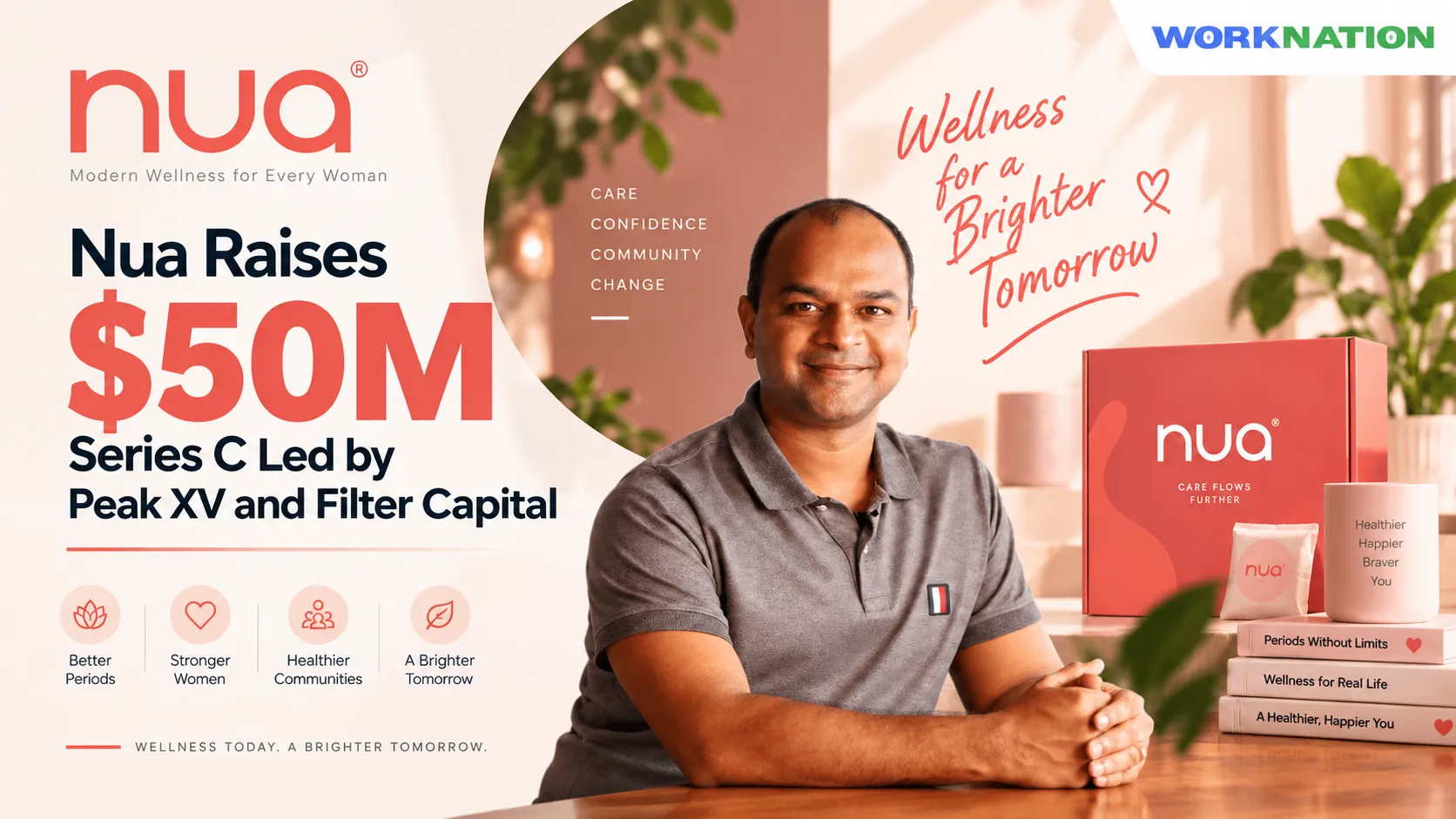
Nua, the Indian women's wellness and personal-care brand, has raised $50 million in a funding round backed by Peak XV Partners, Filter Capital, Mirabilis Investment Trust and Footpath Ventures, according to weekly funding data confirmed on September 11. The round ranks among the largest raised by an Indian women's health company this year and reflects growing investor appetite for the category as consumer awareness and willingness to pay for specialised feminine-care products continues to expand.
Nua built its early reputation on organic, chemical-free feminine hygiene products, a segment historically dominated in India by a small number of large multinational consumer goods companies offering largely undifferentiated product lines. Over time, the company has broadened into a wider women's wellness portfolio, positioning itself as a direct-to-consumer brand built around transparency in ingredients and a subscription-style relationship with customers who value consistency in a category where switching costs and brand loyalty have traditionally been higher than in most personal-care segments.
The involvement of Peak XV Partners, formerly Sequoia Capital India and one of the most prolific venture investors in the Indian consumer technology ecosystem, lends the round significant credibility within a category that has historically attracted less institutional capital relative to its addressable market size than sectors such as fintech or enterprise software. Peak XV's consumer portfolio spans several of India's best-known direct-to-consumer brands, and its participation in Nua's round signals continued conviction that women's health represents an underpenetrated opportunity within Indian consumer venture investing.
India's femtech and women's wellness sector has been characterised for years by a persistent mismatch between market size and investor attention. Women make up roughly half of India's population and control an increasing share of household purchasing decisions, yet dedicated women's health startups have historically raised a disproportionately small share of consumer venture capital relative to categories serving broader or male-skewed consumer bases. Global data on female-founder and female-focused funding has shown similar patterns, with femtech in particular capturing only a small fraction of total health-sector investment despite addressing a market estimated in the hundreds of billions of dollars worldwide.
Nua's $50 million raise arrives at a moment when several Indian women's health and wellness brands have begun to scale meaningfully, supported by rising digital literacy among Indian women, greater comfort discussing menstrual and reproductive health openly online, and a broader cultural shift away from treating feminine hygiene purely as a low-margin commodity category. The company's ability to attract a marquee lead investor alongside three additional institutional backers suggests the round was competitively subscribed, a signal of stronger investor demand than the category has typically seen at this stage of company maturity.
The new capital is expected to support expansion of Nua's product portfolio beyond its founding feminine-hygiene line, continued investment in its direct-to-consumer distribution and subscription infrastructure, and potentially entry into adjacent wellness categories where the brand's existing customer trust could translate into cross-category purchasing. Neither Nua nor its investors have disclosed the specific valuation attached to the round or detailed near-term expansion plans.
The round formed part of an unusually strong week for Indian startup funding overall, during which venture investment into Indian companies doubled to $392 million across 27 deals between September 5 and 11, with women's health emerging as one of several sectors — alongside spacetech and restaurant chains — that drew significant investor interest during the period. For India's broader women-led and women-focused startup ecosystem, Nua's raise offers a data point that larger, more mainstream growth-stage capital is increasingly willing to back the category at scale, rather than treating women's wellness as a niche reserved for smaller impact-oriented or specialist funds.