Octopus Energy, the UK's largest household energy supplier, has unveiled a low-cost add-on that turns its heat pumps into home cooling systems, as Britain prepares for hotter summers after a year in which temperatures reached 38.2°C.
The device, called the Cosy Cooler, is expected to cost £500 to £600 when added to an existing Cosy heat pump. Octopus compares that with £2,000 to £6,000 for a traditional air conditioning system. It announced the product on 14 October and plans to make it available in 2027.
Live trials have begun in homes and offices, and Octopus is inviting more customers to sign up as testers.
How the Cosy Cooler Works
Most modern heat pumps are, in principle, reversible: the same technology that extracts heat from outside air to warm a home can be run in reverse to remove heat. But in the UK, where heat pumps are typically connected to radiators, delivering cooling through that system has been impractical, because radiators are designed to release heat rather than absorb it.
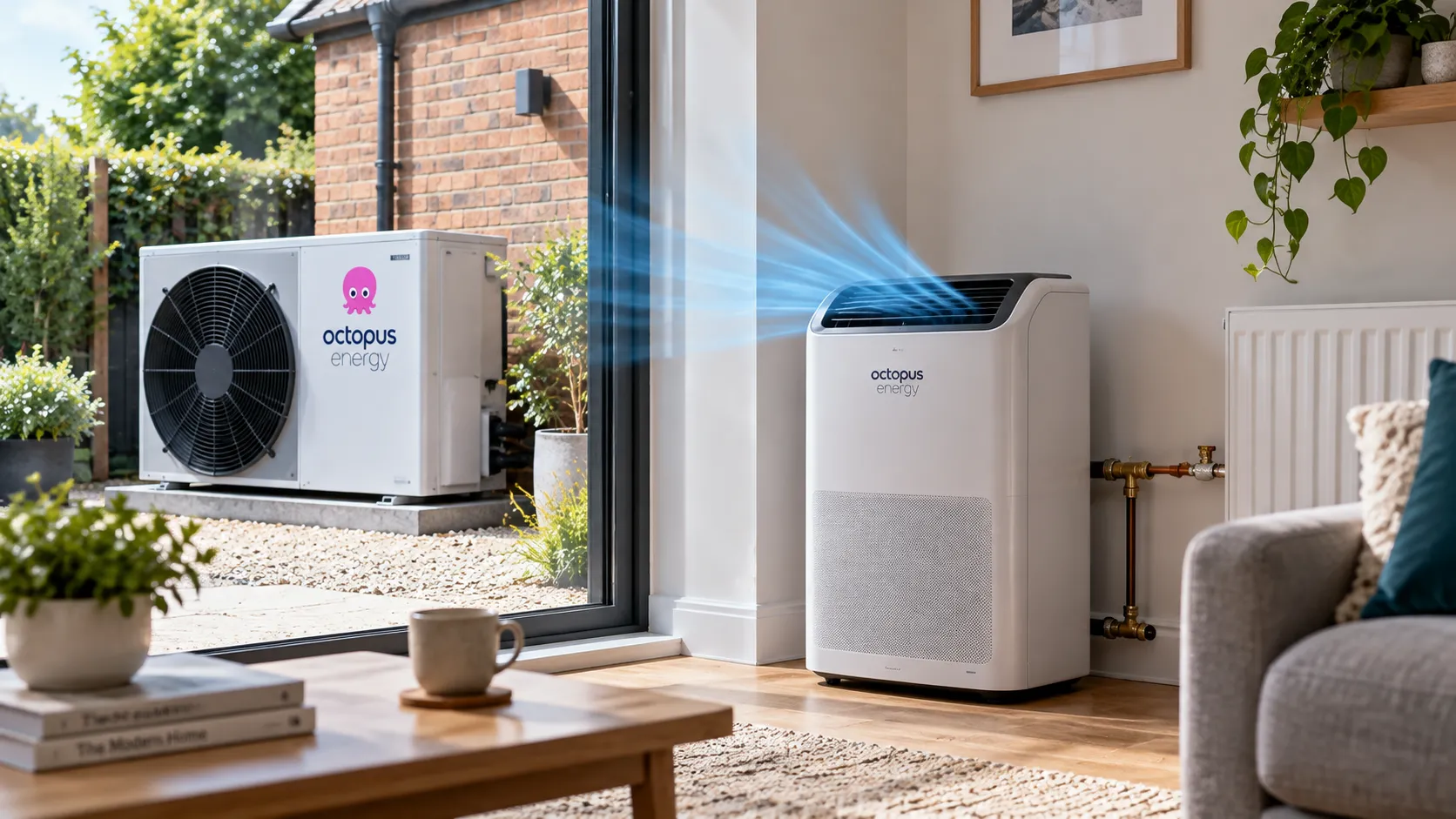
The Cosy Cooler solves that problem by adding an indoor unit. The outdoor Cosy heat pump chills water, which is then pumped through the home's existing central heating pipes. The Cooler, which plugs into the radiator pipework, draws in warm room air, cools it across a built-in heat exchanger and circulates the chilled air back into the room. Unlike many portable air conditioners, it does not need a hose running to the outside.
Octopus describes the unit as roughly the size of a tall kitchen bin. The prototype measures 72.2 centimetres high, 43 centimetres wide and 35.8 centimetres deep, and weighs about 28 kilograms. Installation is expected to take around three hours and requires no major building work.
Each unit cools a single room. Depending on the model of heat pump, homeowners will be able to run two or three units at once in different rooms. Running one unit works with any Cosy heat pump, while running two or three requires a higher-capacity model, according to TechRadar.
Britain's Growing Cooling Problem
The launch reflects a shift in how Britain thinks about home comfort. UK homes have historically been designed to retain heat during long, cool winters, and air conditioning has been rare in domestic properties. But summers are becoming hotter. The summer of 2026 saw temperatures reach 38.2°C in August, and with the El Niño weather pattern expected to develop, attention is already turning to how households will stay cool next year.
Many British homes, particularly modern flats and loft conversions, overheat badly during heatwaves. That poses health risks, especially for older people and those with medical conditions, and makes homes uncomfortable for people who increasingly work from them.
"Sadly, British homes need to be ready for freezing winters and increasingly hot summers," said Greg Jackson, Octopus Energy's founder and chief executive. He described the Cosy Cooler as "the latest result of Octopus ingenuity".
Strengthening the Case for Heat Pumps
The product also gives Octopus a new selling point for heat pumps, which are central to the UK's plans to decarbonise home heating but have been slow to gain mass adoption.
Octopus says the government's Boiler Upgrade Scheme, which provides a grant towards installation costs, means heat pumps now cost the same as or less than a gas boiler to install. A typical gas boiler installation costs around £3,000 in 2026, and 59 per cent of Octopus's boiler-equivalent heat pump installations cost £3,000 or less after the grant, according to the company.
Octopus also says 99 per cent of its Cosy heat pump customers pay less to heat their homes than they would with a gas boiler, saving an average of £230 a year. Over the past 18 months, the company has received 570,000 enquiries from people interested in installing a heat pump.
By offering cooling as an affordable add-on, Octopus can position heat pumps as year-round climate control systems rather than heating-only appliances. That could prove a powerful argument for households weighing the cost and disruption of replacing a gas boiler.
Heat pump adoption in the UK has lagged well behind countries such as Norway, Sweden and France, despite government targets to scale installations sharply this decade. Barriers have included upfront cost, a shortage of trained installers, concerns about running costs and a widespread perception that heat pumps are less effective than gas boilers in older, poorly insulated homes. Octopus has tried to address several of these at once, designing its own units, training its own engineers and pairing installations with smart tariffs that encourage running the system when electricity is cheaper. Adding cooling attacks a different kind of barrier: it gives households a benefit they can feel immediately on the hottest days, rather than a saving they notice only on winter bills.
A British-Engineered Product
Octopus says the Cosy Cooler was designed by British engineers. The company has invested heavily in developing its own heat pump range, aiming to bring down costs through in-house design and manufacturing rather than relying solely on imported products.
The company has not yet disclosed the Cooler's cooling capacity or its running costs, which will be important for households comparing it with portable or fixed air conditioning units.
Climate Adaptation Meets Decarbonisation
The Cosy Cooler sits at the intersection of two major challenges: reducing emissions from home heating, and adapting homes to a warming climate. Conventional air conditioning, if adopted widely, could significantly increase electricity demand during summer peaks. Systems that use heat pumps for both heating and cooling may offer a more efficient way to meet both needs with a single installation.
The idea is relevant far beyond Britain. In countries such as India, where cooling demand is soaring as incomes rise and temperatures climb, the efficiency of cooling technologies has major implications for electricity grids and emissions. Products that combine heating and cooling efficiently are likely to attract growing interest in markets with both cold winters and hot summers.
What Comes Next
Octopus will need to show that the Cosy Cooler performs well in real homes, that installation is as simple as promised, and that running costs are competitive with alternatives. The company is also likely to face questions about how many of its customers already have a Cosy heat pump, since the product cannot be used on its own.
If the trials succeed, the Cosy Cooler could help reframe the heat pump from a green obligation into an upgrade that delivers comfort all year round, a shift that may do more to accelerate adoption than any subsidy.