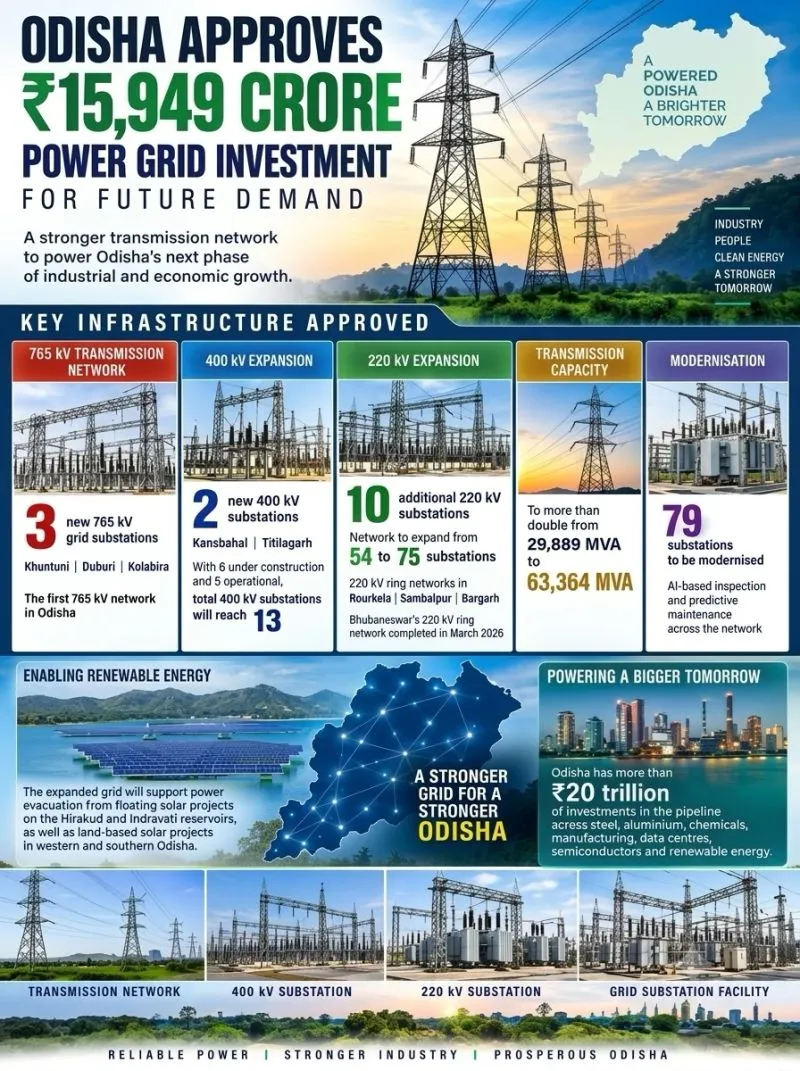
The Odisha state government has approved a Rs 15,949 crore investment plan to upgrade the state's power grid infrastructure, a substantial capital commitment aimed at enhancing distribution reliability, reducing transmission losses and building the additional grid capacity needed to accommodate anticipated future industrial demand growth alongside the state's expanding renewable energy generation capacity. The scale of the investment places it among the larger state-level power infrastructure commitments announced across India in recent months, reflecting the mounting pressure many Indian states face to modernise ageing transmission and distribution infrastructure that was largely built to serve demand patterns and generation sources considerably different from what the grid must now accommodate.
Odisha's power grid upgrade plans arrive against a backdrop of significant industrial growth ambitions for the eastern state, which has increasingly positioned itself as a destination for both traditional heavy industry, including steel and mining-adjacent manufacturing, and newer categories of industrial investment including data centres and electronics manufacturing, each of which carries substantially different power demand profiles and reliability requirements than the state's grid infrastructure was historically designed to serve. Modernising transmission and distribution infrastructure to reliably serve this more diverse and demanding industrial base represents a necessary precondition for the state to successfully compete for the kind of large-scale industrial investment commitments that have increasingly gravitated toward states able to guarantee reliable, adequate power supply. The investment also reflects the broader technical challenge Indian states increasingly face in integrating growing renewable energy generation capacity into grids that were originally designed around the more predictable, dispatchable generation characteristics of coal and other conventional thermal power sources. Solar and wind generation's inherent variability requires more sophisticated grid management capabilities, including improved forecasting, faster-responding balancing resources and, increasingly, battery storage integration, all of which typically demand meaningful transmission and distribution infrastructure upgrades beyond what a grid built purely around conventional generation would require.
Reducing transmission and distribution losses represents a particularly significant component of the investment's expected return, given that technical and commercial losses across India's power distribution networks have historically run considerably higher than international benchmarks, representing both a direct financial drain on state power utilities' finances and a meaningful source of wasted generation capacity that, if recovered through improved grid efficiency, could effectively expand available power supply without requiring proportional new generation capacity investment. Odisha's specific loss reduction targets under the approved investment plan were not fully detailed in initial announcements, though state power sector officials have historically pointed to loss reduction as one of the more cost-effective near-term levers available for improving overall grid reliability and financial sustainability. The investment plan's approval process at the state government level typically involves coordination between the state power utility responsible for grid operations, state finance officials evaluating the fiscal implications of the capital commitment, and often central government power sector agencies given the frequent co-financing arrangements that characterise large-scale state power infrastructure investments in India, which commonly combine state budgetary allocations with central government schemes and multilateral or bilateral development finance institution funding.
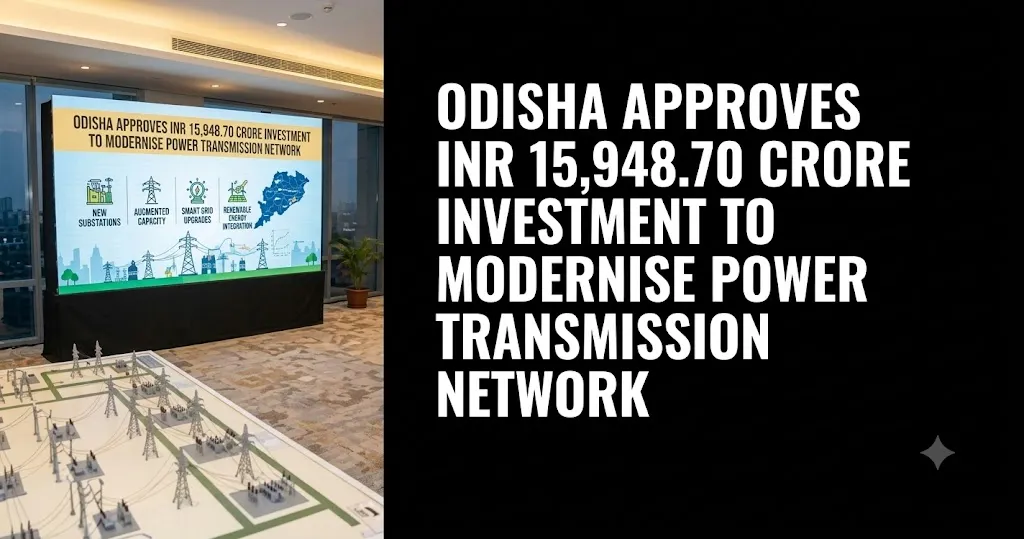
For Odisha's broader economic development strategy, the power grid investment complements other infrastructure commitments the state has pursued in recent years as part of a deliberate effort to position itself as an increasingly attractive investment destination beyond its traditional strength in mining and heavy industry, extending into sectors including electronics manufacturing, data centre infrastructure and downstream value-added manufacturing that depend critically on reliable, adequate power supply as a foundational precondition rather than merely a supporting factor. As the investment plan moves from approval into implementation, the practical execution challenge for Odisha's power sector officials will centre on sequencing the substantial infrastructure build-out efficiently across the state's various regions and demand centres, prioritising upgrades that unlock the most immediate reliability and capacity benefits while managing the multi-year construction timeline that grid infrastructure projects of this scale typically require, a sequencing decision that will meaningfully shape which parts of the state see improved power reliability soonest and which industrial investment opportunities the upgraded grid capacity can support at each stage of the broader rollout. The Rs 15,949 crore Odisha grid investment plan is expected to be implemented in phases over several years, with state power sector officials typically prioritising upgrades in regions facing the most acute existing reliability challenges or the clearest near-term industrial demand growth, a sequencing approach that allows the state to demonstrate tangible improvements to both residential consumers and prospective industrial investors relatively early in the multi-year investment programme rather than requiring the full investment to be completed before any benefits become visible. Odisha's power sector modernisation plans also intersect with the state's growing renewable energy generation ambitions, given that reliable, modernised grid infrastructure represents a necessary precondition for the state to successfully integrate the additional solar and wind generation capacity that would be needed to meaningfully diversify its power generation mix beyond the coal-heavy generation base that has historically dominated the state's electricity supply, positioning this grid investment as foundational infrastructure supporting Odisha's broader long-term energy transition ambitions rather than a standalone reliability improvement initiative alone. Odisha's power utility has separately indicated plans to expand smart metering deployment alongside the broader grid investment, a complementary technology upgrade that officials say will improve both billing accuracy and real-time demand visibility as the state's grid modernisation programme moves through its initial implementation phases. State officials have indicated that a portion of the Rs 15,949 crore investment will be financed through a combination of state budgetary allocation and central government co-financing under existing power sector modernisation schemes, a blended financing structure common among large-scale Indian state infrastructure investments that helps distribute the fiscal burden across multiple levels of government. Neighbouring states pursuing comparable grid modernisation programmes are reportedly watching Odisha's implementation closely as a potential template, given the relatively detailed phasing and financing structure disclosed alongside the investment approval. State officials have also committed to publishing periodic progress updates on the grid investment programme, a transparency measure intended to maintain public and investor confidence throughout the multi-year implementation timeline. The investment plan also includes provisions for periodic third-party audits of implementation progress, a safeguard state officials say will help ensure funds are deployed as intended.