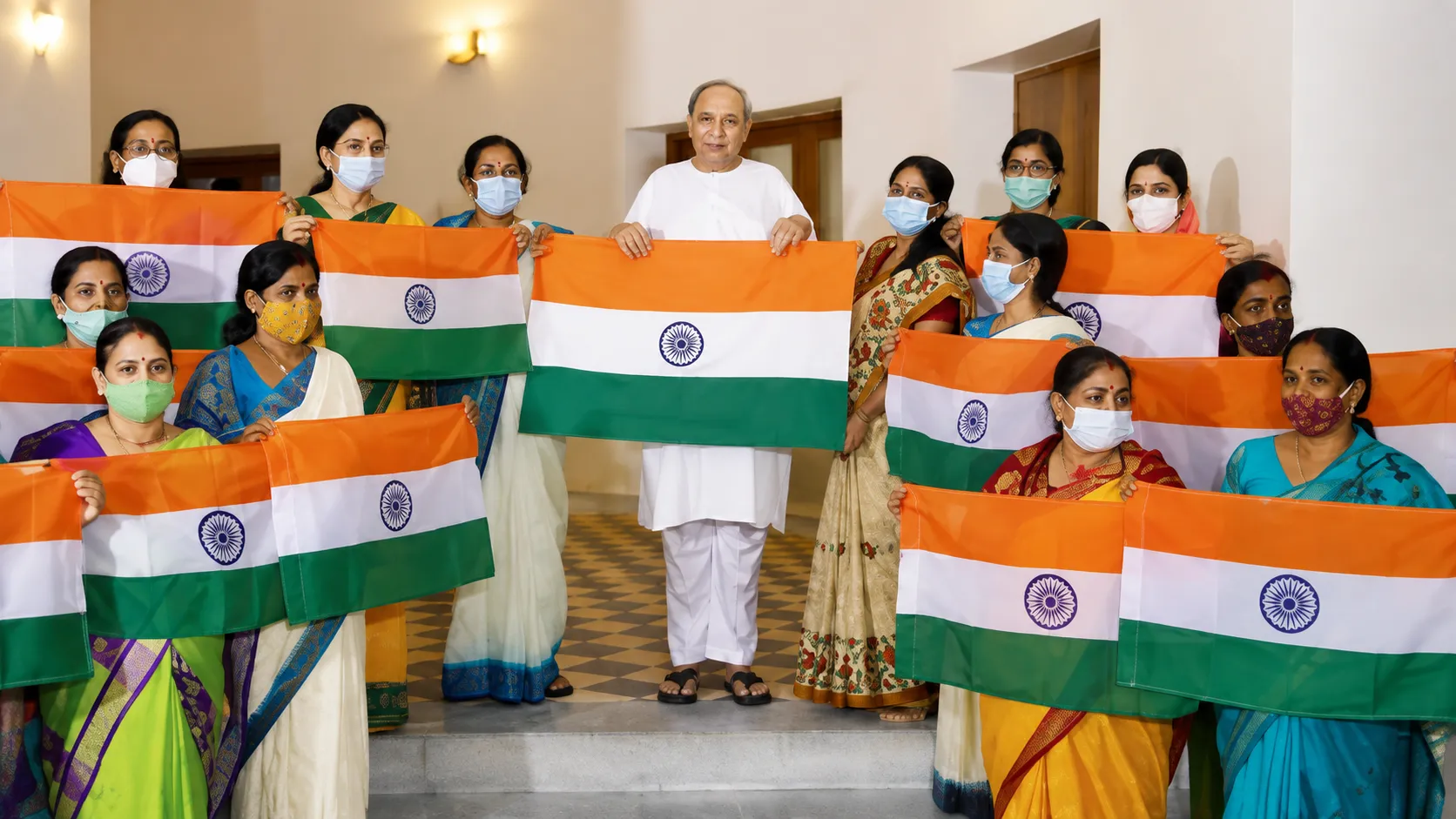
Self-help groups operating under Odisha's Mission Shakti programme have stitched 60 lakh national flags for the Har Ghar Tiranga 2026 campaign, creating livelihood opportunities for 16,162 women across the state. The initiative stands as one of the more striking examples this year of how India's women-centric self-help-group networks can be mobilised at scale to support national campaigns, while simultaneously generating meaningful economic activity for participants.
The scale of the effort — 60 lakh flags produced through a coordinated women's collective network — stands out even among Mission Shakti's own long record of large-scale production initiatives.
Mission Shakti, one of India's largest state-run self-help-group federations, has long served as an economic mobilisation platform for rural and semi-urban women in Odisha, channelling collective enterprise into everything from textile production to food processing. The flag-stitching initiative for Har Ghar Tiranga — a national campaign encouraging citizens to display the Indian flag at their homes — represents a scaled, time-bound production effort that required significant coordination across the state's network of women's self-help groups to meet both the volume and quality requirements of national-flag production.
The Odisha initiative also illustrates the growing role Indian state governments have assigned to women's self-help groups within broader public procurement strategy, extending well beyond traditional livelihood-support programmes into direct participation in state-level supply chains for goods ranging from school uniforms to festival and campaign materials. This evolving role reflects a policy recognition that self-help-group networks, once sufficiently scaled and organised, can offer government departments a reliable, socially beneficial alternative to conventional commercial vendors for appropriate categories of standardised, labour-intensive production.
Beyond the symbolic significance of contributing directly to a national campaign, the initiative provided tangible livelihood income for over sixteen thousand women during the production period, reinforcing Mission Shakti's dual mandate of civic participation and economic empowerment. Self-help-group-based production models of this kind have increasingly been used by Indian state governments as a mechanism for large-scale procurement, combining public-sector demand with grassroots women's enterprise networks in a way that creates measurable, if often seasonal, income opportunities.
The scale of the flag-production initiative also underscores the economic significance that time-bound government procurement contracts can hold for women's self-help-group networks, offering income opportunities that, while often seasonal, can meaningfully supplement household earnings during the production period. Programme administrators note that the skills and production infrastructure built through initiatives like this one frequently carry over into other manufacturing and craft-based livelihood opportunities pursued by the same self-help groups throughout the year, extending the initiative's economic benefit well beyond the immediate campaign period itself.
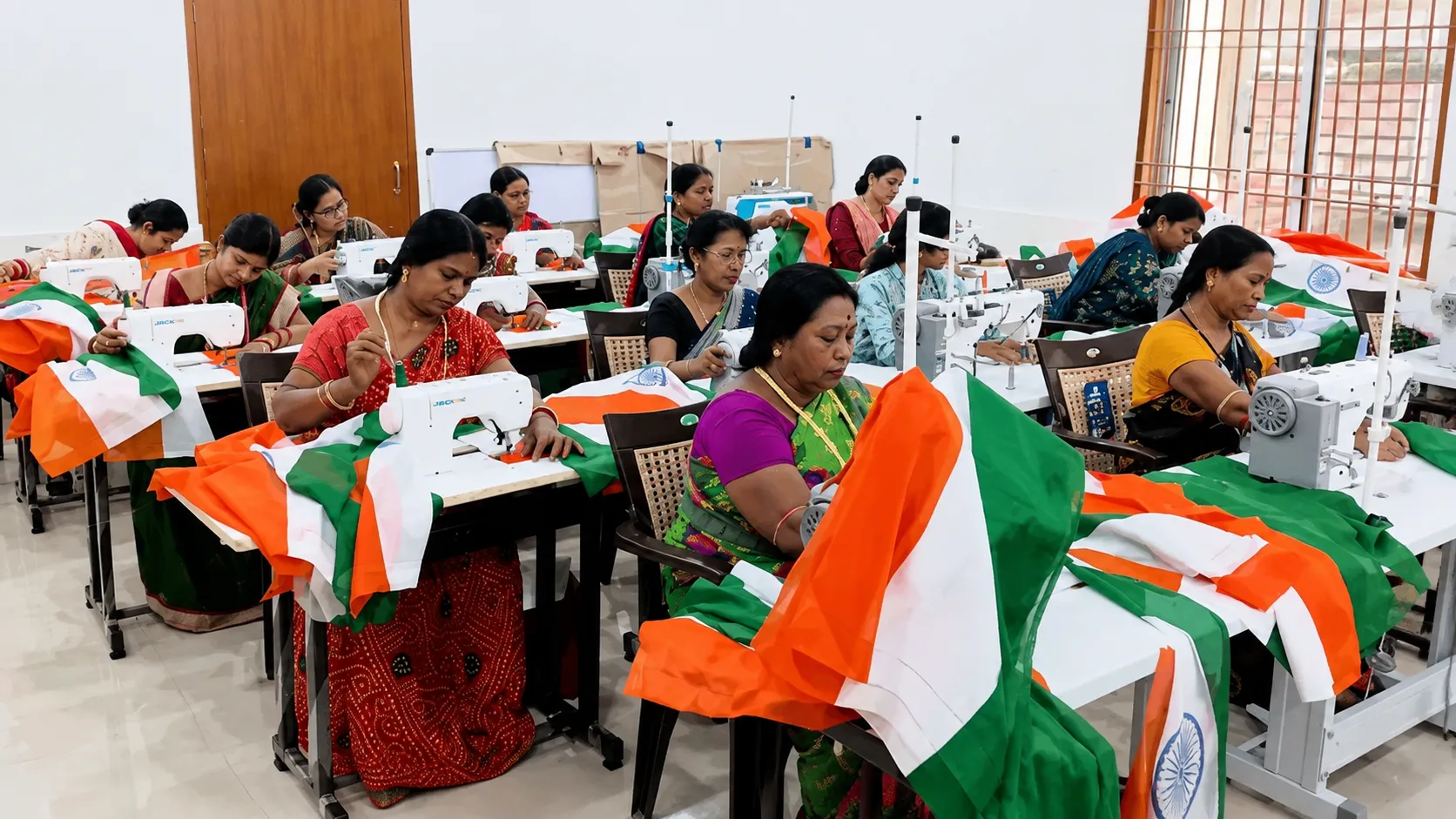
Odisha's experience also offers a useful comparison point for neighbouring states exploring similar self-help-group mobilisation strategies, several of which have sent delegations to study the state's coordination model for large-scale, quality-controlled production runs delivered within tight campaign timelines.
Officials involved in coordinating the flag-production drive noted that quality-control checkpoints were built into the process at multiple stages, ensuring that the finished flags met national specification standards despite the scale and time pressure involved, a logistical achievement that programme administrators say reflects the increasing operational sophistication of Odisha's self-help-group network relative to when the Mission Shakti programme first began scaling more than a decade ago.
Odisha's Mission Shakti programme has, over the past decade, built one of India's more extensive women's self-help-group ecosystems, encompassing millions of members across the state engaged in a wide range of micro-enterprise activities. The flag-production initiative adds to a growing body of evidence suggesting that well-organised self-help-group networks can be rapidly mobilised for large-scale production tasks when structured procurement demand exists, offering a model that other states have periodically sought to replicate for their own women's economic-empowerment programmes.
Self-help-group-based livelihood models have become an increasingly central pillar of India's rural and semi-urban economic-development policy over the past decade, with state governments across the country investing substantially in group formation, skills training and market linkages for women's collectives. Odisha's Mission Shakti programme is frequently cited as one of the more mature examples of this model, having built not only production capacity but also the logistical and quality-control infrastructure needed to fulfil large, time-bound government procurement orders — a capability that distinguishes it from smaller, less-organised self-help-group networks in other states. The flag-production initiative for Har Ghar Tiranga 2026 serves as a visible demonstration of that capacity, offering policymakers in other states a concrete case study of how structured procurement demand, channelled through well-organised women's collectives, can generate both civic participation and measurable economic outcomes simultaneously.
From a national-policy perspective, the Odisha initiative also arrives as several state governments explore formalising self-help-group procurement guarantees within broader public-procurement policy, following growing recognition that such arrangements can deliver measurable livelihood outcomes alongside standard commercial value-for-money considerations. Should Odisha's model prove replicable at similar scale in other states, it could meaningfully expand the role women's self-help-group networks play within India's broader public-procurement ecosystem, extending well beyond the current concentration in a small number of states that have invested most heavily in self-help-group infrastructure to date.
As Har Ghar Tiranga 2026 unfolds across India, the contribution of Mission Shakti's self-help groups highlights a quieter but consequential dimension of the campaign: the economic opportunity it created for thousands of women producers in Odisha. For a state that has invested heavily in self-help-group-based livelihood programmes, the initiative offers a tangible example of how civic campaigns and grassroots economic empowerment can be designed to reinforce one another.
As Har Ghar Tiranga 2026 concludes, the flag-production initiative's longer-term significance may lie less in the specific campaign it supported than in the institutional capability it helped further build within Odisha's self-help-group network — capability that state officials indicate they intend to draw upon for future large-scale procurement needs. For the women involved, the initiative offered not only immediate income but a further demonstration of their collective's capacity to deliver at a scale and quality standard suitable for national-level public campaigns, reinforcing the broader case for continued state investment in self-help-group-based livelihood infrastructure.
State officials have indicated that similar coordinated production efforts may be considered for future national campaigns, building on the operational template established through the Har Ghar Tiranga flag initiative.