An Indian deep-technology company is about to test one of the energy transition's hardest problems — how to store renewable electricity for many hours at a time — on a British university campus, using batteries built in Britain.
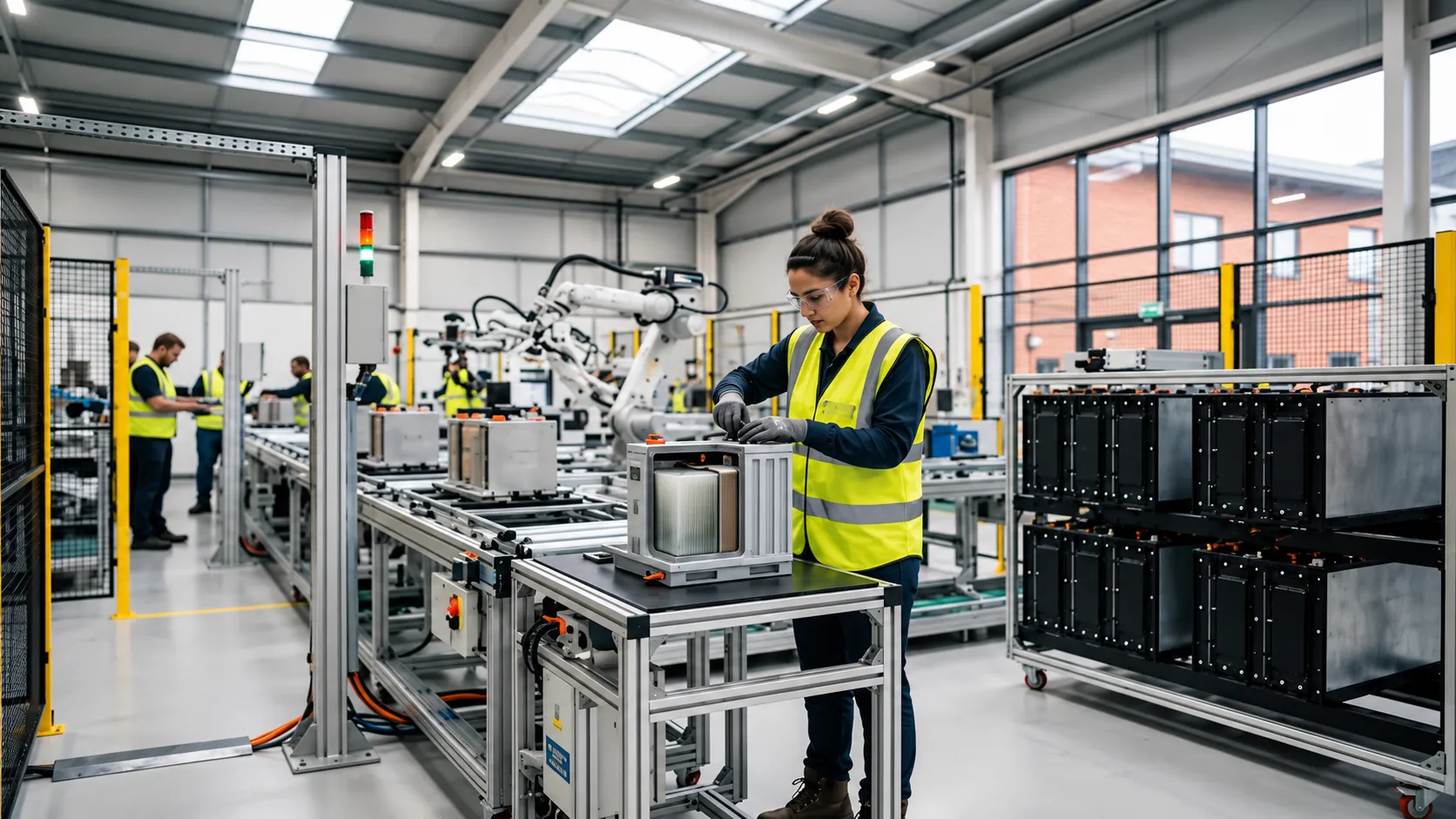
Offgrid Energy Labs, an India-origin energy storage company, has signed a memorandum of understanding with Keele University in England to deploy its ZincGel long-duration energy storage technology at the university's campus, the company announced this week. The pilot will be installed at Keele's Low Carbon Energy Generation Park and will use batteries manufactured at Offgrid's facility in Hook, Hampshire, according to reports by Solar Power Portal, YourStory and Entrepreneur India.
The partners describe it as the UK's first zinc-based long-duration energy storage project to use batteries manufactured entirely in the UK.
What the pilot will test
Keele's Low Carbon Energy Generation Park includes two wind turbines that supply up to half of the campus's electricity. Like all wind generation, their output rises and falls with the weather, and at times they produce more power than the campus can use.
The ZincGel pilot is designed to capture that surplus. It is expected to store about 1 megawatt-hour of surplus renewable energy each month and will operate in a fully islanded configuration, meaning it will run independently of the wider grid.
Over the course of the trial, the partners will evaluate the system's safety, its ability to discharge deeply and its round-trip performance — how much of the energy put into the battery can be recovered. They will also assess how the system performs through seasonal variations in renewable generation.
If the pilot is successful, the partners plan to develop a proposal for a larger, multi-megawatt-hour ZincGel deployment at Keele.
Why zinc, and why long duration
Most of the world's battery storage today uses lithium-ion chemistry, the same technology found in electric vehicles and smartphones. Lithium-ion batteries are excellent at delivering power quickly and are well suited to storing energy for a few hours. But they are less economical for longer durations, depend on critical minerals such as lithium, cobalt and nickel whose supply chains are concentrated in a handful of countries, and carry a risk of fire if damaged or poorly managed.
ZincGel takes a different approach. It uses a proprietary zinc-bromine chemistry and is designed for discharge durations of six to 16 hours. The system avoids lithium, cobalt, nickel and rare-earth materials, and the company says it is non-flammable.
That combination targets a growing gap in the energy system. As countries add more wind and solar power, they need storage that can shift energy from periods of surplus to periods of shortage — from a windy night to a calm morning, or from a sunny afternoon to the evening peak. Storage lasting six hours or more, often called long-duration energy storage, is widely seen as essential for grids that rely heavily on renewables.
The cost of wasted wind
The UK offers a vivid illustration of the problem. When the grid cannot absorb all the electricity generated by wind farms, often because of transmission bottlenecks, operators are paid to switch them off. These curtailment payments are a growing cost for consumers.
According to figures cited by Solar Power Portal, UK curtailment payments reached £1.46 billion in 2025, for about 10 terawatt-hours of surplus wind power. Without more long-duration storage, the annual cost could rise to as much as £8 billion by 2030.