OlsAro, a Swedish agricultural technology company developing climate-resilient crops, has raised €5 million in seed funding to bring its salt-tolerant wheat to market and expand its platform into traits that help cereals cope with heat, drought and poor soils.
The round was led by Industrifonden, with Nordic Foodtech VC as co-lead. Existing investors Future Food Fund, AgFunder, GU Ventures and PINC, the venture arm of Finnish food group Paulig, also took part. Including a €2.5 million round in April 2024, which the company originally described as seed and now calls pre-seed, OlsAro has raised about €7.5 million in total, according to Tech Funding News.
The Gothenburg-based company is a spinout from Lund University and the University of Gothenburg.
A Climate Problem in the Soil
OlsAro's first product addresses a threat to food production that receives less attention than heat or drought: soil salinity. When salt accumulates in soil, through rising seas, poor irrigation practices or naturally saline groundwater, it makes it harder for plants to absorb water and nutrients, sharply reducing yields.
The UN Food and Agriculture Organization estimates that salt-affected soils cover 10.7 per cent of the world's land, about 1,381 million hectares, and that around 10 per cent of both irrigated and rain-fed cropland is affected, although it notes the data are highly uncertain.
The problem is particularly acute in low-lying coastal regions of South Asia, including parts of Bangladesh and India, where sea-level rise and storm surges are pushing salt water into farmland.
Salt-Tolerant Wheat Nears the Market
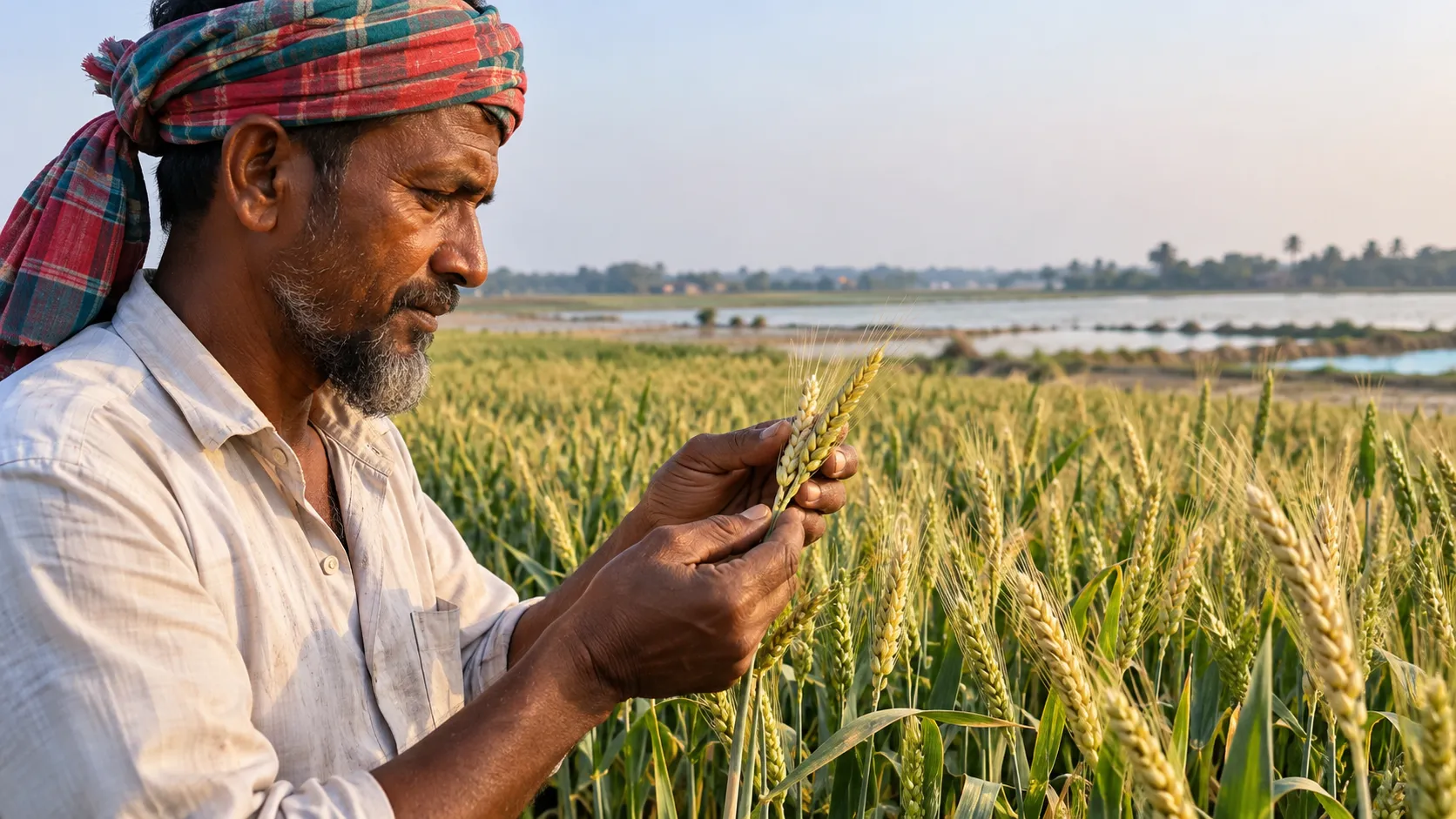
OlsAro's lead product is a salt-tolerant wheat. In field trials under saline conditions in Bangladesh, it produced up to 41 per cent more yield than a moderately salt-tolerant comparison variety, according to the company. The wheat is being field-tested in several international markets, and OlsAro is planning a commercial launch in 2027.
In Bangladesh, the company works with Lal Teer Seed, which handles seed multiplication, logistics, storage, marketing and sales. In July 2025, chief executive Elén Faxö said OlsAro aimed to reach the Bangladeshi market by 2027; at that point, the wheat was in its second year of the distinctness, uniformity and stability testing required for variety registration.
India is also part of the story. DCM Shriram, the Indian agribusiness and chemicals group, tested three OlsAro lines at three saline sites in Uttar Pradesh and Bihar during the 2024-25 winter season. In July 2025, it described the results as encouraging and said it wanted another season of testing.
Inside the SeedAX Platform
OlsAro's long-term ambition goes beyond a single crop or trait. Its proprietary SeedAX platform combines genetics and data, AI-driven trait discovery and advanced breeding technologies to identify climate-resilience traits and integrate them into elite germplasm, the high-performing breeding lines that seed companies use in their commercial programmes.
The company uses two technical routes. One is gene editing. The other is a population approach that uses a substance to induce genetic diversity, which Faxö has described as non-GM in every market, an important distinction in regions where genetically modified crops face strict regulation or consumer resistance.
"This round is about turning that capability into a platform seed companies can use repeatedly," Faxö said.
Rather than building large operations of its own, OlsAro licenses its germplasm to seed company partners, who handle production and distribution. That asset-light model allows the company to reach multiple markets without the cost of building a global seed business.
It also reflects how the seed industry works. Developing a new crop variety and bringing it to farmers can take many years, involving repeated field trials across seasons, registration with national authorities and the multiplication of seed in sufficient quantities for commercial sale. Established seed companies already have the breeding programmes, regulatory expertise and distribution networks to manage that process. By supplying traits and germplasm that slot into those existing programmes, OlsAro can focus on the scientific discovery where it has an edge, while partners take on the capital-intensive work of production and sales. The approach could shorten the path from laboratory to field and allow the company to work with several seed partners in different regions at once.
From Salt to Heat, Drought and Nitrogen
The new funding will support international field trials, commercial work with seed company partners, further research and AI-driven trait discovery, and an expanded intellectual property portfolio. It will also fund new programmes in drought tolerance and nitrogen-use efficiency, which measures how effectively crops convert fertiliser into yield, as well as expansion into other cereals, starting with rice.
Heat tolerance is expected to be the next trait to reach the market after salinity and is already in field trials in several countries.
"Drought and nitrogen are two of the biggest limits on cereal yields worldwide, and both are getting worse," Faxö said. Drought tolerance is most relevant in rain-fed farming systems in Africa, Australia, South America and the Mediterranean, while nitrogen efficiency could help smallholder farmers in low-input systems and European growers facing tighter environmental rules on fertiliser use.
Investors Back the Science
Sara Frykstrand Ångström, investment manager and head of intelligence at Industrifonden, said: "What convinced us about OlsAro was the scientific work behind the company," citing its field trial results and existing partnerships with seed companies. Industrifonden is a Swedish venture investor managing more than SEK 5 billion across deep tech, life sciences and other sectors.
OlsAro joins a growing group of companies applying new genetic tools to climate resilience. Oxford-based Wild Bioscience raised a $60 million Series A in October 2025, Tropic raised €91.3 million in March 2026 to scale gene-edited bananas and rice, and Belgium's Rainbow Crops received a $7 million Gates Foundation grant before raising a €9.7 million seed round in June 2026.
Why It Matters for Food Security
For countries such as India and Bangladesh, where hundreds of millions of people depend on wheat and rice and where climate change is already affecting yields, crops that can withstand salt, heat and drought could be vital to food security and farmer incomes.
OlsAro's challenge will be to move from promising trial results to reliable commercial performance across diverse growing conditions, and to navigate the regulatory processes that govern new crop varieties in each market. If its 2027 wheat launch succeeds and its platform delivers additional traits, the company could become an important supplier of climate-resilient genetics to the seed industry, helping farmers grow more food on land that is becoming harder to farm.