Optivolt, a San Francisco-based company that has spent nearly a decade redesigning the solar panel, has raised $32 million to bring its technology to market, as demand for solar power surges with the growth of AI data centres.
The Series A round, announced on Thursday, October 22, was led by VXI Capital, a hard technology fund founded by the former chief technology officer of the US military's Defense Innovation Unit, ESG Today reported. RA Capital, Valo Ventures and Atlas Innovate also participated. The round brings Optivolt's total funding to $42 million.
The company said it would use the proceeds to fund manufacturing and deployment across residential and utility-scale solar, including projects to power AI data centres.
Rebuilding the solar panel
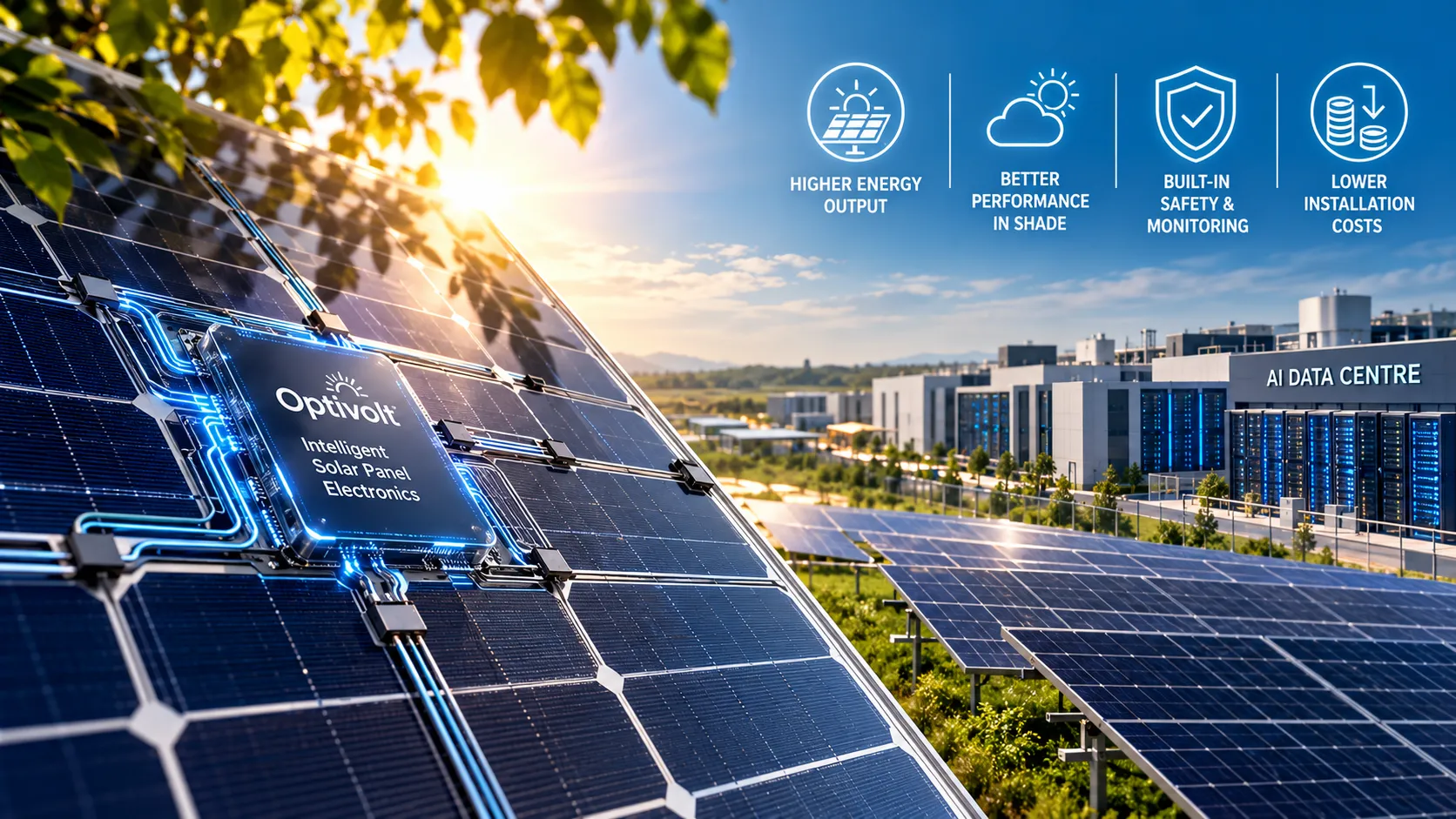
Founded in 2017 by chief executive Rohit Kalyanpur, Optivolt has developed what it calls intelligent solar panel electronics. Rather than adding separate devices to panels, the company integrates power management, monitoring and safety functions directly into the panel.
"For nine years, we've rebuilt the solar panel from first principles," Kalyanpur said, describing the result as "the first solar panel system that thinks for itself."
At the heart of the technology is a component called the Power Balancer, which redistributes energy among groups of cells within a panel in real time. That addresses one of the most persistent problems in solar power: when part of a panel is shaded, by a tree, a chimney, dust or a cloud, its output can fall disproportionately, because cells wired in series are limited by the weakest cell.
Six times the power in shade
Conventional solutions to shading include power optimisers and microinverters, devices bolted onto each panel to manage output. Optivolt says internal tests showed its panels delivered up to six times the power of panels with bolted-on optimisers under defined shade scenarios. The company's figures have not been independently verified.
Optivolt's design also includes rapid shutdown and monitoring, which are required for safety in many markets, particularly for rooftop systems. Integrating these functions could reduce the need for separate equipment, lowering installation costs and potential points of failure.
"Optivolt has spent nine years building the architecture for that future," said Orin Hoffman, managing director at VXI Capital.
Why investors are interested
The investment comes as solar power is being deployed at record rates globally. Solar is now the cheapest source of new electricity in much of the world, and installations continue to break records, led by China, the United States, India and Europe.
Demand from AI data centres has added a new dimension. Technology companies are signing large power purchase agreements for solar and other renewable energy to meet their growing electricity needs and climate commitments. Squeezing more energy from each panel, particularly in less-than-ideal conditions, can improve the economics of solar projects.
The involvement of a fund with defence links also reflects growing interest in energy technologies for national security, including resilient power for military installations and critical infrastructure.
The challenge of scaling
Hardware innovation in solar faces significant hurdles. The industry is dominated by Chinese manufacturers that produce panels at enormous scale and very low cost. New technologies must prove that their performance gains justify any additional cost, and must achieve bankability, the confidence of project financiers that equipment will perform reliably over 25 years or more.
Optivolt will need to scale manufacturing, win certification and build relationships with installers and developers. Its focus on both residential and utility-scale markets gives it multiple routes to customers, but each has different requirements.
The Indian connection
Kalyanpur is one of many Indian-origin entrepreneurs building climate technology companies in the United States. The global solar industry also has deep links to India, which has become one of the world's largest solar markets.
India has installed more than 100 GW of solar capacity and is targeting 500 GW of non-fossil power capacity by 2030. Rooftop solar is being promoted through the PM Surya Ghar scheme, which aims to equip millions of homes with solar panels. Shading from neighbouring buildings, trees and dust is a common challenge for rooftop systems in Indian cities, making technologies that improve performance in shaded conditions potentially relevant.
India is also building its own solar manufacturing industry through production-linked incentives, aiming to reduce dependence on Chinese imports.
How solar panels lose power
A typical solar panel contains dozens of photovoltaic cells connected in series. Because current flows through each cell in turn, the weakest cell limits the output of the entire string. If one cell is shaded or dirty, it can drag down the performance of its neighbours, and in some cases cause localised heating known as hot spots, which can damage the panel over time.
Panels include bypass diodes to route current around shaded sections, but these can only partially mitigate losses. Module-level power electronics, such as optimisers and microinverters, address the problem at the panel level, but they add cost and components that can fail.
Optivolt's approach of managing power at the level of groups of cells within the panel aims to recover more energy that would otherwise be lost. If proven at scale, it could improve output across installations where partial shading is common, from urban rooftops to utility-scale farms with uneven terrain.
Climate tech funding
Climate technology investment has faced headwinds over the past two years, as higher interest rates and policy uncertainty weighed on deals. However, companies linked to power demand from AI data centres have continued to attract strong investor interest, as the electricity needs of technology companies create a large and growing market.
What comes next
With fresh funding, Optivolt will focus on manufacturing and early deployments. Its success will depend on proving its technology's performance in real-world installations and winning over a conservative, cost-focused industry.
If it succeeds, smarter panels could help squeeze more clean energy from every rooftop and solar farm, an increasingly valuable proposition as the world's appetite for electricity grows. For India, where rooftop and utility-scale solar are expanding rapidly, innovations that improve output in real-world conditions could help maximise the return on every installation. Whether Optivolt eventually brings its technology to Indian markets, its approach reflects a broader push to extract more value from the solar boom. The next two years will show whether its nine years of development translate into commercial traction.