
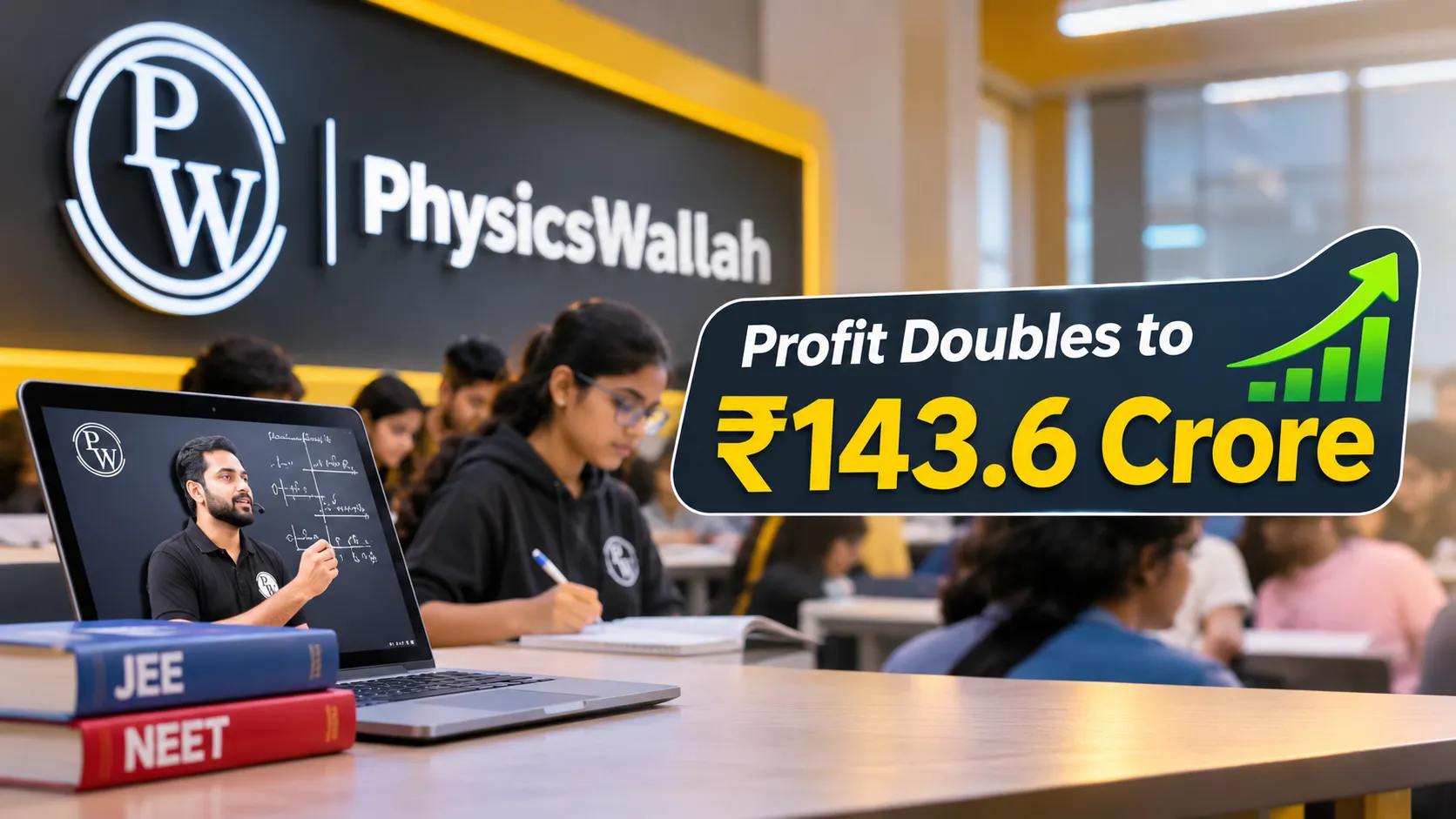
PhysicsWallah, the affordable test-preparation company founded by teacher Alakh Pandey, has more than doubled its quarterly profit. The result gives the company a strong second quarter in its first full year as a listed business.
The Noida-based company reported on Wednesday, November 4, that consolidated net profit for the quarter ended September 30, 2026 rose to ₹143.6 crore, compared with ₹69.7 crore a year earlier. Revenue from operations grew 18.2% to ₹1,242.3 crore.
Total expenses rose 10.6% to ₹1,105.4 crore. The gap between revenue growth and cost growth was the main driver of the profit increase, showing that the company is keeping a tighter grip on spending than it did in its rapid-expansion phase.
A swing back from the June quarter
The September quarter also marks a sharp turnaround from the previous three months. In the June quarter, PhysicsWallah reported a net loss of ₹88.3 crore on revenue of about ₹1,054 crore.
Seasonality explains part of that swing. Test-preparation businesses in India tend to see uneven revenue and costs through the year, driven by the timing of admissions, course launches and the major entrance examinations such as JEE for engineering and NEET for medicine. Costs for new batches and centres are often front-loaded, while revenue is recognised over the course of each programme.
Even allowing for seasonality, the September-quarter result shows that the company can generate meaningful profit when its programmes are running at scale.
Strong full-year foundations
PhysicsWallah's full-year numbers give context to the quarter. In FY26 the company reported revenue of about ₹3,900 crore, up roughly 35% on the previous year.
Management has guided for revenue growth of more than 30% in FY27 and for the company to be profitable at the net level for the full year. The September quarter's profit, which more than offsets the June-quarter loss, puts it on track for that goal. Investors will judge the second half of the year on whether that can be sustained.
From YouTube channel to listed company
PhysicsWallah's story is one of the most distinctive in Indian startups. Alakh Pandey began teaching physics on YouTube in 2016, offering free lessons for students preparing for competitive examinations. His direct, informal teaching style attracted millions of subscribers, many from smaller towns and lower-income families who could not afford the fees charged by established coaching institutes.
In 2020, Pandey and co-founder Prateek Maheshwari turned the channel into a company. They launched paid courses priced far below the market, sometimes at a fraction of what traditional coaching centres charged. The low-price model, combined with Pandey's following, allowed PhysicsWallah to grow quickly while many venture-funded edtech rivals struggled.
The company became a unicorn in 2022 when it raised funding from investors including Westbridge Capital and GSV Ventures. Its listing in November 2025 raised about ₹3,480 crore and was one of the highest-profile education IPOs in India.
Surviving the edtech downturn
PhysicsWallah's results stand in contrast to the troubles of the wider Indian edtech sector. After the pandemic-era boom, when online learning surged as schools closed, many edtech companies cut jobs, scaled back or collapsed as students returned to physical classrooms.
PhysicsWallah took a different path. Instead of staying purely online, it opened physical and hybrid centres, branded Vidyapeeth and Pathshala, in cities across India. This allowed it to serve students who preferred in-person learning while keeping fees low. The hybrid model has become a core part of its business and a key driver of its revenue growth.
The company's focus on affordability also helped. With fees far lower than established competitors, its value proposition held up even as households became more careful about spending on education.
Cost discipline is the story of the quarter
The headline profit is impressive, but the most important figure in the results may be the 10.6% rise in expenses against 18.2% revenue growth.
Edtech companies have often struggled to show operating leverage. Expanding into new cities, hiring teachers and spending on marketing can easily push costs up faster than revenue. PhysicsWallah's ability to hold cost growth well below sales growth suggests that its centres are becoming more productive and that its online and offline offerings are sharing resources effectively.
Teacher costs are among the largest items for any education company. PhysicsWallah's model relies on popular teachers who can serve very large numbers of students, both online and in centres. That allows the company to spread its teaching costs over a large student base, which helps keep fees low while protecting margins.
Why affordable education matters
For The Impactful Global Indian's readers, PhysicsWallah's results carry an impact dimension as well as a financial one. India's competitive examinations decide admission to its most sought-after engineering and medical colleges. For decades, success in these exams was strongly linked to access to expensive coaching, which put students from poorer families at a disadvantage.
PhysicsWallah's model has helped widen access to quality test preparation for students in smaller towns and lower-income households. A profitable, scaled business built on low fees suggests that affordability and commercial success do not have to be in conflict.
The company has also expanded into other areas, including preparation for government jobs, school-level tutoring and courses in regional languages. These are intended to widen its addressable market beyond the engineering and medical exam segments where it first built its reputation.
What investors will watch
The coming quarters will test whether PhysicsWallah can meet its guidance for full-year profitability and more than 30% revenue growth. Analysts will watch enrolment numbers, the pace at which new centres are opened, and how fees evolve as the company expands into new categories.
Competition remains intense. Established coaching institutes, rival edtech platforms and new hybrid entrants are all competing for the same pool of students. PhysicsWallah's brand recognition, scale and pricing give it advantages, but sustaining growth will require continued investment in teachers, technology and centres.
Regulation is another factor. Indian authorities have introduced guidelines for coaching centres in recent years, covering areas such as minimum student ages, fees and student welfare. Compliance with those rules will shape how the company runs its physical network.
A model for mission-driven companies
Pandey has often said his aim is to make quality education affordable for every student in India. The company's growth, from a single YouTube channel to a listed business with more than ₹1,200 crore in quarterly revenue, shows how a mission-driven founder can build a large company in a market long dominated by incumbents.
For international investors watching India's new-age listings, PhysicsWallah's September quarter strengthens the argument that Indian consumer-technology companies can combine scale, social impact and profitability.
The company's first year as a listed business has had its ups and downs, including a loss-making June quarter. But the latest numbers suggest that the core engine of affordable, teacher-led learning is producing sustainable profits. For India's millions of exam aspirants and the investors who backed Pandey's vision, that is an important milestone.