ImpactSustainability5 MIN READ

Prime Minute Emerges With $15 Million to Win the 'First Hour' Against Wildfires With AI and Aerial Suppression

Palo Alto-based Prime Minute has emerged from stealth with a $15 million pre-seed round led by Eclipse, with 8VC participating, to build an integrated system combining AI mission analysis with precision aerial suppression for early wildfire response.

By Aravind Kumar · Author25 September 2026New
Prime Minute Emerges With $15 Million to Win the 'First Hour' Against Wildfires With AI and Aerial Suppression

When a wildfire starts, the first hour often decides whether it becomes a small, contained blaze or a disaster that destroys homes, infrastructure and lives. A new American company has raised an unusually large early-stage round to try to win that first hour more often.

Prime Minute, based in Palo Alto, California, emerged from stealth on Thursday, September 24, with a $15 million pre-seed funding round led by Eclipse, with participation from 8VC, according to the company's announcement.

The company describes its mission as strengthening infrastructure resilience against natural disasters and positions itself as "the first company to build a global resilience prime" — borrowing the defence-industry term for a prime contractor that delivers complete, integrated systems rather than individual components.

The first-hour problem

Wildfires are becoming more frequent and more destructive in many parts of the world, driven by hotter temperatures, longer dry seasons and the expansion of homes and infrastructure into fire-prone areas. According to figures cited by Prime Minute, wildfires cause about $424 billion in damage in the United States each year.

The key to limiting that damage is speed. Firefighters talk about "initial attack" — the first response to a newly reported fire. If crews and aircraft can reach a fire quickly and contain it while it is small, the chances of stopping it are high. If the response is delayed, a fire can grow beyond control within hours, especially in strong winds.

Yet initial attack faces many obstacles. Fires often start in remote areas that are hard for ground crews to reach. Aircraft may not be able to fly at night, in high winds or in poor visibility. And coordinating detection, dispatch and suppression across multiple agencies takes time.

"The first hour of an incident often determines its ultimate impact," said Gabe Sganga, Prime Minute's co-founder and chief growth officer. "Prime Minute was built to close that gap."

What Prime Minute is building

Prime Minute is developing an integrated disaster-response system that combines real-time intelligence, AI-assisted mission analysis and a precision aerial suppression system for wildfires, according to its announcement.

The company says its system is designed to operate in conditions where current approaches struggle: high winds, night-time, degraded visual conditions and areas inaccessible to ground crews. It aims to integrate detection, coordination and suppression into a single system, rather than relying on separate tools operated by different organisations.

The initial focus is rapid wildfire initial attack — reaching and suppressing fires before they escalate.

The team

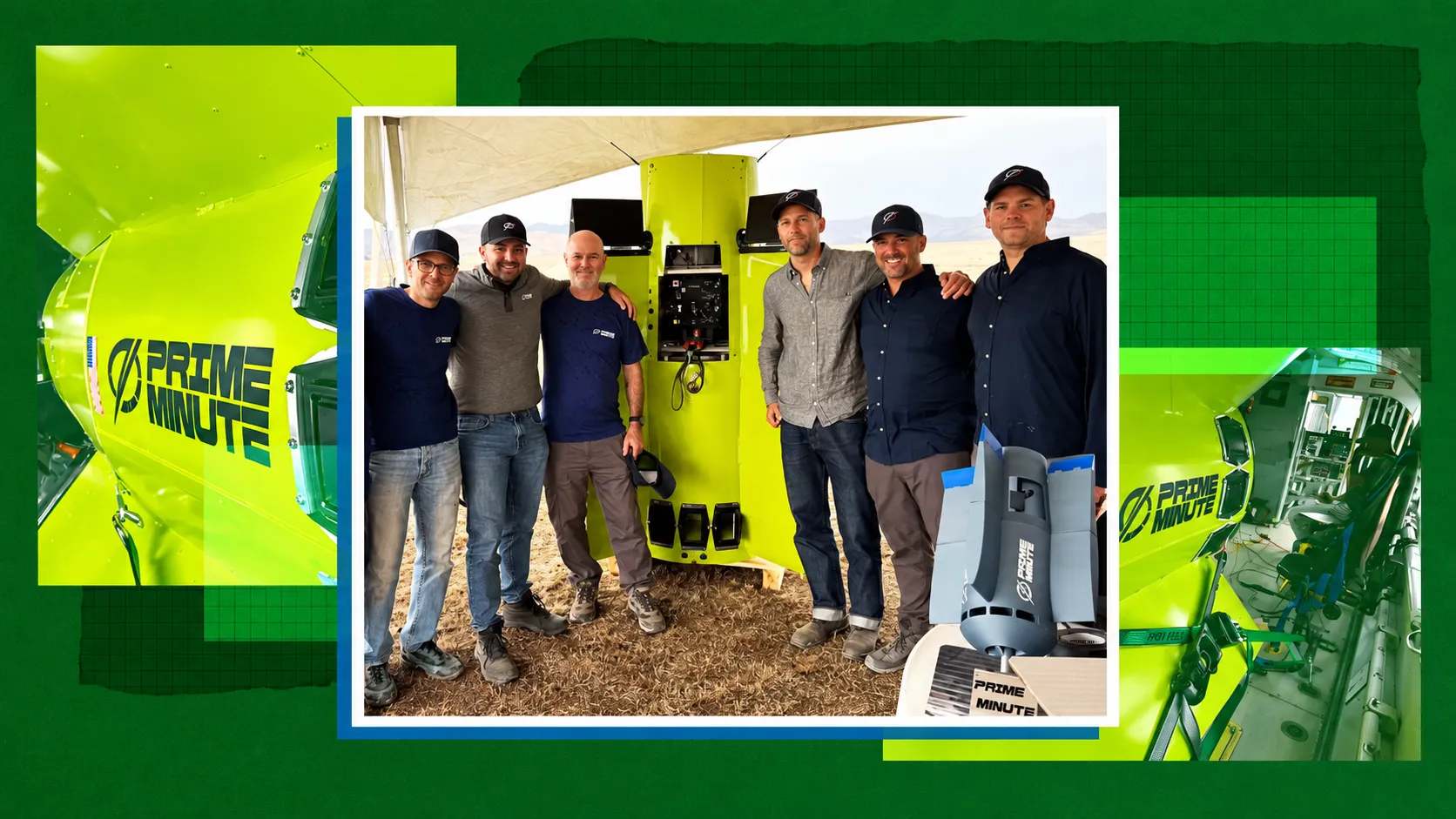
Prime Minute's team includes former operators from organisations such as Palantir, the data analytics company known for its work with governments and defence agencies; Forterra, which develops autonomous systems for defence and industrial use; and Datorios, according to the announcement.

That mix of software, autonomy and operational experience reflects the complexity of the problem. Building a system that works in real emergencies requires not only advanced technology but also an understanding of how emergency agencies operate and make decisions under pressure.

Why a $15 million pre-seed

A $15 million pre-seed round is large by most standards. Many software start-ups raise a fraction of that amount at the same stage. But Prime Minute is not building only software.

“The first hour of an incident often determines its ultimate impact. Prime Minute was built to close that gap.”
— Gabe Sganga, Co-founder & Chief Growth Officer, Prime Minute

The company must integrate sensing, mission software, aerial systems and manufacturing, and test them in real-world conditions. That requires significant capital from the start. According to TechStartups, the funding will be used for product development, domestic manufacturing, hiring, testing and validation.

Eclipse, which led the round, is known for investing in companies that apply technology to physical industries such as manufacturing, logistics, energy and defence. 8VC, co-founded by Palantir co-founder Joe Lonsdale, has backed a number of companies working on government and defence technology.

Their involvement suggests that investors see disaster response as an emerging category with similarities to defence technology, where public-sector customers can support large companies when software and hardware are designed together.

Working with Colorado

Prime Minute is working with the State of Colorado on field evaluations of its wildfire suppression capabilities and plans to deploy a prototype with the state later in 2026.

Colorado has experienced some of the most destructive wildfires in its history in recent years, including the Marshall Fire in late 2021, which destroyed more than a thousand homes near Boulder. The state has invested in new firefighting technologies, including aerial capabilities, to improve its response.

A partnership with a state government provides a crucial proving ground. Emergency services must be confident that new systems are reliable and safe before adopting them, and field evaluations with real agencies are an essential step.

ChatGPT Image Sep 25, 2026, 12_19_39 PM.png

The challenges ahead

Prime Minute faces significant challenges. Developing aerial systems that can operate safely in extreme conditions is technically demanding, and aviation is heavily regulated. Any system that operates near people and property must meet strict safety standards.

Public-sector procurement can also be slow and complex, and emergency agencies often have limited budgets. The company will need to show not only that its technology works but also that it offers good value compared with existing firefighting resources.

Reliability will be paramount. In emergency response, a system that fails at a critical moment could have serious consequences. Field performance, rather than demonstrations, will ultimately determine the company's success.

A global challenge

Wildfires are not only an American problem. Countries from Canada and Australia to Greece, Turkey and Brazil have faced devastating fire seasons in recent years. India, too, experiences thousands of forest fires every year, particularly in the Himalayan states such as Uttarakhand and Himachal Pradesh, where fires threaten forests, wildlife and communities.

As climate change intensifies extreme weather, the need for faster, more effective disaster response is growing worldwide. Climate adaptation — preparing for and responding to the impacts of a warming world — is becoming an increasingly important area of investment alongside efforts to reduce emissions.

Prime Minute's emergence reflects that shift. By applying AI, autonomy and aerial technology to one of the most urgent adaptation challenges, the company is betting that the first hour of a disaster can be won more often. If it succeeds, the impact could be measured not only in dollars saved but in homes, forests and lives protected.

TagsPrime MinuteWildfiresDisaster ResponseClimate AdaptationResilienceEclipse8VCPre-SeedClimate TechAutonomous SystemsColoradoAI

Reader reviews

Sign in to rate and review this article.
Loading reviews…