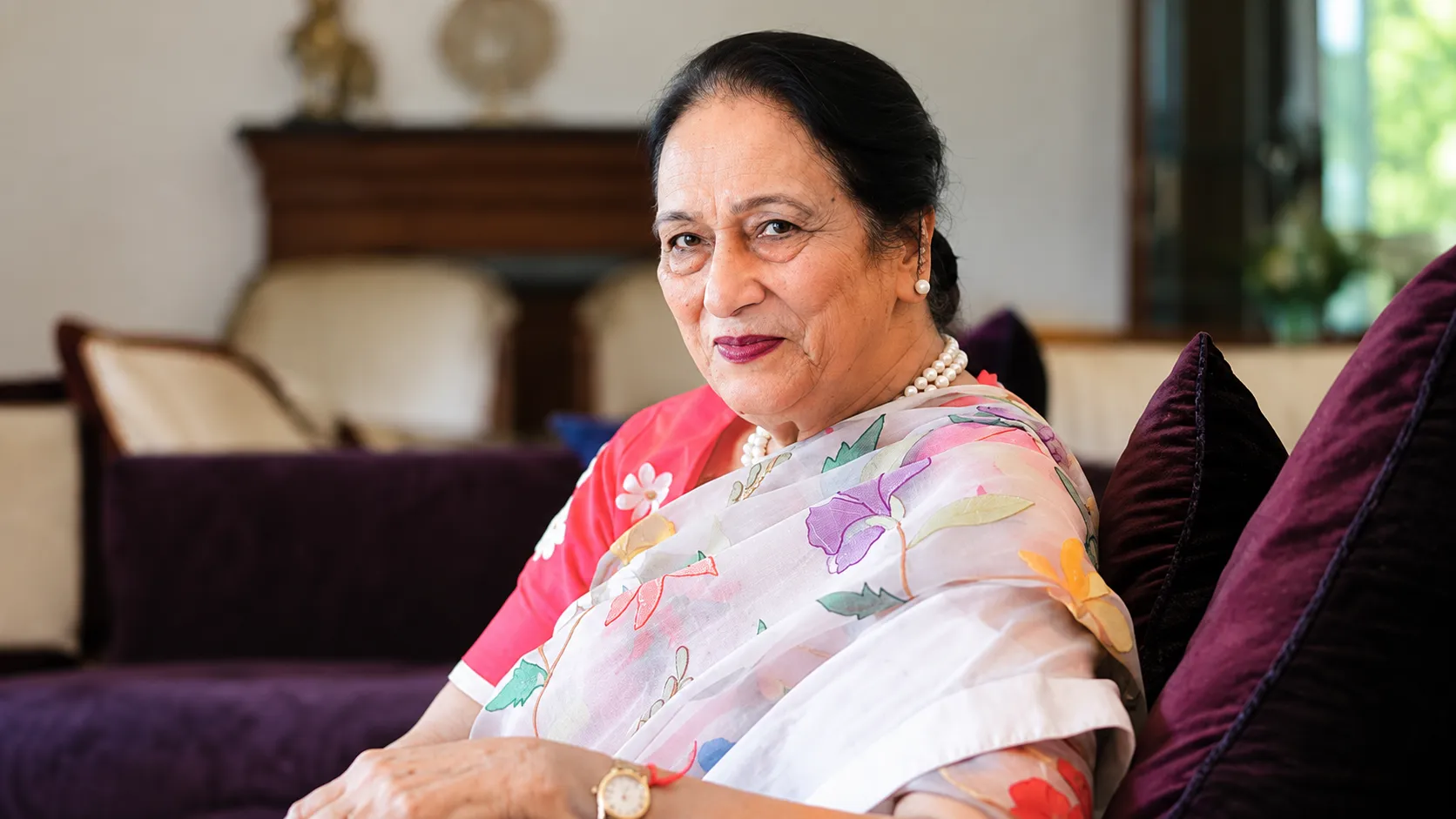
At 86, Rajni Bector is the oldest name on the 2026 Candere Hurun India Women Leaders List, topping its 'Heartland Founders' category — a distinction that, on paper, understates the scale of what she built. Bector is the founder of Mrs. Bector's Food Specialities Limited and the wider Cremica Group of Companies, a publicly listed Indian food business whose brands, including Cremica and English Oven, now supply bakery products, biscuits and condiments to quick-service restaurant chains, Indian Railways and retail shelves across the country. The company's market capitalisation has, at various points, been estimated in the range of ₹6,600 to ₹7,000 crore. It began, in 1978, with an investment of ₹20,000 and a small ice-cream manufacturing unit set up in the backyard of her home in Ludhiana.
Bector's story begins, as it does for so many entrepreneurs of her generation, with the trauma of Partition. Born in Karachi in 1940 into a comfortable family, she spent her early childhood in Lahore before the events of 1947 forced her family to flee to Delhi, reportedly enduring a week-long wait at a train station in scorching heat before securing passage. She completed her schooling in Delhi and, at seventeen, was married into a business family in Ludhiana, Punjab — a marriage that, in the social conventions of the era, might easily have confined her entirely to domestic life.
For roughly two decades after her marriage, that is largely what happened. Bector raised her three sons and, once they were older, took up local social work projects, but by her own account she remained unfulfilled by that role alone. In her late thirties, with time on her hands, she enrolled in a baking course purely out of interest and began selling her creations locally — a hobby that, almost by accident, revealed both a genuine talent and a latent business opportunity. Her husband, Dharamvir Bector, recognising the commercial potential of what had started as a domestic pastime, encouraged her to formalise the venture and helped select the brand name that would eventually appear on packaging across India: Cremica.
In 1978, with an investment of ₹20,000, Bector set up a small ice-cream manufacturing unit in her home's backyard. The venture grew steadily through the 1980s, diversifying from ice cream into breads and, eventually, biscuits — a progression driven as much by opportunistic partnerships as by deliberate strategy. The turning point came in 1995, when McDonald's entered the Indian market and sought local suppliers capable of producing buns and sauces to its specifications; Cremica secured the contract, a validation of quality and scale that opened doors to subsequent partnerships with Pizza Hut, Domino's, Papa John's, Burger King and Indian Railways. By 2006, the company's revenue had crossed ₹100 crore from what had been, less than three decades earlier, a backyard hobby business.

That growth was not without genuine peril. During the 1990s, as terrorism disrupted business across Punjab, the Bector family's operations — by then a business over a century old on her husband's side of the family — were directly affected, including a reported attempt to kidnap her eldest son, Ajay. Rather than retreat, Bector is described by those who have chronicled her career as having fought through the period with resolve, continuing to grow Cremica into what would become the family's principal business even as the broader security environment in Punjab remained fraught. That episode — a mother continuing to build a food manufacturing business through a period of serious personal and family risk — is frequently cited as the defining test of the resilience that has since become central to how Bector's story is told.