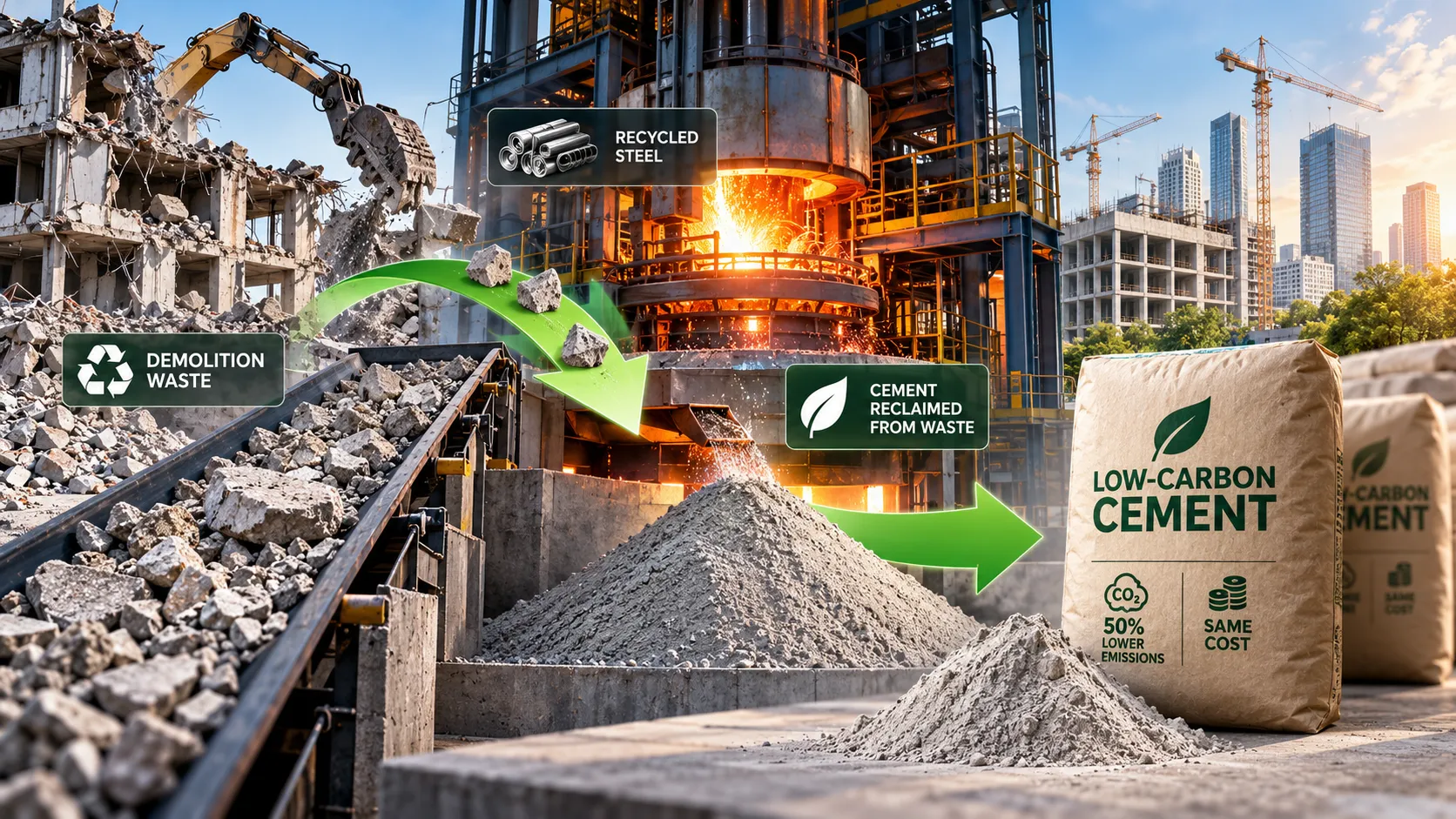
Reclinker, a start-up spun out of the University of Cambridge, has raised £10 million in a Series A round to scale a technology that turns the cement in demolished buildings back into fresh cement, using electric arc furnaces that already recycle scrap steel.
The round, announced on 5 October 2026, was co-led by the Clean Growth Fund and AP Ventures, with participation from the Development Bank of Wales, Kibo Invest, Zero Carbon Capital and Cambridge Enterprise, the university's commercialisation arm. Chief executive Bill Yost said the round was oversubscribed and argued that it showed UK investors are serious about decarbonisation.
The company says its process cuts the carbon emissions associated with cement by half at the same cost as conventional cement, with deeper reductions possible as the technology scales. The money will fund the move from industrial trials to full commercial production at a site in Cardiff, and support expansion to other steel plants in Europe and the United States.
Why cement is so hard to clean up
Cement is the glue of the modern world and one of its largest sources of greenhouse gases. Reclinker estimates that cement production accounts for about 7% of global carbon dioxide emissions, roughly three times the share attributed to aviation.
Most of those emissions come from making clinker, cement's key ingredient. Conventional production heats limestone and other materials in a kiln to around 1,450 degrees Celsius. The heat usually comes from burning fossil fuels, but the larger problem is chemical: when limestone is heated, it releases carbon dioxide as it turns into lime. Even a kiln powered entirely by clean energy would still emit those process emissions, which is why cement is regarded as one of the hardest industries to decarbonise.
Approaches under development include carbon capture at cement plants, alternative binders, new chemistries and blending clinker with substitute materials. Each faces challenges of cost, scale or acceptance in a conservative construction industry governed by strict standards.
A process born in a Cambridge lab
Reclinker's approach was developed by researchers at the University of Cambridge and described in a paper published in Nature in 2024. The method begins with construction and demolition waste. Old concrete contains cement paste that has already been through the kiln once. Reclinker recovers that paste and feeds it into electric arc furnaces that recycle scrap steel.
In steelmaking, materials known as fluxes are added to the furnace to remove impurities, forming a molten layer called slag. Reclinker's insight is that recovered cement paste can play that role. Inside the furnace, it is converted back into clinker-like material while the furnace continues to produce recycled steel. The result is two products from one process: new steel and the active ingredient for new cement, without a separate kiln, without quarried limestone and without fossil fuel heat.
Because the recovered material has already been calcined once, the chemical emissions released when limestone is heated are largely avoided. And because electric arc furnaces can run on renewable electricity, the process emissions can fall further as power grids decarbonise.
Proof at industrial scale
The company has already produced thousands of tonnes of its product at the Cardiff plant of 7 Steel UK, demonstrating that the process works in a real industrial setting rather than only in laboratory trials. It has also secured its first commercial sales.