
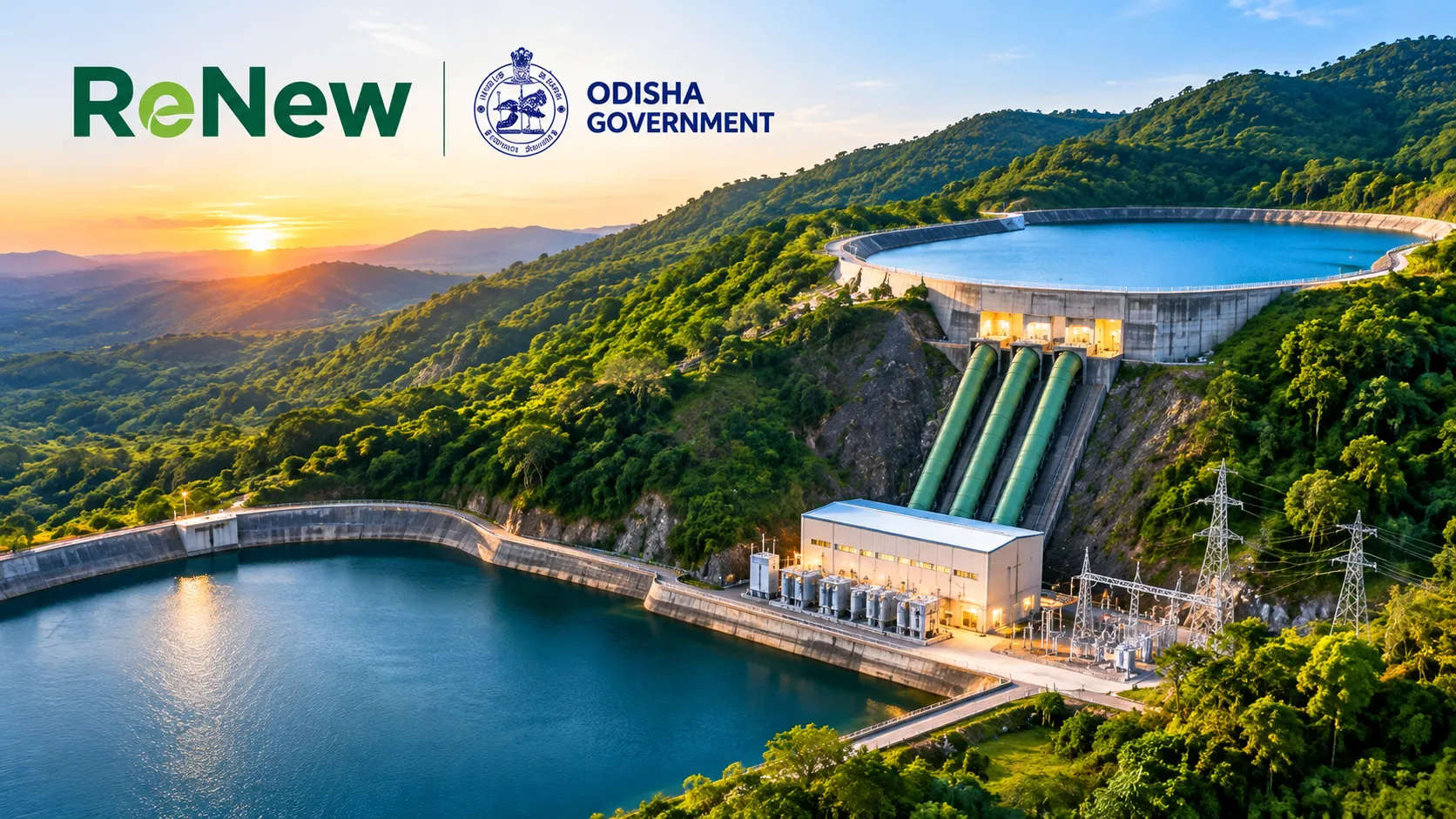
ReNew, one of India's largest renewable energy companies, has signed a memorandum of understanding with the Odisha government for a 1,500 MW pumped hydro storage project in the state's Ganjam district. The project carries an investment of about ₹9,000 crore.
The agreement, reported on November 3, is part of a larger commitment. ReNew expects to invest about ₹45,000 crore in Odisha in total. That would make the company one of the largest private investors in the eastern state's clean energy build-out.
The deal places storage, rather than generation alone, at the centre of India's energy transition. As the country adds solar and wind capacity at record pace, the ability to store power and deliver it when the sun is down or the wind is calm has become the critical bottleneck.
Why storage is now the priority
India has set an ambitious target of 500 GW of non-fossil fuel capacity by 2030, and it has been adding solar capacity at a rapid clip. But solar power peaks around midday, while electricity demand in India peaks in the evening, when households switch on lights, fans, air conditioners and appliances. Without storage, much of the clean power generated during the day can be wasted or "curtailed", and grid operators must lean on coal-fired plants to meet evening demand.
Energy storage bridges that gap. It absorbs surplus renewable power when it is abundant and cheap and releases it when demand and prices are high. India's power planners have repeatedly flagged storage as essential to integrating large volumes of renewable energy without compromising grid stability.
How pumped hydro works
Pumped storage hydropower is the oldest and still the largest form of grid-scale energy storage in the world. The concept is simple. A project uses two water reservoirs at different heights. When there is surplus electricity, the plant pumps water from the lower reservoir to the upper one, storing energy in the form of elevation. When power is needed, water is released downhill through turbines, generating electricity just like a conventional hydropower plant.
The technology has distinct advantages. Pumped storage plants can store large amounts of energy for many hours, typically six to eight hours or more, and have operating lives that can stretch for decades with relatively low degradation. They can also respond quickly to changes in grid demand, helping operators balance frequency and voltage.
The drawbacks are high upfront costs, long construction timelines and site-specific requirements. Projects need suitable terrain, water availability and environmental and land clearances, and they can face local opposition over displacement and ecological impacts. At about ₹6 crore per megawatt, ReNew's Ganjam project is consistent with the capital intensity typical of such schemes.
Batteries are the main alternative. Lithium-ion battery costs have fallen sharply, and India is deploying battery energy storage systems at growing scale. Batteries are faster to build and can be sited almost anywhere, but they are generally better suited to shorter durations and have shorter useful lives. Most energy planners see the two technologies as complementary rather than competing.
Odisha's clean energy push
Odisha is positioning itself as a major destination for clean energy investment. The state has abundant water resources and hilly terrain in several districts suitable for pumped storage, as well as industrial demand from its steel, aluminium and mining sectors.
ReNew's project follows a string of similar commitments. In February 2026, Odisha signed agreements worth about ₹67,000 crore for 6.8 GW of renewable energy projects. These included a 1,000 MW pumped storage project by NHPC and 800 MW of pumped storage by NEEPCO, along with solar, floating solar and other clean energy projects by companies such as BPCL. Welspun New Energy had earlier committed ₹13,500 crore to a 1,200 MW pumped hydro project and 1,000 MW of floating solar in the state. State-owned NHPC also signed an earlier pact with GRIDCO, the state power utility, to develop at least 2,000 MW of pumped storage and 1,000 MW of renewable energy.
Taken together, these deals suggest Odisha is emerging as one of India's leading hubs for pumped storage development, potentially supplying flexible clean power not only to its own industries but to the wider national grid.
ReNew's strategy
ReNew has grown into one of India's largest clean energy companies, with a portfolio spanning utility-scale solar and wind power, as well as manufacturing of solar modules and cells. Over the past few years, the company has increasingly focused on "round-the-clock" renewable power. These are projects that combine solar, wind and storage to deliver steady supply to industrial and utility customers who need power at all hours, not just when the sun is shining.
Pumped storage fits naturally into that strategy. Large-scale storage allows ReNew to bid for contracts that require firm, dispatchable power. It also positions the company to sell flexibility services to grid operators, a market expected to grow as renewable penetration increases.
From MoU to megawatts
As with any MoU, the critical question is execution. Memoranda of understanding signal intent but are not binding investment decisions, and India's pumped storage pipeline has historically moved slowly because of the complexity of land acquisition, environmental clearances, water allocation and the long construction periods involved.
The project's progress will depend on detailed feasibility studies, regulatory approvals, the availability of long-term offtake contracts and financing. Rehabilitation and community engagement in Ganjam will also be important. Large hydro-linked projects in India have at times faced sustained local resistance, and social licence is now as important as financial viability.
Why it matters
India's energy transition is entering a more demanding phase. Building solar and wind farms was the first chapter. The second is about making clean power reliable around the clock, which requires storage, transmission and smarter grid management.
ReNew's ₹9,000 crore commitment in Ganjam is a sign that private capital is beginning to flow into that second chapter at scale. If delivered, the 1,500 MW project would provide clean, flexible capacity for millions of households and industries, and reduce India's reliance on coal during peak demand hours.
For Odisha, which has long been associated with mineral wealth and heavy industry, the clean energy investment wave offers a chance to reinvent itself as a green power hub. For India, it is a test of whether ambitious climate targets can be matched by bricks, mortar and water on the ground.