ImpactSustainability5 MIN READ

Return Secures €835 Million in First-of-Its-Kind Financing to Build Battery Storage in Germany, Targeting 1 Gigawatt a Year

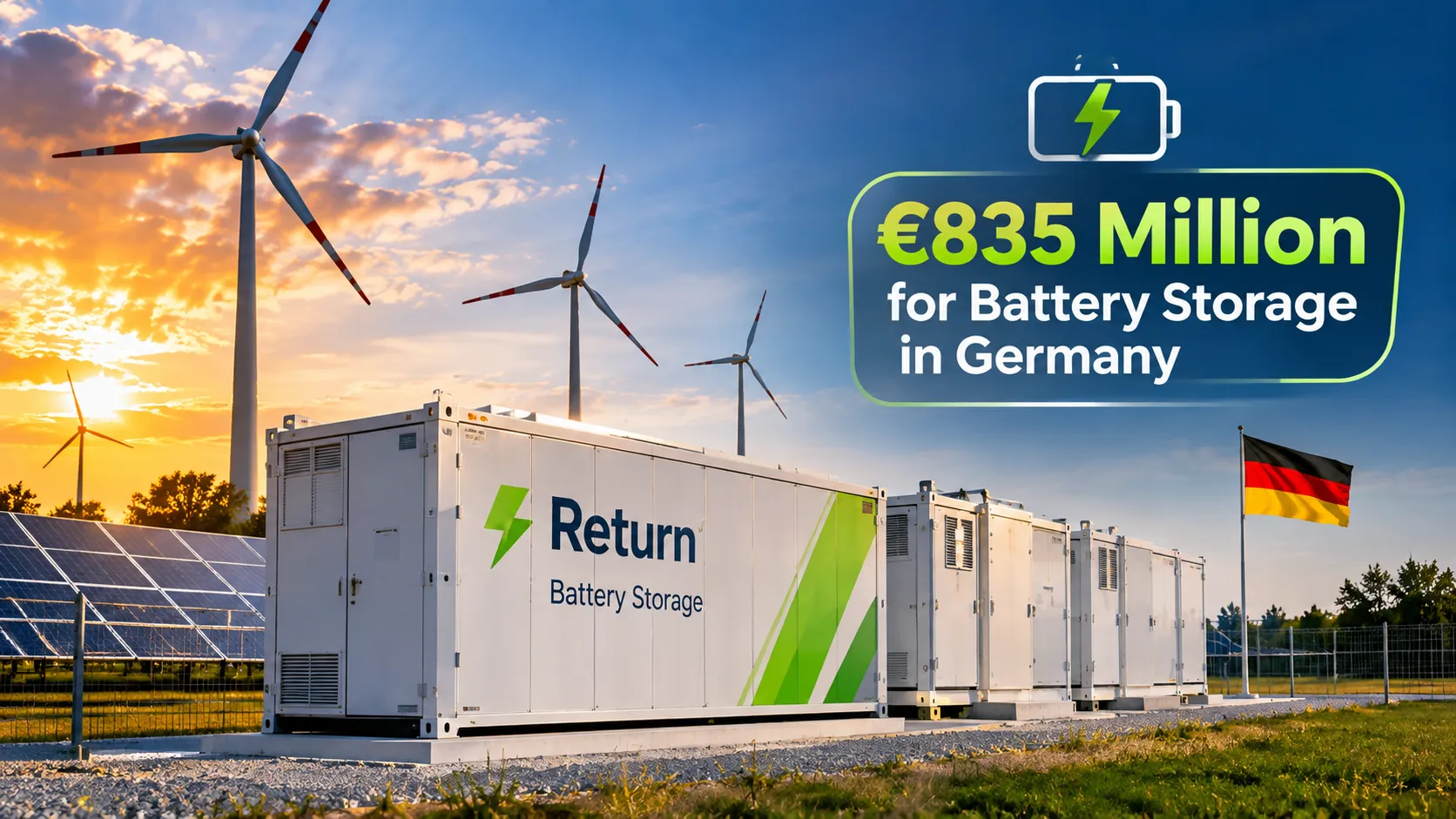
Dutch-founded energy storage company Return has secured €835 million in portfolio financing underwritten by Deutsche Bank and Rabobank to build large-scale battery storage in Germany, it said on November 5. The facility combines physical batteries with a virtual flexibility portfolio, and Return aims to install at least 1 gigawatt of storage in Germany each year from 2027.

By Prathista Lazar · Author6 November 2026New
Return Secures €835 Million in First-of-Its-Kind Financing to Build Battery Storage in Germany, Targeting 1 Gigawatt a Year

As Europe's largest economy leans ever more heavily on wind and solar power, the race to build the batteries that keep the grid stable is attracting serious money from banks.

Return, an energy storage company with offices in Amsterdam and Berlin, has secured €835 million in portfolio financing to build large-scale battery storage in Germany, the company announced on Thursday, November 5. Deutsche Bank and Rabobank underwrote the financing, with Rabobank also acting as financial adviser.

The company described the deal as a "first of its kind" financing that covers multiple facilities, according to its announcement. It aims to install at least 1 gigawatt of battery storage in Germany every year from 2027, implying planned annual investment of €750 million to €1.2 billion, subject to market conditions.

How the financing works

The financing combines funding for physical battery storage assets with Return's Virtual Flexibility Portfolio, which pools capacity from multiple battery projects into a single portfolio that customers can access through one interface.

Under the framework, eligible new projects can access capital without going through a separate financing process for each site, which can save time and costs. Return used a similar multi-project approach in the Netherlands, where its Sirius project reached financial close earlier this year.

The initial portfolio covers 117 megawatts across three German battery projects that are already under construction. More projects are expected to join the facility in the near future and during 2027.

Assuming four-hour batteries cycling twice a day, the facilities could discharge roughly as much electricity each year as about 100,000 German households use, according to Return.

Why Germany needs batteries

Germany's electricity system increasingly relies on wind and solar power, which produce electricity only when the wind blows and the sun shines. This creates large fluctuations in supply, with surpluses on sunny, windy days and shortages at other times. Batteries can store surplus electricity and release it when it is needed, helping to balance the grid, reduce prices and avoid curtailing renewable generation.

"Germany needs more flexible capacity as wind and solar generation grows," said Marc Schmitz, head of project finance Europe at Rabobank, according to Return. Dominik Thumfart, head of infrastructure and energy origination at Deutsche Bank, said that "Battery storage plays a crucial role in Germany's energy transition."

Scaling the financing

Return's chief financial officer, Daniel Witvoet, said the company needs to scale not only its battery capacity but also the way it finances it. "We need to scale not just our battery storage capacity," he said, according to the company's announcement, describing the new framework as a way to finance growth more efficiently.

Project finance for battery storage has historically been more difficult than for wind and solar farms, because battery revenues are less predictable. Batteries earn money by trading electricity, providing grid balancing services and through capacity contracts, and these revenues can fluctuate. Portfolio financing, which spreads risk across multiple projects and contracts, can make lenders more comfortable.

Commercial partners

Return has secured significant commercial agreements that provide revenue certainty. ENGIE expanded its partnership with Return in Germany to 400 megawatts of contracted battery flexibility, and Centrica Energy signed a separate 100 megawatt agreement, according to Return. The company also works with Vattenfall, Essent and Eneco in other European markets.

“Germany needs more flexible capacity as wind and solar generation grows.”
— Marc Schmitz, Head of Project Finance Europe, Rabobank

These agreements, in which energy companies pay for access to battery capacity, provide predictable income that supports the financing.

Advisers

The deal involved a large group of advisers, according to Return. Hogan Lovells and Cadwalader advised the borrowers, and White & Case advised the lenders on legal matters. Baker McKenzie conducted project due diligence, Baringa provided commercial advice, DNV technical advice, EY and EY-Parthenon tax structuring and modelling, and Marsh insurance advice.

Europe's storage boom

Battery storage is one of the fastest-growing segments of Europe's energy market. Falling battery costs, rising renewable generation and volatile electricity prices have made storage increasingly attractive to investors. Germany, the United Kingdom, Italy and the Netherlands are among the most active markets.

The energy crisis that followed Russia's invasion of Ukraine, and this year's energy price spike linked to the conflict involving Iran, have reinforced Europe's focus on energy security and on reducing dependence on imported fossil fuels, further boosting investment in renewables and storage.

Lessons for India

India is also scaling up battery storage rapidly to support its target of 500 gigawatts of non-fossil fuel capacity by 2030. The government has launched viability gap funding for battery storage projects and has required some renewable projects to include storage. Tenders for standalone battery storage and solar-plus-storage projects have grown sharply, and Indian companies are building battery manufacturing capacity.

Financing innovations such as Return's portfolio approach could be relevant for India, where developers are seeking efficient ways to finance large numbers of storage projects.

Batteries and electricity prices

Battery storage can help reduce electricity price volatility by storing power when prices are low, often when renewable generation is high, and releasing it when prices are high. In Germany, electricity prices sometimes turn negative on sunny, windy days, when renewable output exceeds demand, while spiking at other times. Batteries can earn revenue by trading on these price differences while helping to stabilise the market.

As more batteries are built, they are expected to smooth out price swings, benefiting consumers and reducing the need for gas-fired power plants to balance the grid.

4300e769-bd98-41ab-9d7c-1efb60eb6828.png

A growing company

Return has grown rapidly by combining project development, financing and energy trading capabilities. Its model of offering contracted battery flexibility to large energy companies such as ENGIE and Centrica provides predictable revenue, while its virtual flexibility portfolio allows customers to access capacity from multiple projects without managing individual assets.

The scale of the financing also signals growing confidence among banks in the business model for battery storage. As lenders gain experience with storage projects and their revenue streams, financing terms are expected to improve, lowering the cost of capital and accelerating deployment across Europe.

What comes next

Return will add more projects to its German portfolio and work towards its target of 1 gigawatt of new storage each year from 2027. Its progress will be watched as a test of whether innovative financing structures can accelerate the deployment of the battery storage Europe needs to complete its energy transition.

TagsReturnbattery storageBESSenergy storageGermanyDeutsche BankRabobankrenewable energyenergy transitiongrid flexibilityENGIECentricawind and solarproject financesustainabilityclimate financeNetherlandsclean energyIndia battery storageinvestors

Reader reviews

Sign in to rate and review this article.
Loading reviews…

