WomenProfiles6 MIN READ

From Personal Savings to a Sustainability Startup: How Sarika Pathak Kulkarni Built Cresa With Her Father

Sarika Pathak Kulkarni left a career abroad to co-found Cresa, a biodegradable sanitary-pad startup, with her father Mohan Kulkarni, funding the company's earliest years through personal savings and a patchwork of government and CSR grants including a dedicated women-entrepreneurship scheme.

By Nisha Omkumar · Author12 August 2026New
From Personal Savings to a Sustainability Startup: How Sarika Pathak Kulkarni Built Cresa With Her Father

Before Cresa became a company built around a hot-water-soluble sanitary pad, it was a mechanical engineering problem that Sarika Pathak Kulkarni carried home from a career spent designing crankshaft mechanisms, air-cooling systems and water purifiers for some of India's and America's best-known industrial names. A Mechanical Engineer with a Master's degree in Industrial Design, Pathak Kulkarni had already built a track record solving real-world engineering problems for companies including Wheels India, Emerson, Mahindra Hinoday and Acquafine Corporation in the US before she turned that same design instinct toward a far more personal and, in India, largely unaddressed problem: what happens to a sanitary pad after it is used.

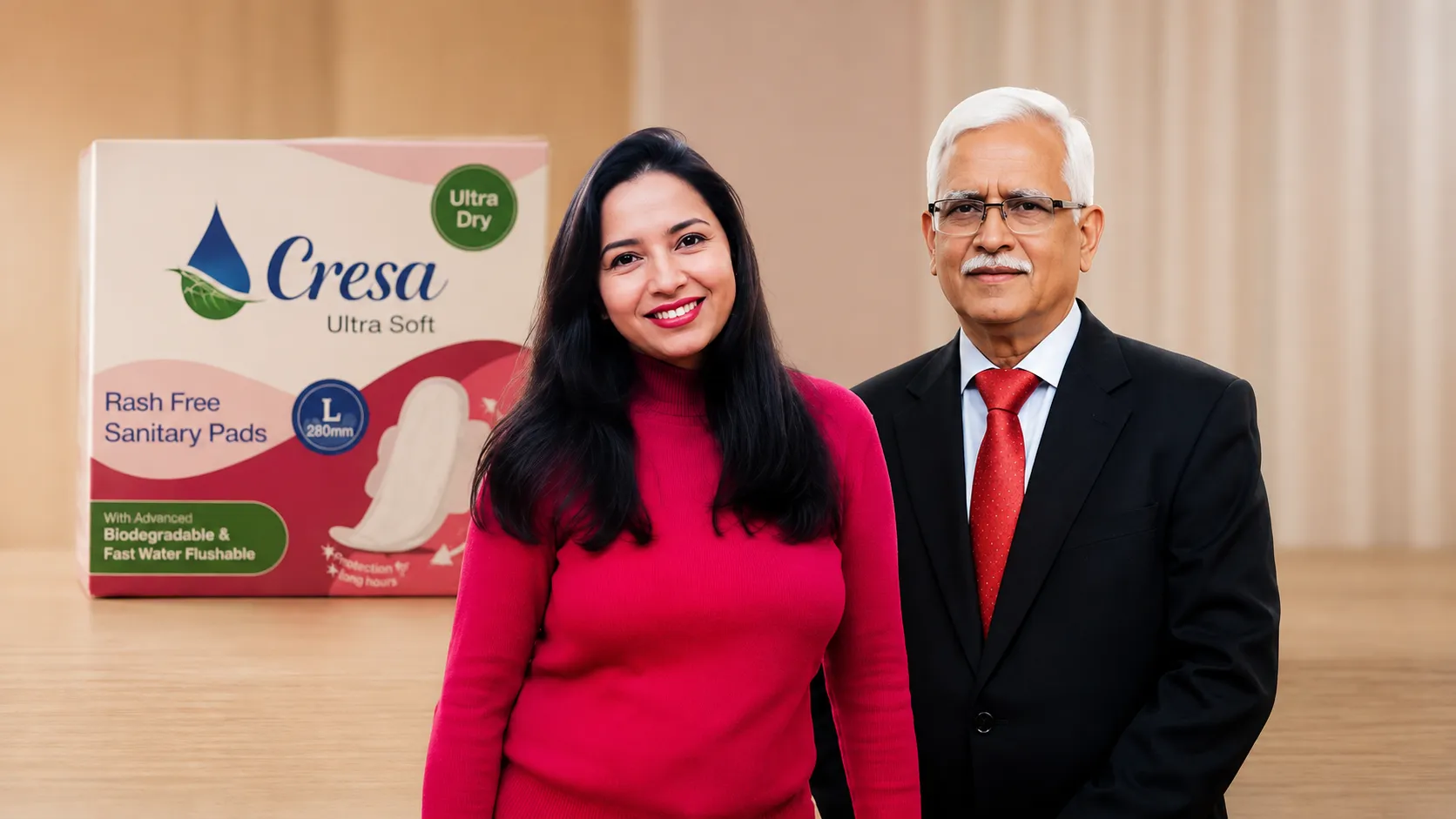
In 2021, Pathak Kulkarni co-founded Cresa, short for Creative Sanitation, together with her father Mohan Kulkarni, setting out to redesign the sanitary pad from the inside out rather than incrementally improving existing plastic-based products. The company's flagship innovation, a pad certified 100 per cent biodegradable, plastic-free and chemical-free, dissolves in hot water in roughly 80 seconds and breaks down completely within a month once flushed, addressing not only landfill waste but the stigma and physical burden that conventional pad disposal places on both users and the sanitation workers who ultimately handle discarded products.

The company's earliest capital came not from venture investors but from the founders themselves. Pathak Kulkarni funded Cresa's initial development using savings accumulated during her years working in the United States, with her father matching that investment, a bootstrapped foundation that reflects a pattern common among first-generation Indian women entrepreneurs building in categories, deep-tech manufacturing and sustainability-focused hardware, that traditional venture capital has historically underfunded relative to software and consumer internet businesses.

From that self-funded base, Cresa built a track record of securing a sequence of milestone-based government and CSR grants that speaks to both the credibility of the underlying technology and the growing, if still fragmented, ecosystem of support available to women-led deep-tech ventures in India. The company received Rs 7 lakh from the Dana Care Foundation's CSR programme in December 2021, Rs 8 lakh under Nidhi Prayas through COEP's Bhau Institute in March 2022, Rs 15 lakh through the Startup India Seed Fund in September 2022, Rs 18 lakh from HDFC's Smart Parivartan programme in April 2023, a further Rs 25 lakh Startup India Seed Fund tranche facilitated through SINE at IIT Bombay in October 2023, and, notably, Rs 5 lakh under the Ahilyadevi Holkar Women Startup Scheme in March 2025, a Maharashtra state government initiative specifically designed to support women entrepreneurs.
ChatGPT Image Aug 12, 2026, 02_57_09 PM.png

That last grant is particularly significant within the broader context of India's women-entrepreneurship policy landscape. Government data presented in the Lok Sabha earlier this year showed that of India's more than 2,12,000 DPIIT-recognised startups, over 1,02,000, nearly half, have at least one woman director or partner, while dedicated instruments including the SIDBI-administered Fund of Funds for Startups have channelled nearly Rs 2,995 crore into women-led ventures since 2020, and the Startup India Seed Fund Scheme has directed roughly Rs 294 crore of its total approved funding specifically to women-led startups. Cresa's grant trajectory, drawing on national schemes, IIT Bombay's incubation infrastructure and a Maharashtra state-specific women's entrepreneurship fund in sequence, illustrates how a founder with strong technical credentials but no initial institutional VC backing can still assemble meaningful, if incremental, non-dilutive capital across a multi-year runway.

We can't compete with plastic rates, but can offer a competitive range to the compostable or biodegradable pad in the market.
Sarika Pathak Kulkarni, Co-founder, Cresa

With that grant-supported foundation now in place, Pathak Kulkarni and Cresa are working to convert years of product validation and government backing into a more commercially scaled business, actively seeking investors and channel partners to support the launch of a fully water-soluble version of the pad and to bring down production costs closer to conventional plastic-based alternatives. "We can't compete with plastic rates, but can offer a competitive range to the compostable or biodegradable pad in the market," Pathak Kulkarni has said, a characteristically pragmatic framing from a founder whose engineering background has consistently favoured solvable, incremental problems over sweeping claims.

The father-daughter co-founding structure at Cresa also stands out within India's broader startup landscape, where most founding teams are built among peers, former colleagues or classmates rather than across generations within a single family. Mohan Kulkarni's role alongside his daughter reflects a specific, if less commonly documented, model of Indian family entrepreneurship in which an older generation's financial resources and life experience combine with a younger founder's more recent technical training and market fluency, a structure that offered Cresa both patient capital, since family investment typically carries none of the return-timeline pressure of institutional venture capital, and a level of trust and shared conviction in the underlying mission that can be difficult to replicate among founders without a pre-existing personal relationship.

For India's broader women-entrepreneurship ecosystem, Pathak Kulkarni's journey, from an engineer's personal savings account through a five-year sequence of government and CSR grants to a company now approaching institutional investors from a position of proven product and policy credibility, offers a working template for founders building in capital-intensive, deep-impact categories that mainstream venture capital has been slower to embrace than software. As India's network of women-focused entrepreneurship schemes, from national Startup India Seed Fund allocations to state-specific programmes such as Maharashtra's Ahilyadevi Holkar Women Startup Scheme, continues to mature, Pathak Kulkarni's ability to sequence funding from multiple distinct sources into a coherent multi-year runway offers a practical case study for other women founders navigating similarly fragmented, grant-dependent early-stage capital landscapes in sectors that institutional venture capital has yet to fully embrace.

Pathak Kulkarni's decision to return to India and redirect an engineering career built partly in the United States toward a distinctly local, socially rooted manufacturing problem also reflects a broader, increasingly visible pattern among Indian-origin professionals who spend early career years abroad before returning to found companies addressing needs specific to the Indian market. Unlike many reverse-migration founder stories centred on technology and software, however, Cresa's path runs through physical manufacturing, materials science and a public-health and dignity-focused mission that required years of grant-funded product development before the company could credibly approach commercial investors, a slower, more capital-patient trajectory that stands in deliberate contrast to the software-first playbooks that dominate discussion of Indian returnee entrepreneurship, and one that may prove instructive for other engineers considering similar deep-impact, hardware-intensive ventures.

TagsSarika Pathak KulkarniCresawomen entrepreneurshipPune startupsustainabilitymenstrual healthself-funded

Reader reviews

Sign in to rate and review this article.
Loading reviews…