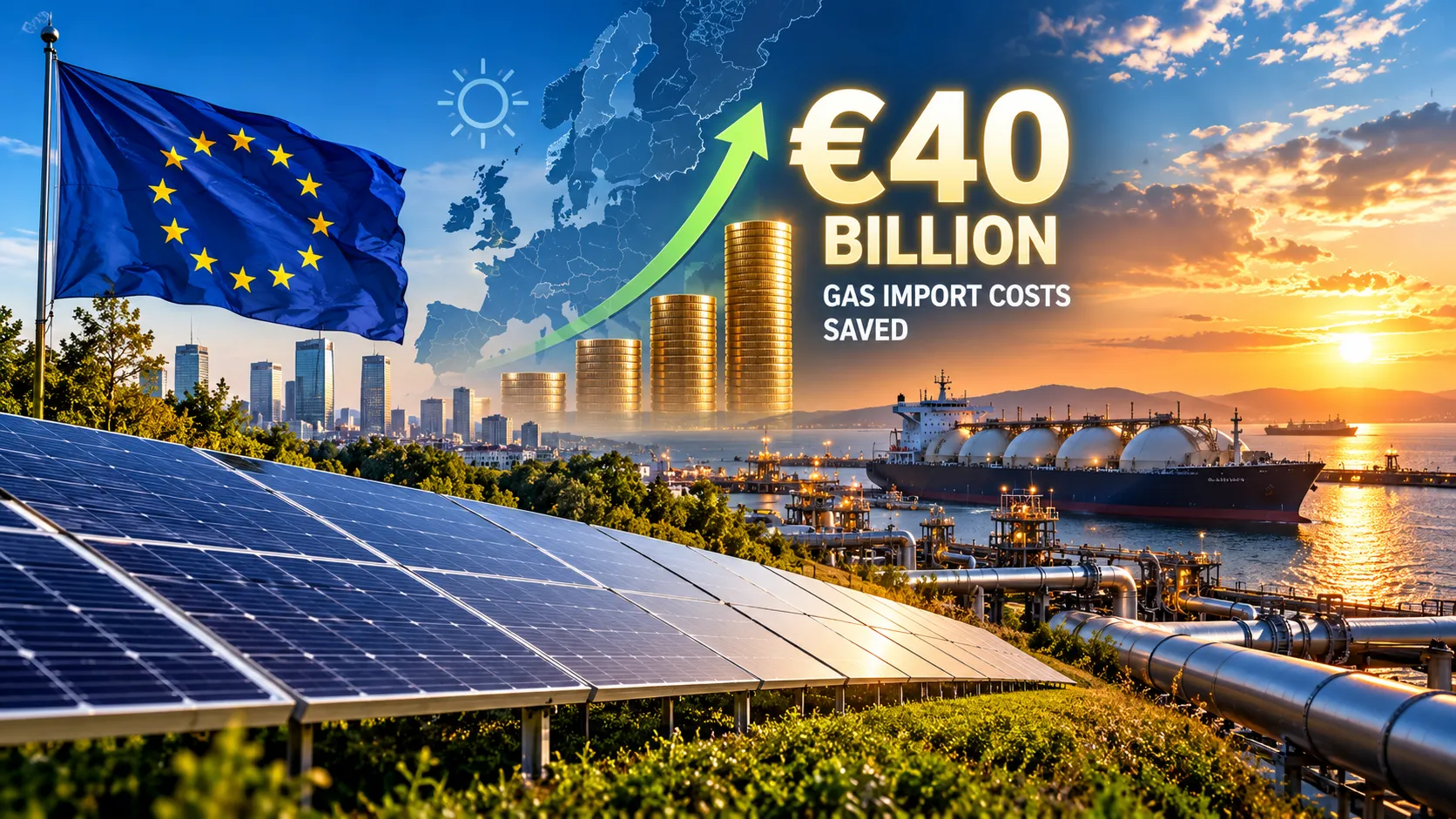
Solar power has saved the European Union more than €40 billion in gas import costs since the outbreak of the war involving Iran disrupted global energy markets, according to new analysis published by industry body SolarPower Europe on 15 October.
The trade association said solar generation across the bloc avoided more than €40 billion of gas imports between 1 March and 15 October 2026, by displacing gas-fired power that would otherwise have been needed to meet electricity demand.
The figure underscores how rapidly solar has become a pillar of Europe's energy security, and comes as the industry urges policymakers to accelerate measures that would further reduce the continent's exposure to volatile fossil fuel markets.
An Energy Shock, Again
The analysis covers a period marked by severe disruption to global gas markets. The conflict effectively closed the Strait of Hormuz, through which roughly one-fifth of the world's liquefied natural gas normally passes, sending prices sharply higher. The Dutch TTF benchmark, Europe's main gas price reference, rose from about €32 per megawatt-hour in late February to more than €72 by the end of September, according to Euronews.
For Europe, the shock revived memories of 2022, when Russia's invasion of Ukraine and the subsequent cut in Russian pipeline gas triggered an energy crisis that pushed electricity prices to record highs and forced governments to spend hundreds of billions of euros on support for households and businesses.
SolarPower Europe argues that Europe's exposure to fossil fuel price shocks is now recurring rather than exceptional, making a structural shift away from imported gas an economic necessity as well as a climate goal.
Solar's Growing Role
Solar has become a major part of Europe's electricity mix. In June 2026, it was the EU's largest single source of electricity, supplying 25 per cent of the bloc's power, according to earlier reporting on SolarPower Europe data. Solar accounted for 41.6 per cent of renewable electricity generation in the second quarter of 2026, up from 37 per cent a year earlier, according to Eurostat.
The savings figure has grown steadily as the year progressed. Earlier in October, SolarPower Europe estimated the savings at €37.4 billion; the latest analysis puts them above €40 billion.
"Every megawatt-hour generated by solar power reduces our dependence on imported fossil fuels and makes Europe safer," Walburga Hemetsberger, chief executive of SolarPower Europe, said in comments reported by Euronews earlier this month.
Gas Still Sets the Price
Despite solar's growth, gas continues to have an outsized influence on European electricity prices. In most European power markets, the most expensive generator needed to meet demand sets the price for all electricity, and that marginal generator is frequently a gas-fired plant.
Renewables supplied 54.1 per cent of EU electricity in the second quarter of 2026, broadly unchanged from a year earlier, while gas-fired generation rose 3.9 per cent. Analysts have noted that gas remains a significant share of generation even when renewables exceed half the mix.
The Industry's Prescription
SolarPower Europe is calling for an emergency EU package designed to deliver benefits within a year. Its proposals include expanding behind-the-meter electrification, solar generation and self-consumption by homes and businesses; accelerating the deployment of large-scale battery storage; reducing how often gas sets the electricity price; and allowing cheaper renewable power to meet peak demand.
Battery storage is central to that agenda. Solar generation peaks in the middle of the day, while demand often peaks in the evening. Storage allows solar power to be shifted to when it is most needed, displacing gas at the times it is most expensive.
Lessons for India
The European experience carries clear lessons for India, which imports most of its oil and a significant share of its gas, and which has also been exposed to the energy price shock from the conflict. India has set ambitious targets for renewable energy capacity and has become one of the world's largest solar markets.
Every unit of solar power generated in India can reduce the need for imported fuels, improve the country's trade balance and insulate consumers from global price spikes. India's push for battery storage, including viability gap funding for grid-scale projects, reflects the same logic that SolarPower Europe is urging on European policymakers.
Storage Becomes the Bottleneck
As solar penetration rises, Europe's challenge is shifting from generating clean power to using it efficiently. On sunny days, solar output in some markets now exceeds demand at midday, pushing wholesale prices to very low or even negative levels and leading to curtailment, where renewable output is wasted because the grid cannot absorb it. Meanwhile, prices often spike in the evening when solar output falls and gas plants are called upon.
Battery storage, both grid-scale and in homes and businesses, is the most direct solution to that mismatch. Investment in European battery storage has risen sharply, and operators have benefited from the price volatility that the energy crisis has created. SolarPower Europe's call for faster storage deployment reflects the industry's view that the next phase of the energy transition depends as much on flexibility as on new generation capacity.
The analysis also has implications for investors. Solar developers, battery storage operators and companies that provide grid flexibility have benefited from high and volatile energy prices, while energy-intensive industries have faced pressure on margins. If Europe follows SolarPower Europe's prescription and accelerates electrification and storage, demand for solar panels, inverters, batteries and grid equipment is likely to rise further, creating opportunities for manufacturers worldwide, including in India, which has expanded its solar manufacturing capacity significantly.
The Bigger Picture
The €40 billion figure is a powerful argument for renewable energy as an economic and security asset, not merely an environmental one. It also highlights a shift in the politics of the energy transition. Where the debate was once framed primarily around climate targets and costs, the repeated energy shocks of recent years have made energy independence a central rationale for clean energy.
For Europe, the challenge now is to move fast enough to reduce exposure before the next shock. For other energy-importing economies, including India, the lesson is the same: the cheapest and most secure energy is increasingly the energy that does not have to be imported.