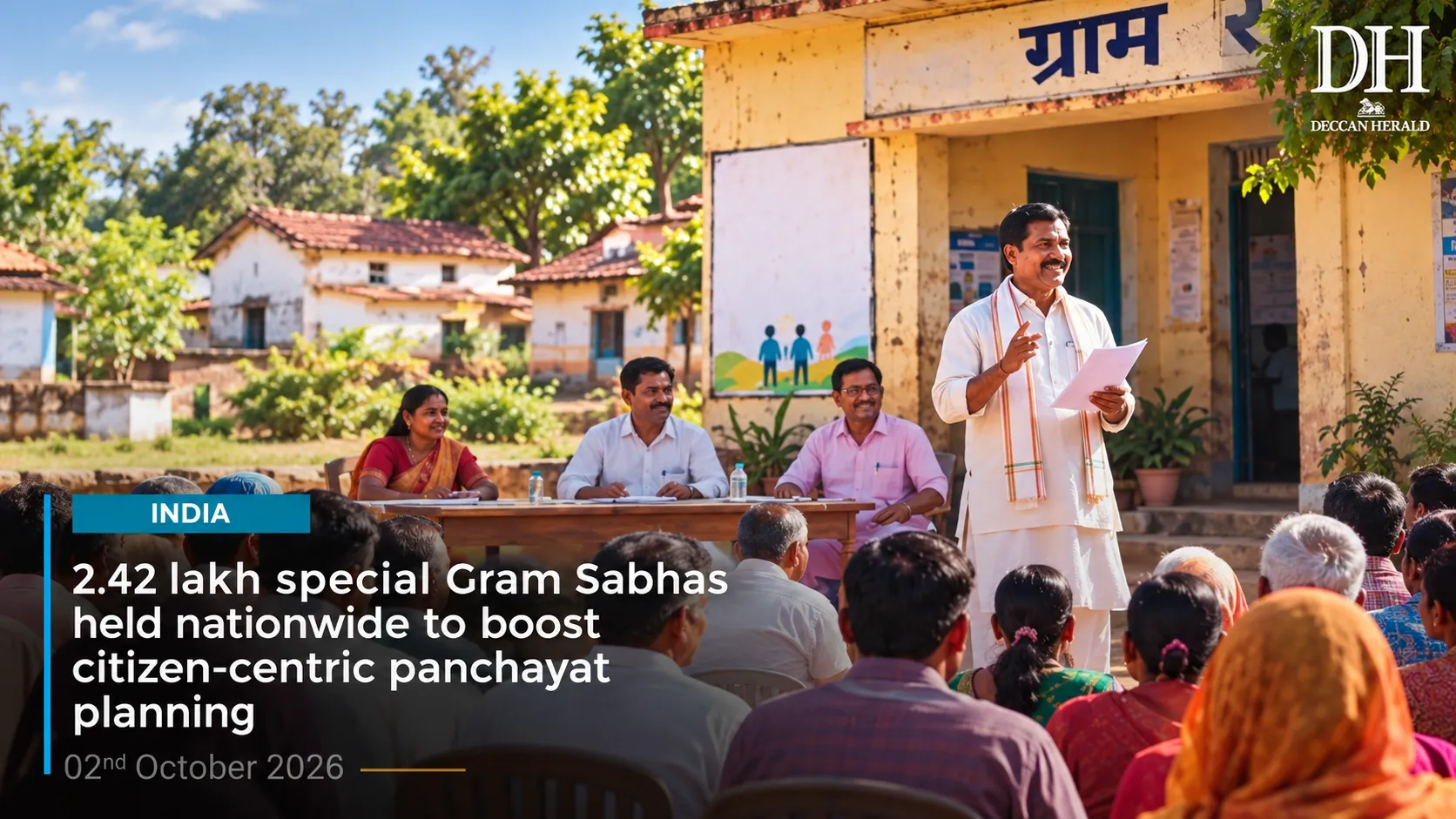
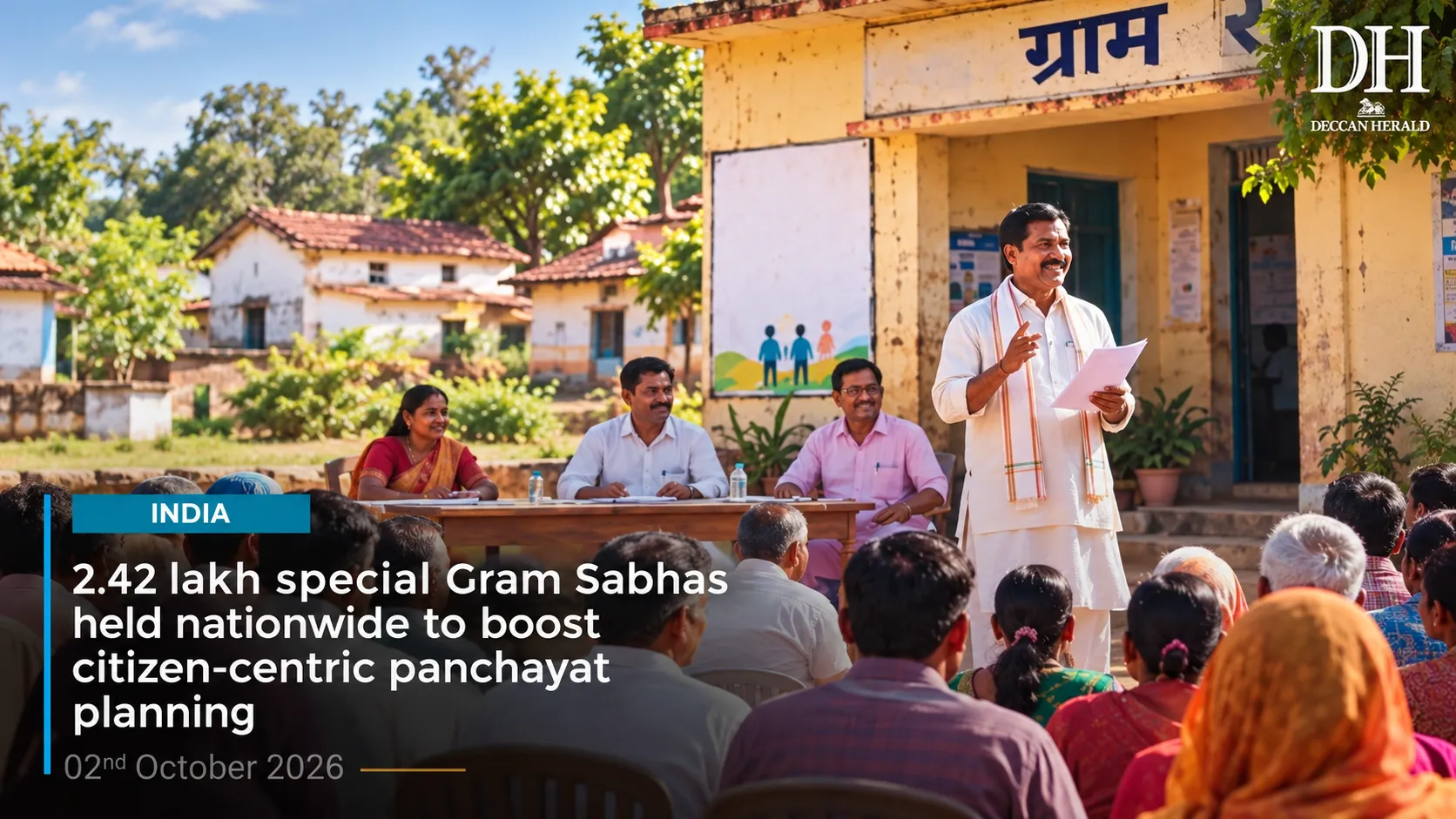
On the 157th birth anniversary of Mahatma Gandhi, India staged one of the largest exercises in direct democracy anywhere in the world. More than 2.42 lakh Special Gram Sabhas, the village assemblies that sit at the base of the country's system of local government, were convened across the country on 2 October.
The meetings marked the start of the People's Plan Campaign 2026-27, run under the banner "Sabki Yojana, Sabka Vikas", or "Everyone's Plan, Everyone's Development". Over the coming weeks, panchayats will use the campaign to prepare their development plans for the financial year 2027-28, deciding how funds will be spent on roads, water, sanitation, schools, health and livelihoods in their villages.
"These Special Gram Sabhas reaffirmed the Gram Sabha as the foundation of participatory democracy and local governance," the Ministry of Panchayati Raj said in a statement. The ministry said it looked forward to the preparation of people-centred Panchayat Development Plans for 2027-28, towards building "Sashakt, Atmanirbhar and Viksit Panchayats" in the larger endeavour of a developed India.
The choice of date is deliberate. Gandhi saw self-governing villages as the foundation of a free India, an idea he called Gram Swaraj. Holding the year's most important village assemblies on his birthday links contemporary development planning to that vision.
What a Gram Sabha does
A Gram Sabha consists of all adults registered as voters in a village panchayat area. Its role was given constitutional backing by the 73rd Amendment in 1992, which created a three-tier system of panchayats and required states to devolve powers and funds to them.
In practice, the Gram Sabha is where residents can question elected representatives, review spending, identify beneficiaries for government schemes and approve plans. The quality of these meetings varies widely. In some villages, they are lively forums with strong participation from women and marginalised groups; in others, attendance is thin and decisions are taken by a few. Campaigns such as this one are designed to raise participation and make planning more systematic.
The development plans that emerge, known as Gram Panchayat Development Plans, matter because panchayats receive substantial grants through the Finance Commission and channel money from a range of central and state schemes. A good plan helps villages prioritise limited resources; a poor one can lead to scattered spending with little lasting impact.
A scorecard of rural schemes
The Special Gram Sabhas also served as a platform to review the progress of national programmes at village level. The ministry highlighted several figures.
Under the Jal Jeevan Mission, which aims to provide piped water to every rural household, tap water connections have risen from 3.23 crore households, or about 17%, when the mission began to more than 16 crore, or about 80%. Under the Swachh Bharat Mission (Grameen), 12.22 crore household toilets have been built, and more than 5.25 lakh villages, or about 89.6%, have declared themselves Open Defecation Free Plus (Model), a status that requires solid and liquid waste management in addition to toilet access.
Under the SVAMITVA scheme, which uses drones to map inhabited rural land and give households formal property records, 3.33 crore property cards have been generated for 2.06 lakh villages. Loans of about ₹1,713 crore have been sanctioned against these cards, an indication that formal titles are beginning to unlock credit for rural families.
Waste, water and consumer rights on the agenda
The meetings coincided with the culmination of the Swachhata Hi Seva 2026 cleanliness campaign, and the newly notified Solid Waste Management Rules, 2026 were discussed in the gram sabhas. Those rules place greater emphasis on segregating waste at source, a shift that will require behavioural change in households as well as investment in collection and processing systems at panchayat level.
Consumer protection featured too. The ministry said the e-Jagriti platform for consumer grievance redressal has disposed of more than 2.55 lakh of the 2.81 lakh cases instituted and received a Silver Award at the National Awards for e-Governance 2026. Bringing such information to village assemblies is part of an effort to make rural citizens aware of rights and remedies that have often been used mainly in cities.
Several other ministries and departments extended support to ensure awareness at the village level, the ministry said, reflecting an attempt to use the gram sabhas as a single window for multiple government messages rather than holding separate meetings for each scheme.
Building capacity in panchayats
Under the Rashtriya Gram Swaraj Abhiyan, the Ministry of Panchayati Raj supports training and capacity building for elected representatives and officials across nine themes of local development. These themes, aligned with the localisation of the Sustainable Development Goals, include poverty-free villages, healthy villages, child-friendly villages, water-sufficient villages, clean and green villages, villages with self-sufficient infrastructure, socially just and secure villages, villages with good governance and women-friendly villages.
The thematic approach aims to help panchayats move from a list of construction projects to outcome-focused planning. A village that adopts the "water-sufficient" theme, for example, might combine rainwater harvesting, repair of traditional water bodies and pipeline maintenance rather than simply requesting new infrastructure. Technology is increasingly part of the process. Panchayats upload plans and spending details to government portals, allowing citizens and auditors to track how money is used. Digital records make it easier to compare villages, identify gaps and hold officials accountable, though connectivity and digital literacy remain barriers in many remote areas.
Why it matters beyond the village
For investors and businesses, India's rural economy can seem remote from the boardroom. It is not. Rural households account for a large share of national consumption, and the quality of local infrastructure, from water supply to roads, affects everything from agricultural productivity to demand for consumer goods. Formal property records under SVAMITVA can expand access to credit, while better sanitation and water reduce health costs that weigh on household budgets.
The Gram Sabha also matters for India's democratic resilience. Women make up a significant share of elected panchayat representatives because of mandatory reservation, and in many states the quota is 50%. When gram sabhas function well, they give these representatives and their constituents a real voice over public money.
The scale of the 2 October exercise is impressive, but the real test comes in the weeks that follow: whether the plans drafted are realistic, whether the voices of women and marginalised groups shape them, and whether funds arrive on time to deliver what villages decide. Gandhi's idea of Gram Swaraj was never only about meetings. It was about villages that can govern themselves. More than seven decades after his death, India is still working out how to make that idea real at scale.