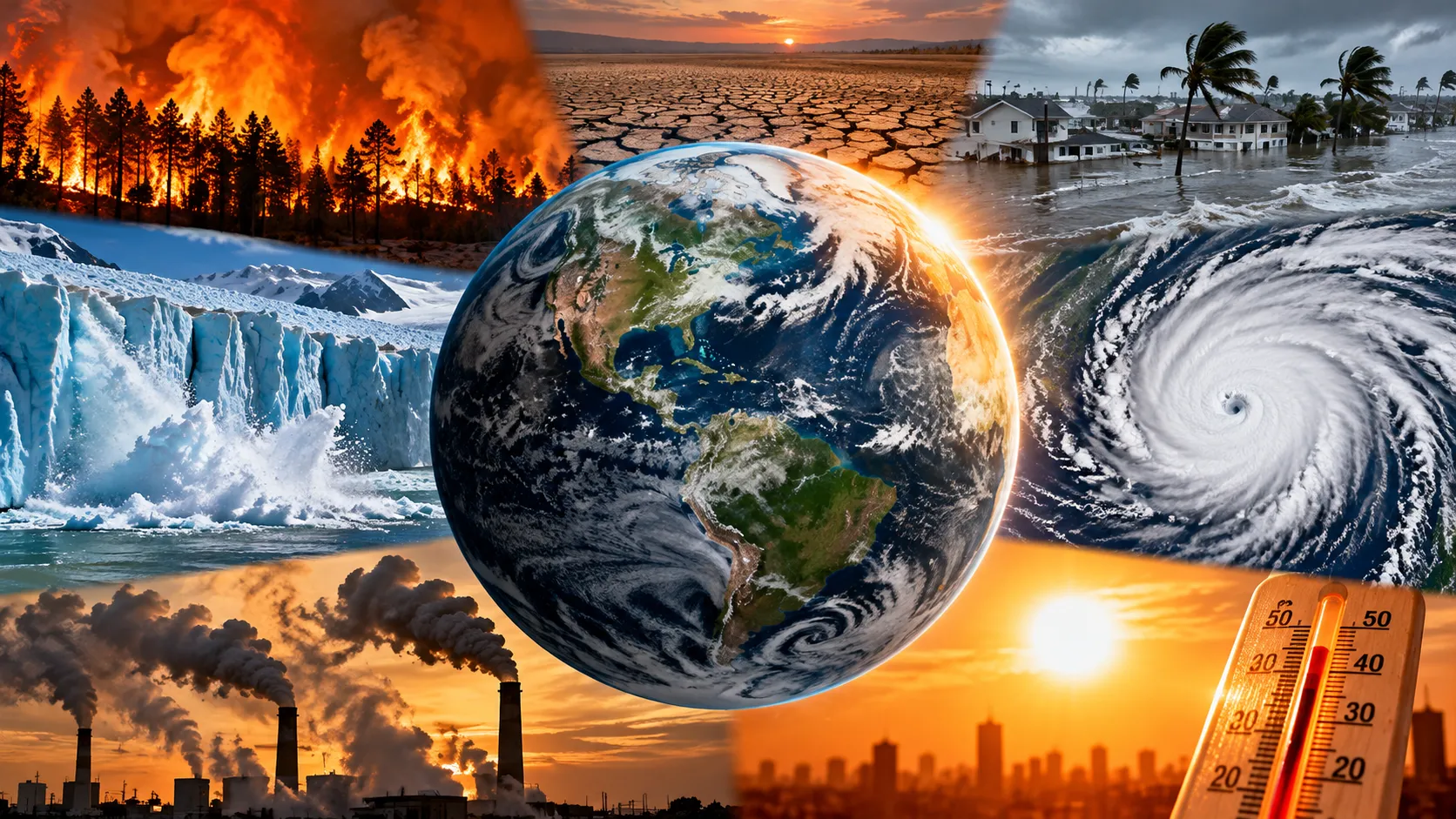
The Earth's climate system was pushed to, and possibly beyond, its limits in 2026, with seven of 16 key planetary indicators reaching record extremes, according to an annual assessment published on 14 October.
"The 2026 State of the Climate Report: Challenges and Opportunities", published in the journal BioScience, tracks what its authors call the planet's "vital signs": measures including greenhouse gas concentrations, ocean heat content and acidity, ice sheet mass, the number of hot days and global surface temperature. It is the seventh annual edition of the report.
The findings paint a stark picture of a climate system that is not only warming but warming faster. Yet the authors also highlight a significant turning point in the energy transition, arguing that the tools to change course exist and the challenge now is deploying them quickly enough.
Seven Indicators at Record Levels
Of the 16 indicators analysed, seven reached record extremes: global sea level, global ocean heat content, worldwide glacier thickness, the mass of the Greenland ice sheet, and the atmospheric concentrations of each of the three most common greenhouse gases, according to a summary of the report by Eos, the news publication of the American Geophysical Union.
Atmospheric carbon dioxide passed 428 parts per million in May 2026, roughly 50 per cent above pre-industrial levels. Methane and nitrous oxide concentrations also hit new highs.
The surface temperature anomaly is now near 1.5°C above pre-industrial levels, the threshold that the Paris Agreement sought to avoid exceeding over the long term. Ocean pH has fallen to 8.050 and continues to decline, reflecting the absorption of carbon dioxide by the oceans. Sea level stands more than 7 centimetres above its 1993 average.
The world's ice is retreating rapidly. Greenland has lost about 6,000 gigatonnes of mass and Antarctica more than 2,500 gigatonnes. Minimum Arctic sea ice extent has hovered around 4 to 5 million square kilometres since 2010.
Warming Is Speeding Up
Perhaps the most concerning finding is that warming is accelerating. The rate of global warming has roughly doubled, from about 0.19°C per decade between 1970 and 2010 to about 0.36°C per decade since 2010, according to the report. Ocean heat uptake is also accelerating.
Meanwhile, the burning of fossil fuels continues to rise. Global consumption of oil, coal and gas increased by 0.9 per cent in 2025.
William Ripple, an ecologist at Oregon State University and lead coauthor of the report, said continued warming could trigger further feedbacks and tipping points, making climate change "increasingly difficult to control".
The Risk of Tipping Points
The report's authors flag the risk of crossing several critical tipping points, thresholds beyond which parts of the climate system could shift into new states that are difficult or impossible to reverse.
These include a slowdown of the Atlantic Meridional Overturning Circulation (AMOC), the system of ocean currents that carries warm water northwards and helps regulate climate across Europe and beyond; runaway drying and deforestation of the Amazon rainforest; and rapid melting of the Greenland and West Antarctic ice sheets, which could drive substantial sea-level rise.
Nico Wunderling, a climate scientist at the Potsdam Institute for Climate Impact Research who was not involved in the report, said the negative trends "need to be watched closely". He noted that there is evidence that the rate of warming, and not only the absolute temperature, may be what could trigger an AMOC slowdown, making the recent acceleration particularly significant.
A Turning Point in Energy
Amid the warning signs, the report identifies encouraging developments. Renewable energy and battery storage are expanding rapidly. In 2025, renewables surpassed coal in global electricity generation, a milestone Ripple described as an "important turning point".
"These developments show that we have some of the technologies needed to move away from fossil fuels," Ripple said. The challenge, he argued, is deploying them fast enough to reduce fossil fuel use rather than simply adding new energy supply on top of it.
Wunderling called the scale and speed of the solutions highlighted in the report "particularly encouraging".
Cutting Emissions Is Not Enough
The authors conclude that reducing emissions, while essential, will not be sufficient on its own. The report supports a recent United Nations assessment that carbon removal will be needed to avoid the worst impacts of climate change, alongside rapid emissions cuts, effective adaptation and ecosystem protection.
Ripple also urged scientists to communicate their findings clearly to the public and to policymakers, rather than confining their work to academic research.
What It Means for Business and Investors
For business leaders and investors, the report reinforces several trends that are already reshaping markets. Physical climate risks, from heatwaves and floods to rising sea levels, are increasingly affecting supply chains, infrastructure and insurance costs. Companies that operate in coastal areas, depend on water-intensive processes or rely on climate-sensitive agriculture face growing exposure.
The implications are especially pronounced for South Asia. Extreme heat already reduces outdoor working hours and labour productivity in India, while erratic monsoons affect crop yields, rural incomes and food prices. Rising seas and stronger cyclones threaten densely populated coastal cities and the ports and industrial clusters that line them. For the global Indian business community, climate risk is no longer a distant scenario to be modelled in sustainability reports but a factor that is shaping insurance premiums, lending decisions, supply chain planning and the location of new investment.
At the same time, the rapid growth of renewable energy and battery storage represents one of the largest investment opportunities of the coming decades. The shift is visible in markets such as India, which has set ambitious targets for renewable capacity, and in Europe, China and the United States, where investment in clean energy continues to grow despite political headwinds in some places.
The report's call for carbon removal also points to an emerging industry that will need significant investment and policy support to scale.
The Window Is Narrowing
The 2026 State of the Climate report delivers a familiar message with heightened urgency. The planet's vital signs are deteriorating, warming is accelerating and the risk of crossing irreversible thresholds is rising. But the technologies needed to change course are available and increasingly competitive on cost.
The question, as the report frames it, is no longer whether the world can transition away from fossil fuels, but whether it can do so fast enough. For governments, businesses and investors alike, the answer will be shaped by decisions made in the next few years.