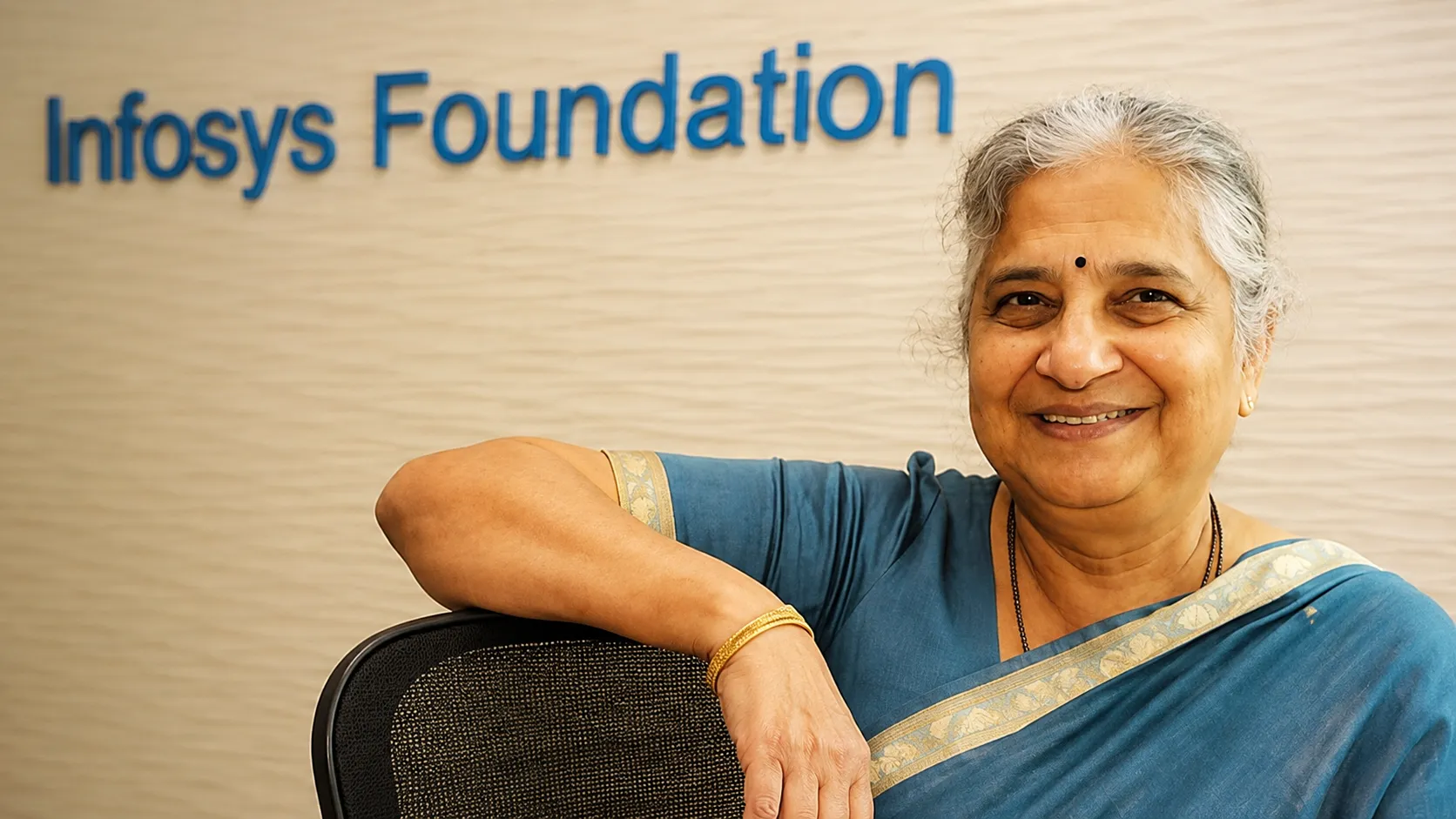
Long before Sudha Murty became one of India's most recognisable philanthropists, she was, by a considerable margin, one of its most improbable engineers. Born on August 19, 1950, in Shiggaon, Karnataka, to a surgeon father and a schoolteacher mother, Murty pursued an engineering degree at a time when the discipline remained almost entirely closed to women in India, and went on to become the first woman engineer hired by Tata Engineering and Locomotive Company, now Tata Motors — a milestone achieved after she reportedly wrote directly to the company's leadership to challenge a recruitment advertisement that excluded women applicants. That early act of quiet, methodical defiance would become something of a template for the decades that followed.
Today, Murty is best known globally in three overlapping capacities: as Founder-Chairperson of the Infosys Foundation, the philanthropic arm of the technology company her husband, N.R. Narayana Murthy, co-founded; as the author of more than 40 books in English and Kannada, spanning novels, short fiction, children's literature and memoir, which have made her arguably India's most widely read living writer; and, since March 2024, as a nominated Member of Parliament in the Rajya Sabha, India's upper house, in recognition of her decades of social work and contribution to education. The 2026 Candere Hurun India Women Leaders List formally recognised the second of these roles, placing her atop its 'Authors' category on the strength of what the list's compilers described as the highest readership impact among the influential Indian women writers assessed.
Murty's role in Infosys's own founding history is frequently understated in accounts that focus primarily on her husband's entrepreneurial journey. She was, in fact, one of the company's earliest investors, contributing her own savings toward its initial capital at a time when the venture's prospects were entirely unproven, and she managed household and family responsibilities during Infosys's formative years specifically so that Narayana Murthy could dedicate himself fully to building the company. That contribution — financial, logistical and, by most accounts, emotional — is one that Infosys's own institutional memory has increasingly credited in recent years, even as Murty herself has generally downplayed her role in the company's early success in favour of discussing her subsequent, independently built career in philanthropy and education.
That independent career began in earnest with academia. Murty transitioned from her engineering career into teaching, becoming a professor at several engineering colleges in Bangalore, before her focus shifted decisively toward philanthropy with the establishment of the Infosys Foundation in 1996, a public charitable trust of which she became founding chairperson. Over the subsequent three decades, the Foundation, funded by a share of Infosys's corporate profits, has become one of India's most prominent corporate philanthropic vehicles, directing resources toward education, healthcare, rural development, arts and culture, and disaster relief across the country. Murty has personally overseen the establishment of libraries, orphanages and healthcare initiatives, and has been closely associated with the Gates Foundation's public healthcare initiatives in India, extending her philanthropic reach well beyond Infosys's own corporate umbrella.
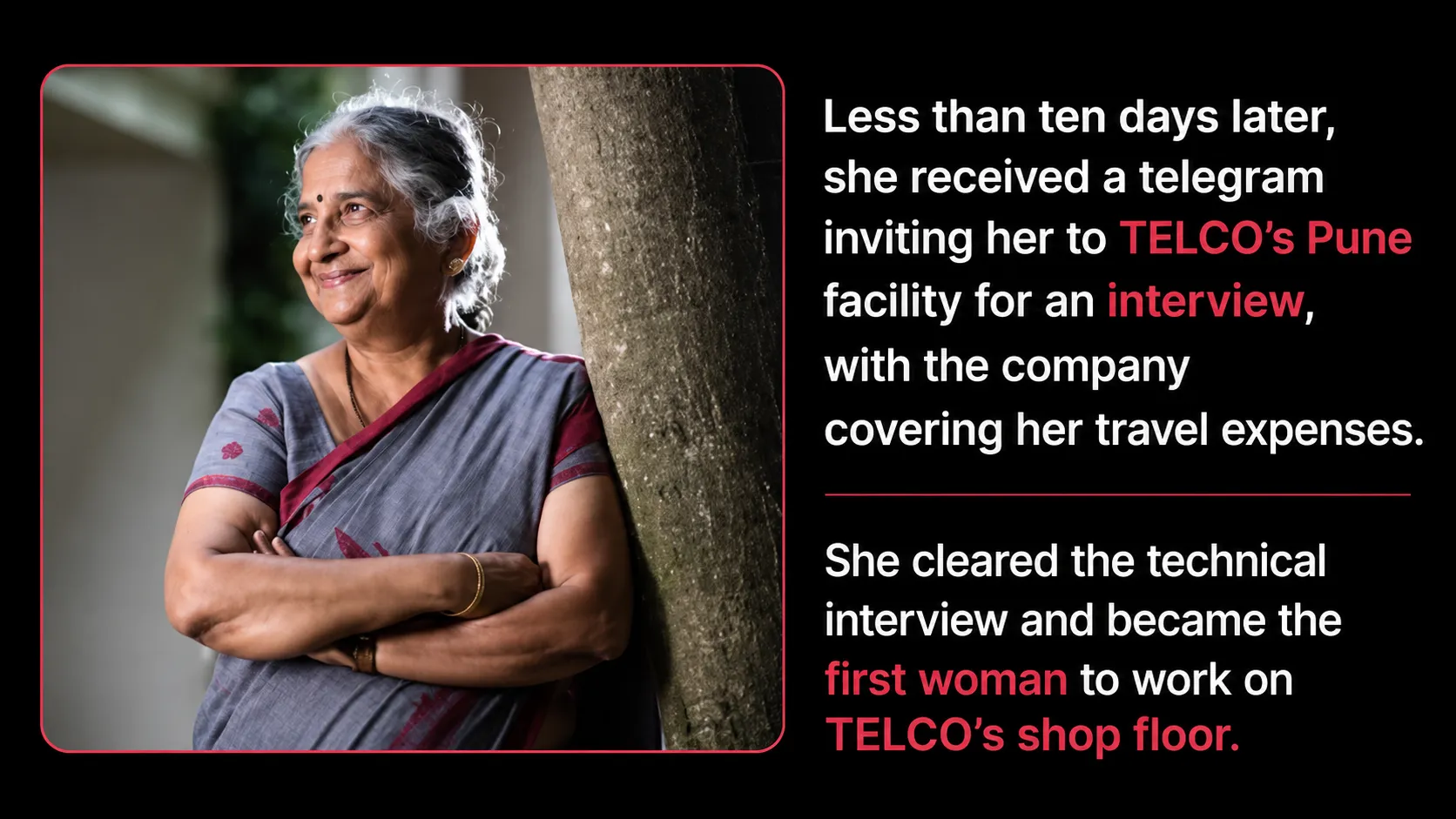
Murty's literary output has, in parallel, made her one of the most commercially successful and culturally influential authors in contemporary India. Her books — including titles such as 'How I Taught My Grandmother to Read,' 'Wise and Otherwise' and 'Dollar Bahu' — are notable for a plain-spoken, morally grounded prose style that draws heavily on real-life experiences from her decades of social work, rendering complex questions of class, gender and rural development accessible to a mass readership spanning both English and Kannada audiences. She is also the founder of the Murty Classical Library of India at Harvard University, an initiative aimed at making classical Indian-language literary works available in authoritative English translation for global scholarly and general readership — a project that positions her not merely as a popular author but as an institution-builder within the broader field of Indian literary and cultural preservation.
Her honours reflect the breadth of this dual career in social work and literature. In 2006, the Government of India awarded her the Padma Shri, the country's fourth-highest civilian honour, specifically for social work; in 2023, she received the Padma Bhushan, India's third-highest civilian award, a recognition that placed her among a small cohort of individuals honoured twice at escalating levels for sustained public contribution. In March 2024, she was nominated to the Rajya Sabha, a largely ceremonial but symbolically significant recognition reserved for individuals whose contributions to fields such as literature, science, art and social service are deemed to merit direct parliamentary representation outside the electoral process — a role in which she has continued to be a prominent public voice on education and social policy through 2026.
Murty's family life has, in recent years, drawn international attention for reasons only tangentially related to her own career: her daughter, Akshata Murty, a fashion designer and businesswoman, is married to Rishi Sunak, who served as Prime Minister of the United Kingdom, making Sudha Murty the mother-in-law of a former British head of government — a family connection widely reported in both Indian and international media, though one that Murty herself has generally kept separate from her own public role as an educator and philanthropist. Her son, Rohan Murty, is a computer scientist and the founder of the enterprise software company Soroco, extending the family's presence in technology entrepreneurship into a second generation.
Unlike several other names on the 2026 Hurun India Women Leaders List, Murty's personal wealth is comparatively modest relative to the scale of her public influence — a distinction the list's own methodology implicitly acknowledges by placing her in the Authors category rather than among its wealth-creation rankings. Estimates of her personal net worth, drawn primarily from book royalties and her limited personal holdings, have circulated in the low single-digit millions of dollars, a figure that stands in deliberate, almost pointed contrast to the multi-billion-dollar fortunes associated with her husband's stake in Infosys. Murty has stated publicly and repeatedly that she lives simply and directs a significant share of her earnings toward charitable causes, drawing no personal salary from her chairpersonship of the Infosys Foundation despite having built it into one of India's most consequential philanthropic institutions.
At 75, Murty's continued prominence on lists like Hurun's 2026 Women Leaders ranking reflects a career that has resisted easy categorisation: an engineer who broke a corporate gender barrier before she turned thirty, a philanthropist who built one of India's most durable charitable institutions from nothing, an author whose plainly told stories have reached millions of readers across two languages, and, most recently, a legislator whose parliamentary seat was granted in recognition of decades of work that long preceded any political ambition. For a country whose lists of influential women increasingly celebrate founders and financiers, Murty's inclusion — grounded in readership rather than revenue — is a reminder that influence in India continues to take forms that resist a single, tidy metric.