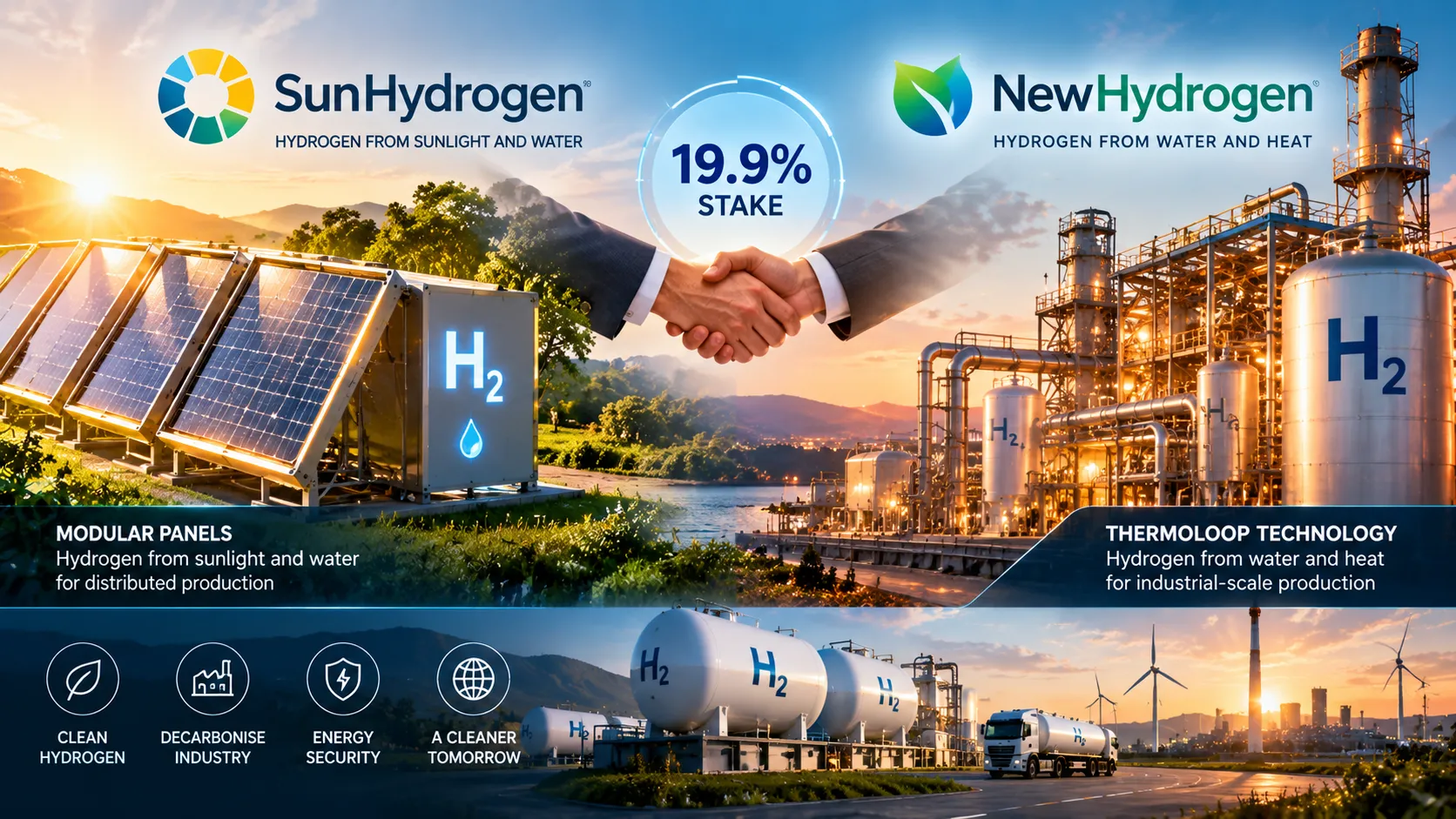
SunHydrogen, a US developer of technology that produces hydrogen from sunlight and water, has taken a 19.9 per cent stake in NewHydrogen, a company pursuing a different route to clean hydrogen, in a deal that brings together two complementary approaches to one of the energy transition's most difficult challenges.
SunHydrogen announced on 26 October that it now holds a 19.9 per cent ownership position in NewHydrogen and has the right to purchase additional shares. Both companies trade on the OTCQB market in the United States. Reports based on NewHydrogen's regulatory filing put the size of the private placement at about $3 million in shares and warrants.
SunHydrogen president and chief executive Tim Young said the company intends to hold its NewHydrogen stake for the long term.
Two Paths to Clean Hydrogen
The two companies are developing distinct technologies that target different segments of the hydrogen market.
SunHydrogen's technology uses sunlight and water to produce hydrogen directly through modular panels, an approach sometimes called photoelectrochemical water splitting. The panels are designed for distributed production, generating hydrogen on site near where it will be used.
NewHydrogen's ThermoLoop technology uses water and heat to produce hydrogen at industrial scale. It is aimed at centralised production and could use heat from power plants and, in the future, small modular nuclear reactors.
Because the technologies serve different needs, SunHydrogen describes them as complementary rather than competing. The investment gives SunHydrogen's shareholders exposure to the centralised industrial hydrogen market while it continues to focus on distributed production.
Why Hydrogen Matters
Hydrogen is seen as a potentially critical fuel for decarbonising sectors where electrification is difficult, including steelmaking, fertiliser production, refining, shipping, aviation and long-duration energy storage. When produced using renewable or low-carbon energy, hydrogen can be used without emitting carbon dioxide.
Most hydrogen produced today, however, is made from natural gas or coal in processes that emit significant greenhouse gases. So-called green hydrogen, made by splitting water using renewable electricity in electrolysers, remains considerably more expensive than fossil-based hydrogen.
Lowering the cost of clean hydrogen is therefore one of the central challenges of the energy transition. Technologies that produce hydrogen directly from sunlight or from heat, without the intermediate step of generating electricity, could potentially reduce costs, though they remain at earlier stages of development than conventional electrolysis.
The Energy Security Angle
Young argued that regions dependent on imported natural gas, including much of Europe and Asia, could benefit most from producing hydrogen locally from water. Recent volatility in global gas markets, driven by geopolitical disruption, has strengthened interest in domestic energy sources.
For countries that import most of their gas, locally produced clean hydrogen could reduce exposure to price shocks while cutting emissions from industry.
Early-Stage Technologies
Both companies' technologies remain in development and must achieve key technical and commercial milestones before reaching commercial scale. Small-cap clean-energy developers often face significant challenges in raising capital, scaling manufacturing and demonstrating that laboratory results can be replicated in real-world conditions.
The hydrogen industry more broadly has experienced setbacks. Several large green hydrogen projects have been delayed or cancelled due to high costs, uncertain demand and policy changes, and some hydrogen companies have seen their valuations fall sharply. In the United States, changes to clean energy tax credits have added uncertainty for hydrogen developers.
Strategic Logic
By taking a significant minority stake rather than acquiring NewHydrogen outright, SunHydrogen gains exposure to a complementary technology without the costs and risks of full integration. The arrangement also creates a working relationship between two companies pursuing the same goal through different methods, which could facilitate knowledge sharing.
Strategic minority investments are common in emerging technology sectors, where companies seek to diversify their bets across multiple approaches whose ultimate success remains uncertain.
India's Hydrogen Ambitions
India has set ambitious goals for green hydrogen. Its National Green Hydrogen Mission, launched in 2023 with an initial outlay of about ₹19,744 crore, targets production of 5 million tonnes of green hydrogen a year by 2030. The government has offered incentives for electrolyser manufacturing and green hydrogen production, and major Indian companies, including Reliance, Adani, Larsen & Toubro and state-owned energy firms, have announced large hydrogen projects.
India's abundant solar resources make it a potentially low-cost producer of green hydrogen, and the country hopes to become an exporter. Technologies that reduce the cost of producing hydrogen from sunlight, such as those being developed by SunHydrogen, could be particularly relevant to India's ambitions, though they remain some way from commercial deployment.
Competing Approaches to Clean Hydrogen
The race to produce affordable clean hydrogen includes several competing technologies. Conventional electrolysis, using alkaline, proton exchange membrane or solid oxide electrolysers powered by renewable electricity, is the most mature route and is being deployed at scale in China, Europe and elsewhere. Chinese manufacturers have driven down electrolyser costs significantly, and the International Energy Agency has examined the reasons for their cost advantage.
Other approaches include producing hydrogen from natural gas with carbon capture, known as blue hydrogen, extracting naturally occurring hydrogen from underground deposits, and novel methods such as the photoelectrochemical and thermochemical processes pursued by SunHydrogen and NewHydrogen. Each faces trade-offs in cost, scalability, efficiency and technological readiness. Investors and policymakers are backing a range of approaches in the hope that at least some will deliver the cost reductions needed for hydrogen to play a major role in decarbonisation.
The deal also illustrates how smaller listed clean-energy companies are seeking to build portfolios of complementary technologies, spreading risk across approaches at a time when the path to commercial hydrogen remains uncertain.
What Comes Next
SunHydrogen and NewHydrogen will continue to develop their respective technologies, with the investment providing NewHydrogen additional capital and a strategic partner. Investors will watch for progress on technical milestones, pilot projects and partnerships that could move the technologies closer to commercial use.
The deal is a small one by the standards of the global energy industry, but it reflects the broader search for breakthroughs that could make clean hydrogen affordable, a goal that remains central to hopes of decarbonising heavy industry worldwide.