WomenVoices5 MIN READ

Swiggy Renews Insurance Cover for 25 Lakh Delivery Partners, Extending Maternity Benefits to Women Riders and Spouses

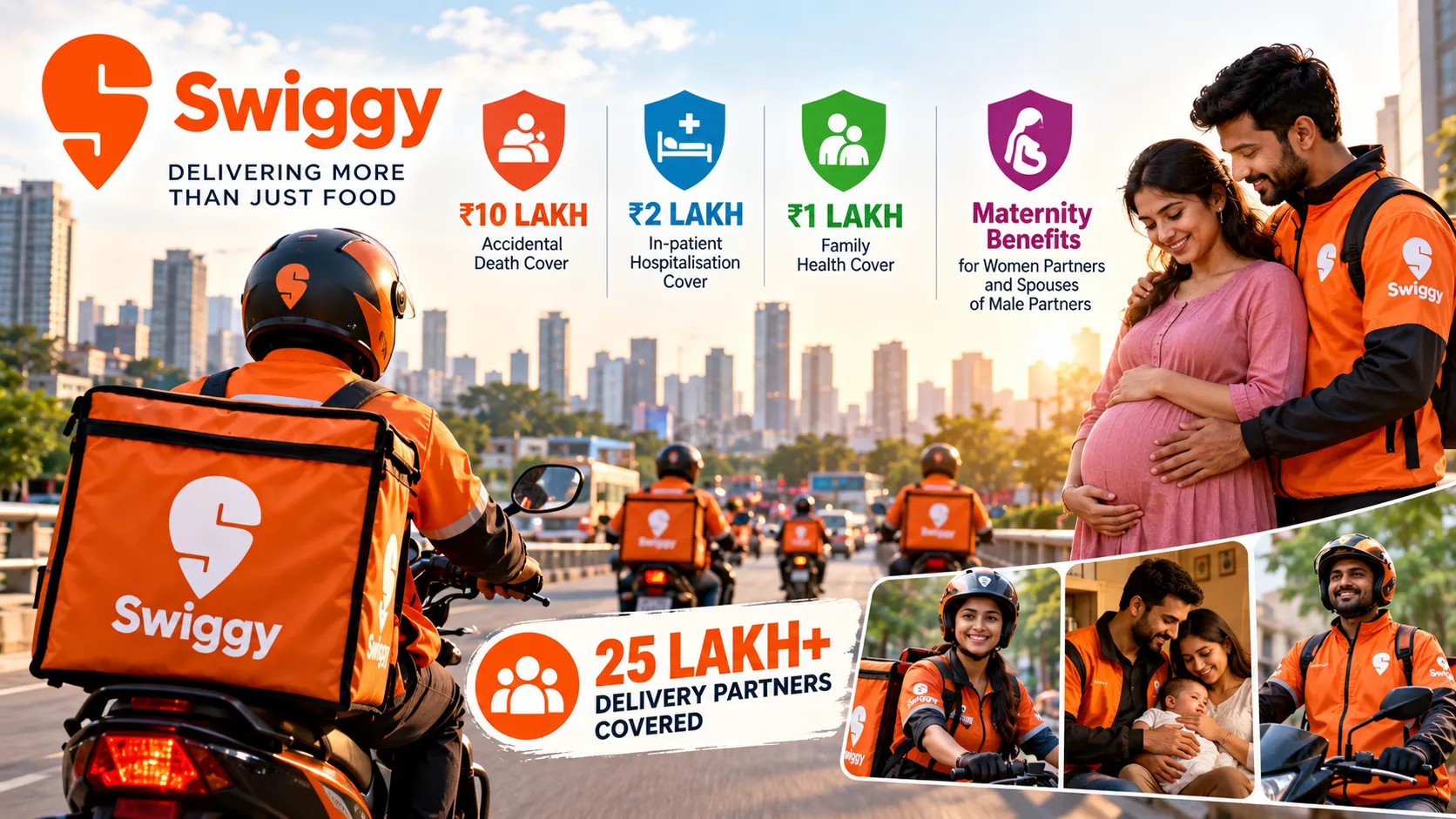
Swiggy has renewed its insurance programme with IndusInd General Insurance for more than 25 lakh delivery partners, covering accidental death of up to ₹10 lakh, hospitalisation of up to ₹2 lakh and maternity benefits for women partners and the spouses of male partners.

By Prathista Lazar · Author27 October 2026New
Swiggy Renews Insurance Cover for 25 Lakh Delivery Partners, Extending Maternity Benefits to Women Riders and Spouses

Swiggy, the food delivery and quick-commerce company, has renewed its insurance programme for delivery partners, covering more than 25 lakh workers and extending maternity benefits to women partners as well as the spouses of male partners.

The programme, renewed with IndusInd General Insurance, formerly Reliance General Insurance, provides accidental death cover of ₹10 lakh, in-patient hospitalisation cover of up to ₹2 lakh and family health cover of up to ₹1 lakh, the company said on 26 October.

Swiggy said the programme covered more than 25 lakh delivery partners during the 2026 financial year.

Maternity Benefits for a Changing Workforce

The maternity component is one of the most significant aspects of the programme. Benefits extend to women delivery partners and to the spouses of male partners, recognising that a delivery worker's household may face financial strain from childbirth whether the worker is a woman or a man.

According to Swiggy, in the previous policy period, 75 per cent of maternity claims were made by spouses of male partners and 25 per cent by women partners. The data reflects the composition of the delivery workforce, which remains predominantly male, while showing that a meaningful number of women workers are using the benefit.

Women's participation in gig work, including delivery, has been growing in India. Platforms have introduced measures to attract and retain women workers, such as flexible schedules, safety features in their apps, women-only shifts and designated rest points. Yet women still face barriers in delivery work, including safety concerns, social norms and the physical demands of the job.

Maternity coverage addresses one of the key vulnerabilities facing women in informal and gig employment. Unlike salaried employees, who are entitled to paid maternity leave under Indian law, gig workers typically have no such protection, and pregnancy can mean a sudden loss of income alongside medical costs.

Why Insurance Matters for Gig Workers

India's platform economy employs millions of people as delivery partners, ride-hailing drivers and service providers. Most are classified as independent contractors rather than employees, which means they are not entitled to the social security benefits that formal workers receive, such as provident fund, employer-provided health insurance and paid leave.

Delivery work carries significant risks. Riders spend long hours on congested roads, often under time pressure, exposing them to accidents. Health problems linked to heat, pollution and long working hours are also common.

Insurance coverage provided by platforms can therefore make a significant difference to workers and their families, offering financial protection against accidents, illness and major life events.

The Regulatory Backdrop

The renewal comes as India moves to formalise social security for gig and platform workers. The Code on Social Security, part of a set of labour reforms consolidating older laws, recognises gig and platform workers and provides for social security schemes funded in part by contributions from platform companies.

Several states have also introduced their own legislation. Rajasthan was among the first to pass a law for platform workers' welfare, and Karnataka and others have followed with measures that include welfare boards and levies on platforms to fund benefits. The central government has also registered gig workers on its e-Shram portal and extended health coverage under the Ayushman Bharat scheme to registered platform workers.

“For India's gig workers, insurance is often the only safety net between an accident or a pregnancy and financial crisis.”
— TIGI Analysis

These developments mean that platforms are increasingly expected to contribute to workers' welfare as a matter of law, not just as a voluntary benefit.

69e79aec-26c7-428d-9632-8910252215dd.png

Competition for Workers

Insurance and welfare benefits have also become a tool in the competition for delivery workers. As quick commerce has expanded rapidly, demand for delivery partners has surged, and platforms compete to attract and retain reliable workers.

Swiggy competes with Eternal's Zomato and Blinkit, Zepto and other platforms for the same pool of workers. Benefits such as insurance, flexible payouts and support programmes can help platforms reduce churn and maintain service quality.

Swiggy's Business Context

The insurance renewal comes at a time when Swiggy is under pressure to improve profitability. The company recently narrowed its quarterly loss and has begun moving its Instamart quick-commerce business towards an inventory-led model. Investors are watching costs closely, making welfare spending a balancing act between worker wellbeing and financial discipline.

Insurance programmes negotiated at scale with insurers can be relatively cost-efficient, allowing platforms to provide meaningful coverage at a manageable cost per worker.

What It Means for Women's Work

India has one of the lowest rates of female labour force participation among major economies, though it has risen in recent years. Flexible work offered by platforms has the potential to bring more women into paid employment, particularly those who need to balance work with family responsibilities.

For that potential to be realised, platform work must be safe and offer basic protections. Maternity benefits, safety features and fair pay are among the measures advocates say are essential to making gig work viable for women.

Measuring the Impact

Insurance coverage on paper is only valuable if workers know about it and can claim it easily. Labour researchers have noted that gig workers are sometimes unaware of the benefits available to them or find claims processes complex. Platforms that invest in awareness, simple claims procedures and support can make the difference between nominal and meaningful protection.

Swiggy's disclosure of claims data, including the split of maternity claims between spouses and women partners, suggests the benefit is being used. Making such data public can help build trust among workers and inform policymakers designing social security schemes for the platform economy. As state and central schemes are rolled out, coordination between platform-provided insurance and government programmes will be important to avoid gaps or duplication and to ensure that workers moving between platforms remain covered.

What Comes Next

As India implements its social security framework for gig workers, platforms like Swiggy are likely to face greater expectations and obligations. Programmes like the renewed insurance cover provide a foundation, but labour advocates continue to call for broader protections, including minimum earnings, transparent algorithms and grievance mechanisms.

For the millions of workers who keep India's cities supplied with food and groceries, such protections can determine whether gig work offers a pathway to stability or leaves them exposed to life's biggest risks.

TagsSwiggyGig WorkersDelivery PartnersInsuranceMaternity BenefitsWomen in Gig EconomyIndusInd General InsuranceSocial SecurityPlatform WorkersCode on Social SecurityZomatoQuick CommerceWorker WelfareWomenIndia

Reader reviews

Sign in to rate and review this article.
Loading reviews…

