ImpactSustainability5 MIN READ

Tata Motors' EV Sales Jump 75% to 16,244 and Kia Posts Record Electric Sales as India's Electric Car Market Gains Speed

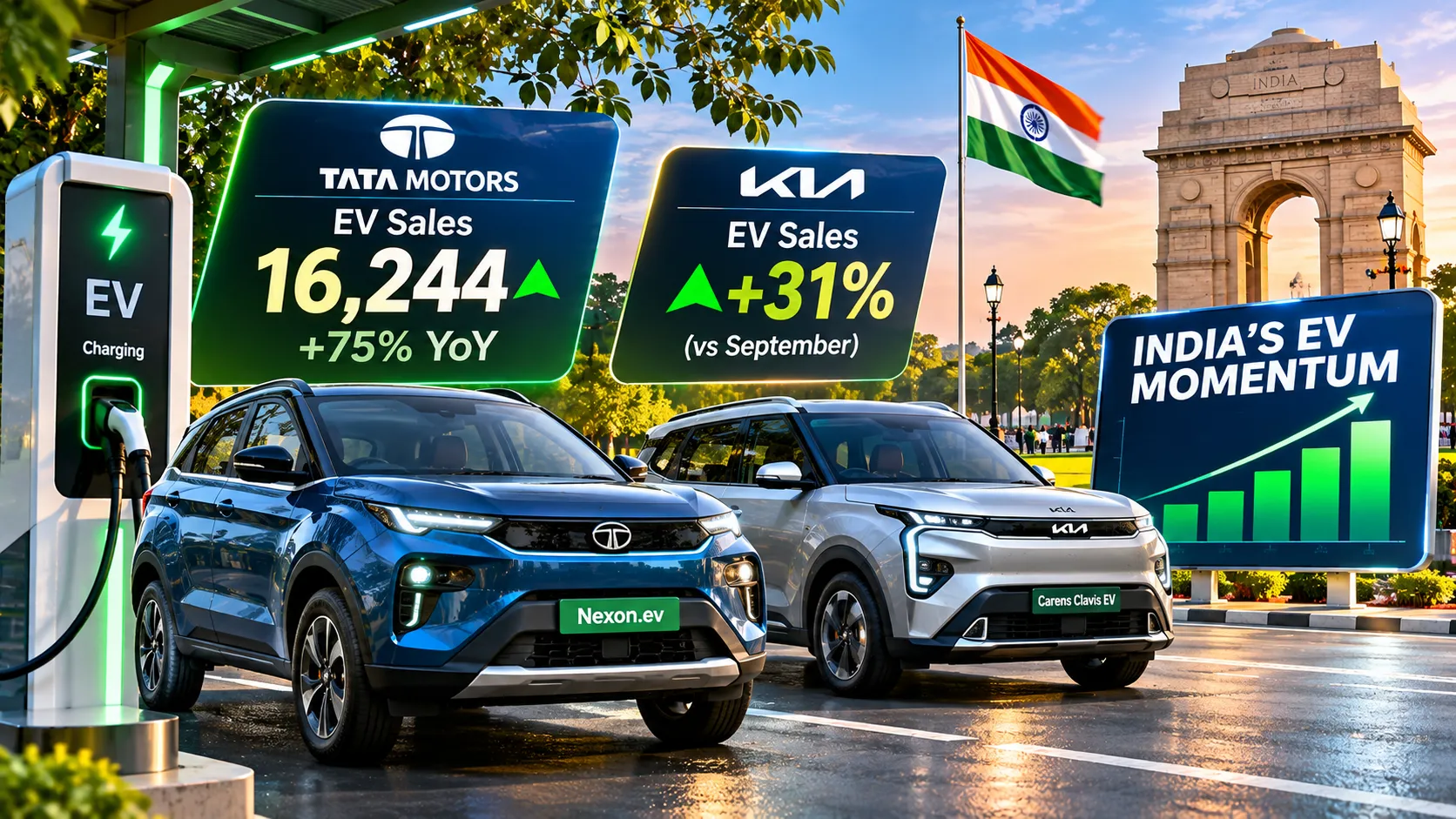
Tata Motors' electric vehicle sales rose 75% to 16,244 units in October 2026 from 9,286 a year earlier, while Kia India reported record EV sales, up 31% from September, according to company data released on November 1. The figures suggest India's electric car market is moving beyond early adopters as more models, better charging and higher petrol prices draw buyers.

By Prathista Lazar · Author2 November 2026New
Tata Motors' EV Sales Jump 75% to 16,244 and Kia Posts Record Electric Sales as India's Electric Car Market Gains Speed

India's record month for car sales in October carried an important message for the country's energy transition: electric cars are accelerating faster than the market as a whole.

Tata Motors' electric vehicle sales, including domestic and international, rose 75% to 16,244 units in October 2026 from 9,286 a year earlier, according to company data released on Sunday, November 1, and reported by Business Today. Kia India reported record EV sales, up 31% from September, though it did not disclose an absolute figure.

Tata Motors' overall domestic passenger vehicle sales rose 21% to 73,894 units, meaning EVs grew more than three times faster than its total business.

Tata's EV leadership

Tata Motors has been India's leading electric car maker for several years, building an early lead with the Nexon EV, launched in 2020, and expanding its range with the Tiago EV, Tigor EV, Punch EV and Curvv EV. Its EV business is part of Tata Passenger Electric Mobility, which has attracted investment from TPG Rise Climate.

The 75% growth in October suggests that Tata's broader range of models at different price points is attracting new buyers, and that festive demand has extended strongly into electric vehicles. Tata has also invested in charging partnerships and battery production through group company Agratas, which is building battery factories in India and the United Kingdom.

Kia's electric push

Kia India's record EV sales were driven by its electric models, including the Carens Clavis EV, an electric version of its popular family vehicle. Kia also reported its highest-ever monthly domestic wholesales of 33,462 units in October. Its parent group, which includes Hyundai, has been expanding its electric line-up in India, including the Hyundai Creta Electric.

A broadening market

India's electric car market has become more competitive and diverse. Mahindra & Mahindra has launched electric SUVs on its dedicated INGLO platform, MG Motor offers models such as the Windsor EV and ZS EV, and Hyundai, BYD and luxury brands including Mercedes-Benz and BMW also sell electric cars in India. Maruti Suzuki, the market leader, has entered the segment with its first electric SUV.

Greater choice has helped address one of the main barriers to EV adoption in India: the limited availability of affordable models in popular segments. As more carmakers launch EVs, prices have become more competitive.

Why buyers are switching

Several factors are driving EV adoption. Petrol prices were raised by about ₹7.50 a litre in May, increasing the running cost advantage of electric cars, which are significantly cheaper to operate per kilometre. Electric cars also benefit from lower GST rates than petrol and diesel cars, and many states offer road tax and registration fee waivers.

Charging infrastructure has expanded, with public charging stations increasing in cities and along highways, and many buyers charge at home. Improvements in battery range have reduced range anxiety for typical daily driving.

The penetration picture

Despite rapid growth, electric cars still account for a small share of India's passenger vehicle market, which sold record volumes in October. Electric two-wheelers have achieved much higher penetration, with record registrations of 2.23 lakh units in October. Electric three-wheelers have also gained significant market share, particularly e-rickshaws.

Increasing EV penetration in cars will require further reductions in prices, more charging infrastructure, particularly in smaller cities, and greater consumer confidence in battery durability and resale values.

“Electric cars in India are crossing from niche to mainstream one festive season at a time.”
— TIGI Impact Desk

Government policy

The government has supported EV adoption through incentives, lower taxes and manufacturing schemes. The PM E-DRIVE scheme focuses on two-wheelers, three-wheelers, buses and charging infrastructure rather than private cars. A scheme to promote electric car manufacturing allows companies that commit to investing in local production to import a limited number of EVs at lower duties, aimed at attracting global manufacturers.

India has set a goal of significantly increasing the share of EVs in new vehicle sales by 2030, as part of its strategy to reduce oil imports and emissions.

Energy security angle

With crude oil prices elevated by the conflict in the Middle East, reducing dependence on imported oil has become a strategic priority. India imports more than 85% of its crude oil, and transport fuels account for a large share of consumption. Every electric car replacing a petrol car reduces oil demand, contributing to energy security over time.

b9da7b70-ce45-42e7-aa2c-1cf626a87a2d.png

Battery supply chain

Building a domestic battery supply chain is essential for India's EV ambitions. Battery cells make up a large share of an EV's cost, and India currently imports most cells, largely from China. Companies including Tata's Agratas, Ola Electric, Reliance and others are building cell factories under the production-linked incentive scheme for advanced chemistry cells.

Global context

India's EV growth is part of a global trend, although the pace varies widely by country. China's EV market dwarfs India's, with BYD alone selling 490,168 new energy vehicles in October. Learning from China's experience, Indian policymakers aim to build domestic manufacturing capacity while encouraging competition.

What it means for investors

For investors, rising EV sales strengthen the long-term case for companies positioned in electric mobility, including carmakers, battery manufacturers and charging infrastructure providers. Tata Motors' leadership in EVs is an important part of its investment story.

The commercial vehicle shift

Electrification is also advancing in commercial vehicles. Electric buses have been deployed in many Indian cities, supported by government schemes, and electric three-wheelers have become common for passenger and goods transport. Light commercial vehicles for last-mile delivery are also going electric, as e-commerce and quick commerce companies seek to reduce costs and emissions. Tata Motors, Mahindra and several startups offer electric commercial vehicles.

Resale and financing

Concerns about resale values and battery life have been barriers for some car buyers. As more electric cars enter the used-car market and battery durability becomes better understood, these concerns are likely to ease. Banks and non-bank lenders have also expanded financing options for EVs, sometimes offering lower interest rates as part of green lending programmes, which helps make electric cars more affordable.

What comes next

November sales, covering Diwali, will show whether EV momentum continues through the peak festive period. Carmakers are expected to launch more electric models in the coming months, and the expansion of charging networks will be key to sustaining growth. October's figures suggest that India's electric car market is entering a new phase of faster adoption.

Policymakers, carmakers and consumers will all be watching whether the momentum seen in October can be sustained beyond the festive season, which would mark a decisive step in India's shift to electric mobility.

TagsTata MotorsTata EVNexon EVPunch EVCurvv EVKia IndiaCarens Clavis EVelectric carsEV salesIndia EV marketMahindra electric SUVMG MotorHyundai Creta Electriccharging infrastructurePM E-DRIVEpetrol pricesclean transportenergy transitionauto industrysustainability

Reader reviews

Sign in to rate and review this article.
Loading reviews…

