
The Stack, a Goa-based supplements brand co-founded by Shreya Jain and Kshitij Rihal, has raised ₹21.5 crore in a seed round, a sharp step up in funding for a young company that has deliberately kept its product range small.
The round was co-led by Sauce, OTP Ventures and Huddle Ventures, with participation from AYRA Ventures. The company did not disclose its valuation or the stake sold. It plans to use the money to expand its team, invest in research and gradually broaden its product line.
The raise comes less than a year after The Stack's previous institutional round. In January 2026, it raised ₹5.5 crore led by OTP Ventures and Huddle Ventures, which valued the business at about ₹27.5 crore, according to StartupTalky. The new round lifts total disclosed funding to about ₹27 crore and, given its size relative to the earlier valuation, points to a significant step up.
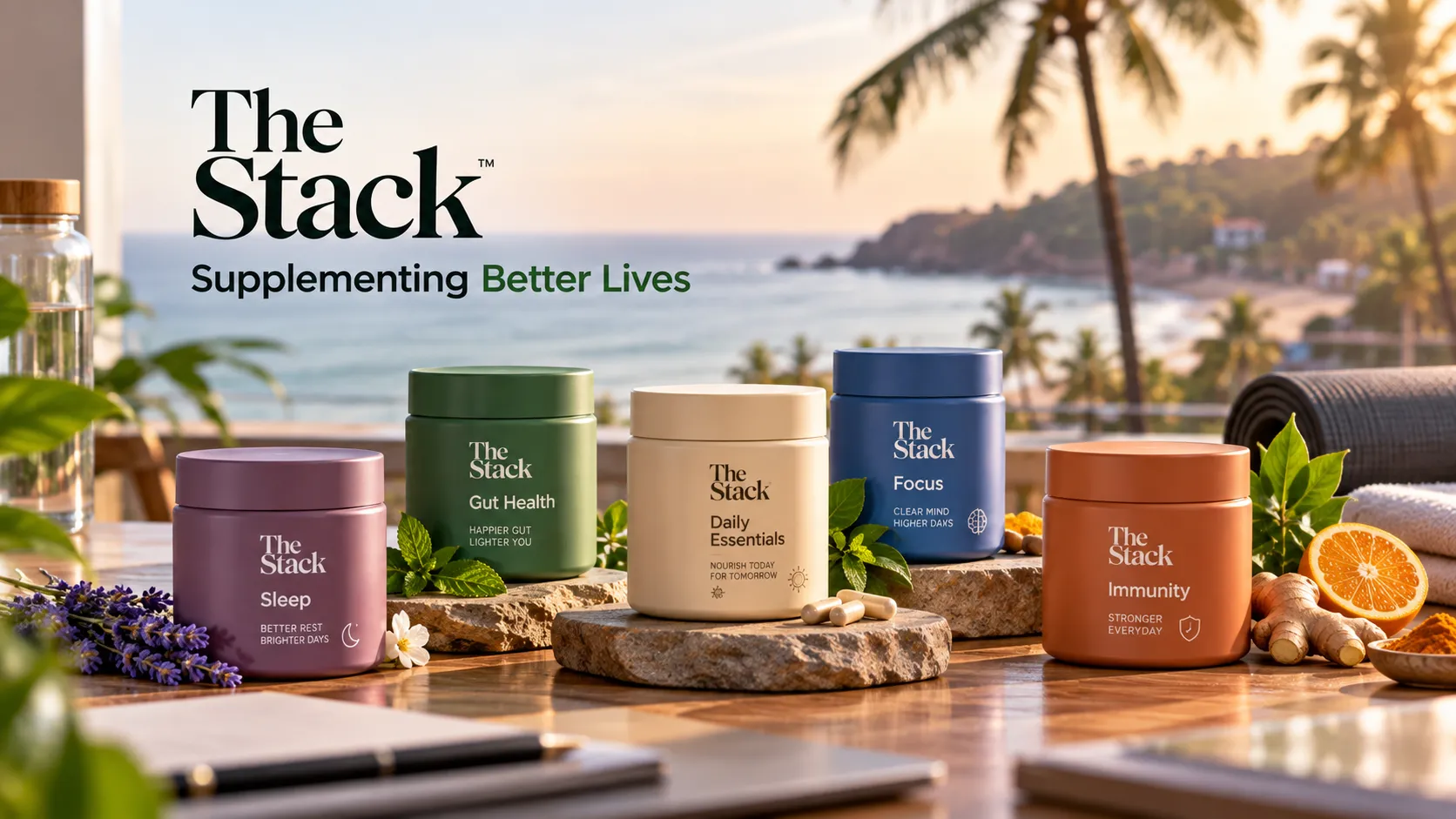
Five Products, by Design
In a category where many direct-to-consumer brands race to launch dozens of SKUs, The Stack has taken the opposite path. The company currently sells just five supplement products, covering sleep, gut health and general functional health.
Rihal has described the strategy as "saying no", both to launching lots of products and to aggressively upselling customers. The approach rests on a simple thesis: in a market where consumers are increasingly sceptical of exaggerated health claims, a tightly curated, science-led range can build more trust than a sprawling catalogue.
The company sells directly to consumers, increasingly through subscriptions, a model that rewards brands whose customers return month after month. According to company-reported figures, about one in three customers places a second order within six months, and the top 10 per cent of customers account for roughly 30 per cent of revenue. The Stack says revenue grew fivefold in the six months after its January round and is targeting six to seven times growth across fiscal 2027. These figures are unaudited, and the company has not disclosed the base from which the growth is measured.
An Early-Stage Company in the Numbers
Regulatory filings show how early the business still is. Stack Nutraceuticals, the legal entity, was incorporated on 5 February 2024 and is registered in Tiswadi, Goa. For the year to March 2025, it reported revenue of ₹5.04 lakh and a net loss of ₹8.87 lakh, according to StartupTalky. Its filings classify it under wholesale trade rather than manufacturing, which suggests production is outsourced to contract manufacturers, a common model among Indian supplement brands. Accounts for fiscal 2026 have not yet been filed.
The gap between those modest early figures and the size of the new round shows that investors are backing trajectory and retention metrics rather than current scale.
A Notable Line-Up of Backers
The investor list blends consumer specialists, operators and a prominent figure from Indian pharmaceuticals.
Sauce, the new lead, is a consumer brands fund whose portfolio includes Supertails, Perfora, MyMuse and Hocco. OTP Ventures is run by Suhail Sameer, the former chief executive of BharatPe; its first fund closed at ₹500 crore and its portfolio includes Traya and NatHabit. Huddle Ventures returns after co-leading the January round.
AYRA Ventures is run by Samina Hamied, a third-generation member of Cipla's founding family. She served as Cipla's executive vice-chairperson from 2016 to 2024 and joined the board of Mahindra & Mahindra as an independent director in October 2025. Her involvement brings pharmaceutical credibility to a brand that is building its identity around scientific rigour.
The round also drew a roster of angel investors, including Delhivery co-founders Sahil Barua, Kapil Bharati and Suraj Saharan; Ultrahuman co-founders Mohit Kumar and Vatsal Singhal; and Viraj Sheth of Monk Entertainment.
Women Founders in India's Wellness Economy
The Stack's raise adds to a growing list of women co-founded consumer brands attracting institutional capital in India's health and wellness market. Women founders remain significantly underrepresented in Indian venture funding, but consumer categories such as beauty, personal care and wellness have been among the more active areas for female-led companies.
For Shreya Jain and her co-founder, the challenge now is to translate early loyalty into durable scale without diluting the focus that defines the brand.
A Market Shaped by Big Exits
The supplements category has seen consolidation that has sharpened investor interest. In February 2026, Hindustan Unilever acquired the remaining 49 per cent of Zywie Ventures, the parent of OZiva, for ₹824 crore, valuing the business at about ₹1,682 crore. HUL had paid ₹264 crore for its initial 51 per cent stake in December 2022. On the same day, HUL sold its 19.8 per cent stake in Nutritionalab, which owns Wellbeing Nutrition, to pharmaceutical company USV for ₹307 crore.
Those deals show that the category's largest exits so far have come through FMCG conglomerates and pharmaceutical companies rather than public markets. For brands such as The Stack, they also offer a template for how value can be realised if a brand builds a loyal customer base and a trusted reputation.
Trust is not just a marketing asset in this category; it is increasingly a regulatory necessity. Health supplements and nutraceuticals in India are governed by the Food Safety and Standards Authority of India, which sets rules on permitted ingredients, dosages, labelling and the claims brands are allowed to make. As the market has grown, regulators and consumer groups have paid closer attention to products promising dramatic results with little evidence. Brands that build their positioning around research, transparent ingredient lists and modest, defensible claims may find themselves better placed than those that relied on aggressive influencer marketing during the category's early boom. For a company led by founders who say their strategy is about restraint, that shift in the market's expectations could work in their favour.
The Road Ahead
The Indian supplements market is crowded and fiercely competitive. New brands launch frequently, performance marketing costs remain high, and regulatory scrutiny of health claims is tightening. Many consumers remain wary of products whose benefits are difficult to verify.
The Stack's bet is that restraint can be a competitive advantage. By keeping its range narrow, investing in research and prioritising retention over aggressive selling, it aims to build the kind of trust that turns first-time buyers into long-term subscribers.
With ₹21.5 crore in fresh capital and backing from investors with deep consumer, operational and pharmaceutical experience, the company now has the resources to test that thesis at a larger scale. The next year will show whether its retention metrics hold as it moves beyond its early adopters and into the broader Indian market.


