Ultraviolette Automotive, one of India's most ambitious electric motorcycle makers, is scaling up both its product range and its manufacturing footprint as it seeks to become a global player in performance electric two-wheelers.
On Thursday, October 22, the Bengaluru-based company launched the X-47 Venom, the next generation of its X-47 Crossover and the first motorcycle built on its new VX-100 platform. The bike carries an introductory price of ₹2.65 lakh for the first 5,000 customers, after which the starting price will rise to ₹3 lakh, Business Standard reported. Bookings opened on launch day, with deliveries due to begin in November.
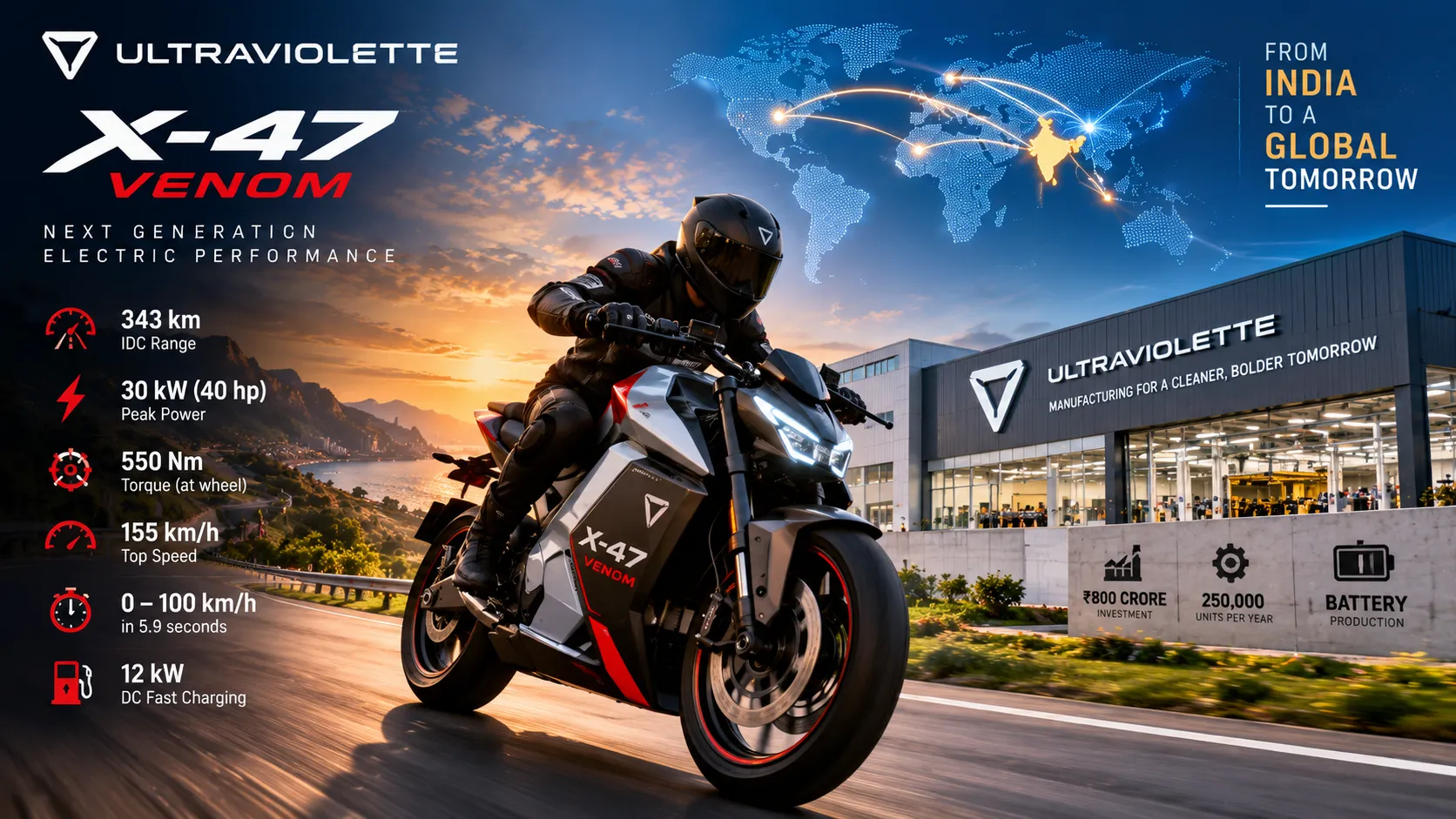
At the same time, the company said it is investing about ₹800 crore in a new manufacturing facility in Hosur, Tamil Nadu, with capacity for 250,000 units a year. The plant will include multiple vehicle assembly lines and battery production lines, adding to its existing facility near Bengaluru, which can produce up to 50,000 units a year.
The X-47 Venom
The X-47 Venom has an Indian Driving Cycle certified range of 343 km, a peak power output of 30 kW (40 hp) and 550 Nm of torque at the wheel. It reaches a top speed of 155 km/h and accelerates from 0 to 100 km/h in 5.9 seconds, according to the company. Its kerb weight of 180 kg is up to 20 kg lighter than the previous generation.
The motorcycle supports 12 kW DC fast charging, which Ultraviolette claims is unique among electric two-wheelers in India, along with a 1.6 kW onboard charger. Features include a 77 GHz rear radar for blind-spot monitoring, lane-change assistance and rear-collision warnings, a 7-inch touchscreen display, cruise control and connected features, Entrackr reported.
A new platform
The VX-100 is a new 100-volt electrical architecture designed to improve performance, efficiency, charging speed, safety and weight. It combines new battery technology, an in-house motor and a next-generation motor control unit. Ultraviolette claims the battery offers up to 20% higher energy density, twice the cooling performance and heat dissipation up to 50% faster than before.
Safety features include a pyro-fuse that isolates the circuit within microseconds during a critical fault, a battery management system that monitors each cell, and individual cell fuses. The modular design will support different battery capacities and power levels across future products.
The company plans to launch four products on the VX-100 platform over the next year, including the Shockwave and Tesseract, as well as other motorcycles and scooters.
Going global
Exports are central to Ultraviolette's strategy. "We are getting big on exports," said co-founder and chief technology officer Niraj Rajmohan. "Over the next two to three years, around 20-25 per cent of our entire vehicle sales will come from international markets."
The company's initial focus is about 20 European countries, including Germany, France, Italy, Spain, the Netherlands and the United Kingdom. It also plans to target North America and Latin America. The X-47 Venom will make its European debut at EICMA, the international motorcycle exhibition in Milan, on November 3.
Europe is an attractive market for premium electric motorcycles, with strong environmental regulations, established motorcycling culture and charging infrastructure. However, it is also competitive, with established manufacturers and specialist electric brands vying for customers.
Ambitious volume targets
Ultraviolette is targeting sales of about 20,000 vehicles a month within two years, split roughly equally between scooters and motorcycles. It expects monthly demand could exceed 10,000 vehicles by the end of the next financial year. "We expect our demand to pick up once the new products are launched," Rajmohan said.
Those targets represent a dramatic increase from the company's current scale, which has focused on premium, low-volume performance motorcycles. Entering the scooter segment, which accounts for a large share of India's electric two-wheeler sales, will be key to reaching them.
The company and its backers
Founded in 2016 by Narayan Subramaniam, its chief executive, and Niraj Rajmohan, Ultraviolette is backed by investors including Lingotto, TDK Ventures, Qualcomm Ventures, Zoho Corporation, TVS Motor Company, Yali Capital and Speciale Invest. Chief executive Subramaniam said the new products combine "distinctive design with deeper engineering capabilities and technology."
India's electric two-wheeler market
India is the world's largest market for two-wheelers, and electric models are gaining share, supported by government incentives, rising fuel costs and growing consumer acceptance. Established manufacturers such as TVS Motor, Bajaj Auto and Hero MotoCorp compete with electric-first companies such as Ola Electric, Ather Energy and newer entrants.
High fuel prices, with crude oil above $110 a barrel amid conflict in West Asia, strengthen the economic case for electric vehicles by widening the gap between fuel and electricity costs per kilometre.
Why it matters for sustainability and Make in India
Ultraviolette's expansion has implications beyond its own business. Electrifying two-wheelers, which make up the majority of vehicles on India's roads, is crucial to reducing urban air pollution and oil imports. Domestic battery manufacturing, which the Hosur plant will include, can strengthen India's EV supply chain and reduce dependence on imports.
Success in exports would also demonstrate that Indian companies can compete in premium global markets with design and engineering, not just low costs.
The economics of electric motorcycles
Performance electric motorcycles face a different set of challenges from electric scooters. Riders of larger motorcycles typically expect long range, high speeds and quick refuelling, which require large batteries and fast charging. Batteries are the most expensive component of an electric vehicle, making premium electric motorcycles costly to produce.
Advances in battery technology, falling cell prices and more efficient motors are gradually improving the economics. Ultraviolette's claims of higher energy density and faster charging on the VX-100 platform are aimed at addressing these concerns. Local production of battery packs at the Hosur plant could also help reduce costs and improve control over quality and supply.
What comes next
Ultraviolette's immediate priorities are deliveries of the X-47 Venom, the European launch at EICMA and the construction of the Hosur plant. Its ability to scale production, maintain quality and win customers abroad will determine whether it can turn its global ambitions into reality. The company's journey will also be watched as a test case for whether Indian electric vehicle startups can build premium brands that resonate with riders in demanding markets such as Europe, where established manufacturers have decades of heritage.