ImpactSustainability5 MIN READ

Electric Aircraft Maker VÆRIDION Raises €30 Million, Unlocking €124 Million in Total to Build Its First Nine-Seat Microliner

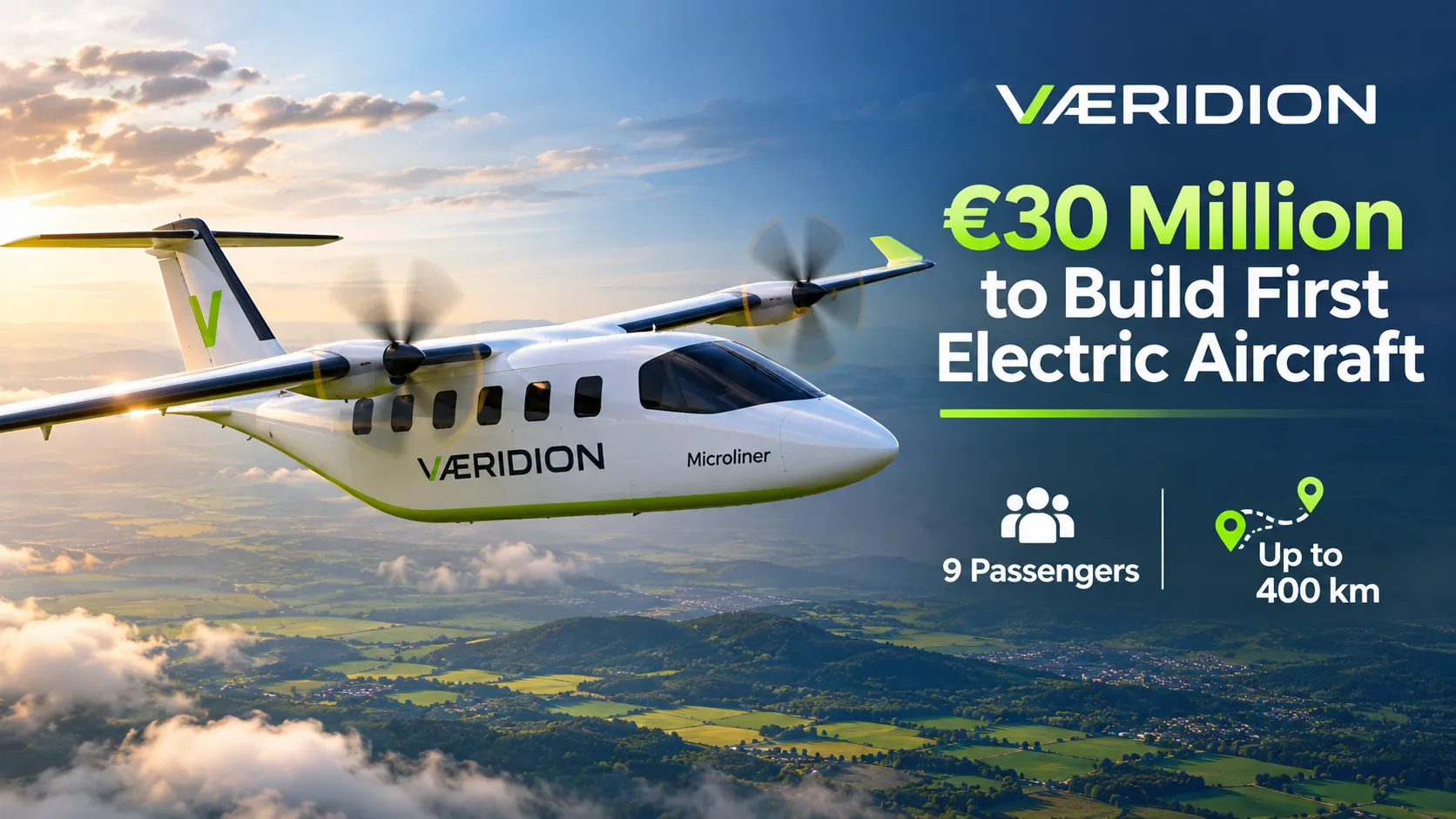
Munich-area startup VÆRIDION raised €30 million in a Series A2 round led by SHIFT Invest and Invest-NL on November 5, part of €124 million in fresh funding that includes a proposed €94.5 million European Commission grant. The company is building a nine-seat all-electric Microliner with a 400 km range, targets certification in 2030 and has provisional orders for 130 aircraft.

By Prathista Lazar · Author6 November 2026New
Electric Aircraft Maker VÆRIDION Raises €30 Million, Unlocking €124 Million in Total to Build Its First Nine-Seat Microliner

A German startup aiming to bring all-electric aircraft to regional routes has secured the funding it needs to build its first certifiable prototype, as rising fuel prices and Europe's climate goals revive interest in electric aviation.

VÆRIDION, based in Oberpfaffenhofen near Munich, raised €30 million in a Series A2 funding round, according to AIN Online, which reported the deal on Thursday, November 5. The round was led by SHIFT Invest and Invest-NL, the Dutch national investment institution, with contributions from World Fund, Project A, Vsquared Ventures and Alexander Rittweger.

Together with a proposed €94.5 million grant from the European Commission, the round brings the company's fresh funding to about €124 million, according to AIN Online. The grant, which would come from the Commission's innovation fund, is intended to develop the final assembly line at Oberpfaffenhofen. Tech Startups noted that the grant is proposed and separate from the equity round.

VÆRIDION has raised €60 million from private investors to date.

"This equity round enables us to build our first conforming aircraft," said founder and chief executive Ivor van Dartel, according to AIN Online. He also highlighted what he described as the company's "exceptional capital efficiency."

The Microliner

VÆRIDION is developing the Microliner, an all-electric aircraft that can carry nine passengers up to 400 kilometres, according to AIN Online. It also offers 10 cubic metres of cabin space for freight, making it suitable for cargo, logistics and medical missions as well as passenger flights.

The aircraft is designed for short regional routes, connecting smaller communities that are poorly served by existing air services, or replacing long road or rail journeys. AIN Online estimated the implied unit price at about €5.6 million.

Timeline to certification

VÆRIDION has already established its certification basis with the European Union Aviation Safety Agency (EASA), and is applying for EASA design organisation approval, according to AIN Online. It plans to begin manufacturing its first conforming prototype, built to the standards required for certification, in early 2027, with flight testing potentially starting in 2027. The company is targeting EASA type certification in 2030.

Orders and partners

The company has provisional sales agreements for 130 Microliners, with a combined prospective value of €730 million, according to AIN Online. The launch customer is ASL, a Belgian private aviation group.

VÆRIDION is working with a range of established aerospace and technology suppliers. Partners include GKN Aerospace, Evolito for electric propulsion, Molicel for batteries, MT-Propeller and Drive System Design.

The fuel price tailwind

VÆRIDION said fuel price spikes linked to the conflict involving Iran have increased interest in electric aircraft, according to AIN Online. Higher jet fuel prices have raised costs for airlines and made the economics of electric aircraft, which use cheaper electricity, more attractive. The company also noted that Europe imports around 57% of its energy, making energy security a strong argument for electrification.

Can electric planes fly?

Electric aviation faces significant technical challenges. Batteries store far less energy per kilogram than jet fuel, which limits the range and payload of electric aircraft. That is why most electric aircraft projects focus on small planes and short routes, where battery technology is already sufficient.

The sector has also seen setbacks. Several electric aviation startups have struggled to raise funds or have collapsed, as development and certification have proved more expensive and slower than expected. VÆRIDION's emphasis on capital efficiency and established suppliers reflects lessons from these failures.

“This equity round enables us to build our first conforming aircraft.”
— Ivor van Dartel, Founder and CEO, VÆRIDION

Aviation's climate challenge

Aviation accounts for a significant and growing share of global carbon emissions, and is one of the hardest sectors to decarbonise. While sustainable aviation fuels and hydrogen are being developed for larger aircraft, electric propulsion offers a zero-emission option for short flights. The European Union has set ambitious climate targets and supports clean aviation technologies through research and innovation funding.

Lessons for India

India has been expanding regional air connectivity through its UDAN scheme, which subsidises flights to underserved airports and smaller towns. Small, low-cost electric aircraft could, in the future, make such regional routes more economical and sustainable. Indian companies and startups are also exploring electric aviation, including electric air taxis, and India's large and growing aviation market could be an important opportunity for electric aircraft makers.

Investors back the vision

VÆRIDION's investor base combines climate-focused venture capital with public institutions. SHIFT Invest is a Dutch impact investor focused on sustainability, and Invest-NL is the Netherlands' national investment institution. World Fund is a European climate tech venture fund, while Project A and Vsquared Ventures are established technology investors. The European Commission's proposed grant reflects the EU's interest in supporting clean aviation technologies developed in Europe.

The mix of private and public funding is common for capital-intensive climate technologies, where long development timelines and regulatory requirements can deter purely private investors.

301d3670-c80c-4e28-9203-171a810629f2.png

The economics of electric flight

Electric aircraft could offer significantly lower operating costs than conventional aircraft on short routes, because electricity is cheaper than jet fuel and electric motors require less maintenance than combustion engines. These savings could make routes that are currently unprofitable viable, particularly to smaller airports. The challenge is to achieve sufficient range and payload with today's battery technology, which is why VÆRIDION has focused on a nine-seat aircraft for short regional routes.

Battery technology continues to improve, and future advances in energy density could extend the range and capacity of electric aircraft, broadening their potential applications.

VÆRIDION's headquarters at Oberpfaffenhofen, a historic aerospace hub near Munich that hosts research institutions and aerospace companies, gives it access to engineering talent and infrastructure. The planned final assembly line, supported by the proposed European Commission grant, would allow the company to move from prototype development to series production if certification is achieved. Building a manufacturing base in Europe also aligns with the EU's goals of strengthening its industrial capabilities in strategic clean technologies and reducing its dependence on imported energy.

The company's progress will also be closely watched by regional airlines and governments seeking low-emission alternatives for short-haul routes across Europe.

What comes next

VÆRIDION will use the funding to build its first conforming Microliner and advance towards certification. The finalisation of the European Commission grant, progress in flight testing and the conversion of provisional orders into firm contracts will be key milestones. Its success would mark an important step towards bringing zero-emission flight to regional routes in Europe and beyond.

TagsVÆRIDIONelectric aviationelectric aircraftMicrolinersustainable aviationIvor van DartelSHIFT InvestInvest-NLWorld FundProject AEuropean CommissionEASAregional aviationzero-emission flightclimate techGKN AerospaceMoliceldecarbonisationIndia regional connectivityinvestors

Reader reviews

Sign in to rate and review this article.
Loading reviews…