
WomenEntrepreneurship11 MIN READ

Vaishali Nigam Sinha: The Wall Street Banker Who Co-Built India's Second-Largest Renewable Energy Company

Vaishali Nigam Sinha left a finance career on Wall Street and in London to co-found ReNew in 2011, building it into India's second-largest renewable energy company and, in 2025, becoming the first private-sector leader elected president of the UN Global Compact Network India.

By Aravind Kumar · Author10 August 2026New
Vaishali Nigam Sinha: The Wall Street Banker Who Co-Built India's Second-Largest Renewable Energy Company

Vaishali Nigam Sinha's route into India's clean energy industry did not run through an engineering degree or a career in power utilities, the more conventional pathways into the sector. It ran through Wall Street. After completing a master's degree in public policy at Columbia University's School of International and Public Affairs, where she studied as an American Association of University Women scholar, Sinha spent years working in finance in New York and London, in roles measured, as she has described it, in deals closed and books balanced. That career, by most external measures, was a success. It was also, by her own account, a source of growing unease — a tension between a metric of professional achievement and a different, harder-to-quantify sense of value she felt was missing.

That tension eventually led her, in 2011, to co-found ReNew alongside her husband, Sumant Sinha, at a moment when renewable energy in India was neither well understood by capital markets nor obviously investable at scale. Fifteen years later, ReNew has grown into India's second-largest renewable energy company and a NASDAQ-listed entity trading under the ticker 'RNW,' and Sinha herself has become one of the most consequential voices shaping how Indian industry approaches sustainability, ESG governance and gender parity in leadership.

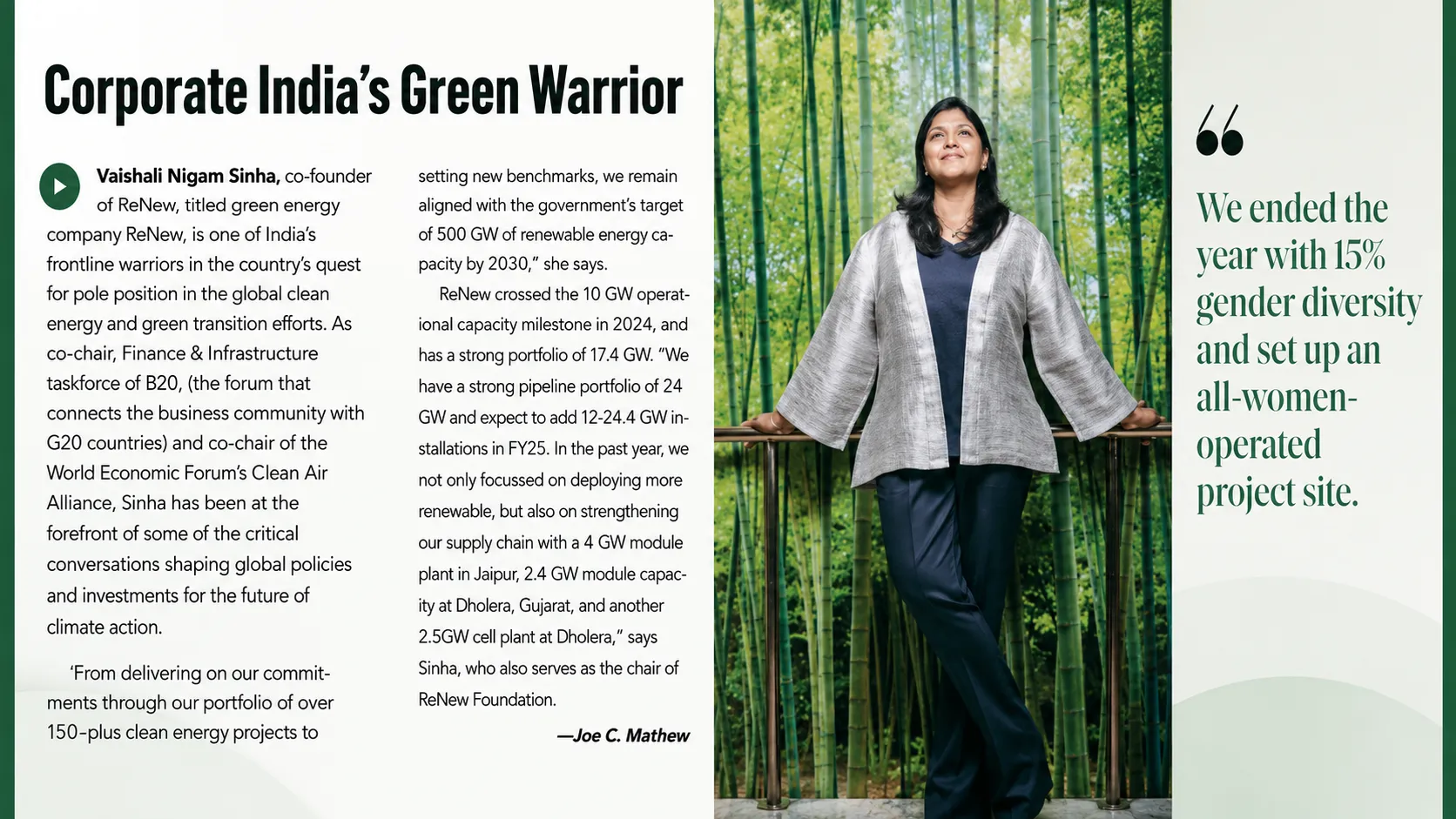
Sinha has been candid about the fact that her role at ReNew was not an obvious or pre-ordained one. 'I thought there was no real role for me at ReNew,' she has said of the company's early days — a striking admission from someone who would go on to become Co-Founder and Chairperson S
ChatGPT Image Aug 10, 2026, 11_49_18 AM.png

ustainability, effectively the architect of how the company positions itself to global capital markets, regulators and civil society. Her reasoning for taking the leap anyway reflects a broader philosophy she has articulated repeatedly in interviews: that genuine value creation tends to live precisely where an opportunity is not yet well understood by the wider ecosystem, but where an individual retains real conviction. Renewable energy in India in 2011, when fossil fuels still dominated the country's generation mix and the economics of solar and wind remained unproven at scale, fit that description closely.

Her background in finance turned out to be far more directly relevant to building ReNew than it might have appeared at the outset. Renewable energy development is, in practice, a capital-intensive business built on structured project finance, long-term power purchase agreements and the ability to raise debt and equity across multiple jurisdictions and currencies — precisely the skill set Sinha had developed over years on Wall Street and in London. As she has put it, describing India's energy transition: 'You have a country with a lot of people below the poverty line, a lot of people without access to electricity. So it was about electricity access first, not just clean electricity' — a framing that distinguishes India's decarbonisation path from that of wealthier economies, where the primary policy goal is simply displacing existing fossil generation rather than simultaneously extending access to power for the first time.

As costs for solar and wind technology fell through the 2010s, the economic case for renewables in India strengthened, and ReNew scaled alongside it. Sinha's specific mandate within the company crystallised around sustainability and ESG strategy, and under her leadership ReNew has assembled a genuinely global set of credentials: the company was named India's top-ranked energy sector company in S&P Global's 2025 Corporate Sustainability Assessment, placing in the 93rd percentile globally and among the top 10% of energy companies worldwide, and it was the only Indian electric utility company included in S&P Global's Sustainability Yearbook 2025. These are not vanity metrics — for a capital-intensive company that depends on continued access to global debt and equity markets, top-tier ESG ratings translate directly into a lower cost of capital and broader access to institutional investors with sustainability mandates.


If you're very comfortable with something, the opportunity to create value isn't as great. And if something isn't really understood by the ecosystem, but you have the conviction, then perhaps you must go for it.
Vaishali Nigam Sinha, Co-Founder, ReNew

Sinha's influence extends well beyond ReNew's own balance sheet. She is the Founding Chair of the ReNew Foundation, the company's philanthropic arm, through which the ReNew India Initiative has reached more than 1.5 million people across roughly 250 villages with community programmes aligned to the UN Sustainable Development Goals — including, notably, a first-of-its-kind training initiative for women that was showcased at the 2022 Sharm el-Sheikh Climate Change Conference, COP27. In 2025, she was elected President of the UN Global Compact Network India, becoming the first private-sector leader to hold that position since the network's founding more than two decades earlier — a role that places her at the intersection of Indian corporate sustainability practice and the UN's global standards-setting apparatus.

Sinha's policy and advocacy footprint reads as extensively as her corporate one. She serves as Co-Chair of the World Economic Forum's Alliance for Clean Air, tackling air pollution through the combined lens of climate action, public health and sustainability; sits on WEF's South Asia Regional Action Group; and acts as a senior advisor to the Alliance of CEO Climate Leaders. She is a member of the Global Advisory Council for the 1 Trillion Trees Initiative and of the Governing Council of The Energy and Resources Institute, one of India's most established environmental policy think tanks. Domestically, she co-chairs the Confederation of Indian Industry's Centre for Women Leadership, and in 2024 she co-chaired the Finance and Infrastructure Task Force of the B20, the official business forum of the G20, under Brazil's presidency of the grouping. She has also written extensively on gender parity in Indian business, co-editing 'Pathways to Equality,' a T20 compendium of essays examining the social, political and economic dimensions of achieving gender equality — work that earned her a place among Business Insider's '100 People Transforming Business' in 2022.

That combination — operating executive, ESG architect, and global policy advocate — is precisely what the 2026 Candere Hurun India Women Leaders List recognised when it ranked Sinha first in its 'New Economy' category, a designation reserved for leaders building India's clean energy, deep-tech and climate-technology sectors from the ground up. The list's broader finding, that 84% of its 117 honourees are self-made rather than having inherited their positions, fits Sinha's own trajectory closely: she did not enter renewable energy through family wealth or an existing industrial base, but through a deliberate professional pivot away from a lucrative finance career and toward a sector she judged, correctly, to be radically under-capitalised relative to its future importance.

Fifteen years after ReNew's founding, Sinha's story has become something closer to a template for how India's clean energy transition has actually been financed and governed — not primarily by engineers scaling up existing technology, but by finance professionals who recognised, early, that decarbonising a country still extending basic electricity access to hundreds of millions of people would require precisely the kind of structured capital markets expertise that Wall Street, ironically, had spent decades perfecting for entirely different purposes.

TagsVaishali Nigam SinhaReNew PowerClean Energy IndiaWomen EntrepreneursSustainabilityESG LeadershipHurun India Women LeadersClimate Finance

Reader reviews

Sign in to rate and review this article.
Loading reviews…
