Madagascar's unique wildlife has long been a target for traffickers. A new partnership with an Indian wildlife centre aims to help bring some of those animals home.
Vantara, the wildlife rescue, rehabilitation and conservation centre in Jamnagar, Gujarat, signed a non-exclusive memorandum of understanding (MoU) with Madagascar's Ministry of Environment and Sustainable Development (MEDD) on Tuesday, November 24, Business Today reported. The agreement covers a ten-year conservation strategy.
The pact fulfils a commitment Vantara made to India's CITES Management Authority on August 19. CITES, the Convention on International Trade in Endangered Species of Wild Fauna and Flora, regulates international trade in protected species.
What the deal covers
Under the agreement, Vantara will help return Malagasy animals seized abroad to Madagascar and support their rescue, rehabilitation and veterinary care. This includes health checks, disease screening, transport, quarantine and post-arrival care.
Vantara will also help train local wildlife experts through training programmes, internships and specialist exchanges, and share scientific expertise, including field research and genetic profiling, to help determine which animals can be returned to the wild and where.
The partnership may include helping to build a National Wildlife Rescue and Rehabilitation Centre in Madagascar. The centre would remain the property of Madagascar, operate under MEDD and be located on land provided by the government.
Final decisions on all matters rest with Madagascar, advised by its CITES Scientific Authority, according to the report.
The voices behind the pact
"These animals belong to the forests that shaped them," said Nolave Luck Aristide Andriatsihala, Madagascar's Minister of Environment and Sustainable Development, according to Business Today.
Rakotondravoninala Valison Kiady of MEDD said the partnership aims to "turn this commitment into concrete actions."
Vantara chief executive Vivaan Karani said that "protecting these species in their natural habitats is central to our ten-year conservation strategy."
Madagascar's extraordinary biodiversity
Madagascar, the world's fourth-largest island, separated from other landmasses millions of years ago, allowing a remarkable array of species to evolve in isolation. The vast majority of its mammals, reptiles and amphibians are found nowhere else on Earth.
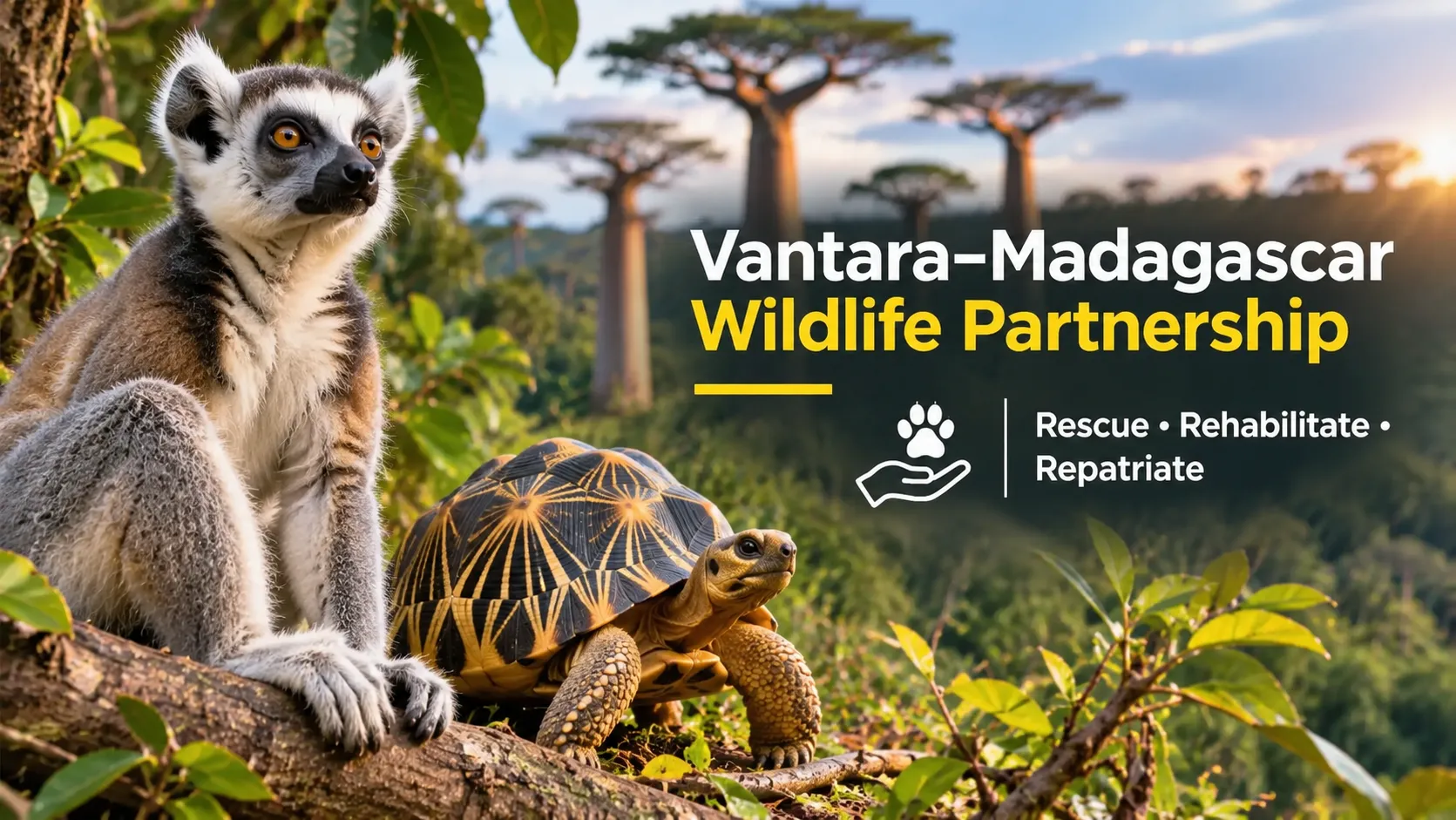
Lemurs, a group of primates found only in Madagascar, are among its most famous inhabitants. According to the IUCN Red List, 90% of Madagascar's lemur species are threatened with extinction, making them one of the most endangered groups of mammals on the planet.
The radiated tortoise, with its striking star-patterned shell, is another iconic species. The Turtle Survival Alliance estimates that wild radiated tortoise numbers fell by more than 47% between the late 1990s and 2013, according to the report.
The threats
Madagascar's wildlife faces severe threats. The island lost about 29% of its tree cover between 2001 and 2023, according to figures cited by Business Today, as forests were cleared for agriculture, charcoal production and logging.
Illegal wildlife trade is the second-leading cause of biodiversity decline after habitat loss. Lemurs and tortoises are trafficked for the exotic pet trade and other markets, often in cruel conditions.
Between January and April 2026, rescuers received more than 1,000 tortoises from six confiscation cases, according to the report. In 2024, Thai authorities intercepted 48 lemurs and more than 1,000 tortoises; 131 tortoises died in transit, and permit complications delayed flights back to Madagascar twice.
Why repatriation is difficult
Returning seized animals to their home country is complex. Animals must be kept healthy during legal proceedings, screened for diseases that could harm wild populations, transported safely and given time to recover before any release. Paperwork and permits between countries can cause long delays, during which animals may suffer or die.
Many countries that seize trafficked wildlife lack the facilities or expertise to care for exotic species, and source countries may lack the capacity to receive large numbers of returned animals. Partnerships that combine veterinary expertise, logistics and funding can help address these gaps.
Vantara's growing global role
Vantara, established by the Reliance Foundation, has grown into one of the world's largest wildlife rescue and rehabilitation facilities, caring for thousands of animals from India and abroad. It has attracted both praise for its scale and resources and scrutiny over the international transfer of animals, with conservation groups and regulators examining the legality and welfare of such movements.
The Madagascar partnership, built around repatriation and in-country capacity building, reflects an emphasis on conservation in species' native habitats.
India–Africa conservation ties
The agreement adds a conservation dimension to growing ties between India and African countries. India has worked with several African nations on wildlife conservation, including the reintroduction of cheetahs from Namibia and South Africa to Kuno National Park under Project Cheetah.
What it means for global conservation
Experts say tackling illegal wildlife trade requires action at every stage: protecting habitats, strengthening law enforcement, reducing demand and ensuring that seized animals are properly cared for and, where possible, returned to the wild. Partnerships between countries and organisations can help close gaps in this chain.
The welfare dimension
Animal welfare experts emphasise that trafficked animals often arrive in poor condition, suffering from stress, dehydration, injuries and diseases. Proper veterinary care, quarantine and gradual rehabilitation are essential before any attempt to return them to the wild.
Some animals may never be suitable for release, and long-term care facilities in their home countries can provide sanctuary while supporting conservation education.
Building local capacity
One of the most significant aspects of the agreement is its focus on training Malagasy wildlife experts. Long-term conservation depends on local professionals who understand the country's ecosystems and can lead rescue, rehabilitation and monitoring efforts.
Internships and specialist exchanges can help build that expertise, while a national rescue centre would give Madagascar its own infrastructure for handling confiscated animals.
A long-term commitment
The ten-year horizon of the partnership is significant. Conservation outcomes such as restoring wild populations take many years to achieve, and long-term commitments allow partners to plan, build infrastructure and train staff without the uncertainty of short funding cycles.
Regular reporting on animals repatriated and released would help demonstrate the partnership's impact.
Public awareness
Conservation groups say that reducing demand for exotic pets is as important as enforcement. Public awareness campaigns in destination countries can discourage people from buying trafficked animals, cutting off the market that drives poaching.
What comes next
Vantara and Madagascar's environment ministry will now work on implementing the agreement, including planning for the proposed rescue centre and the repatriation of animals currently held abroad. Conservationists will watch whether the partnership delivers measurable results for lemurs, tortoises and Madagascar's other threatened species.