
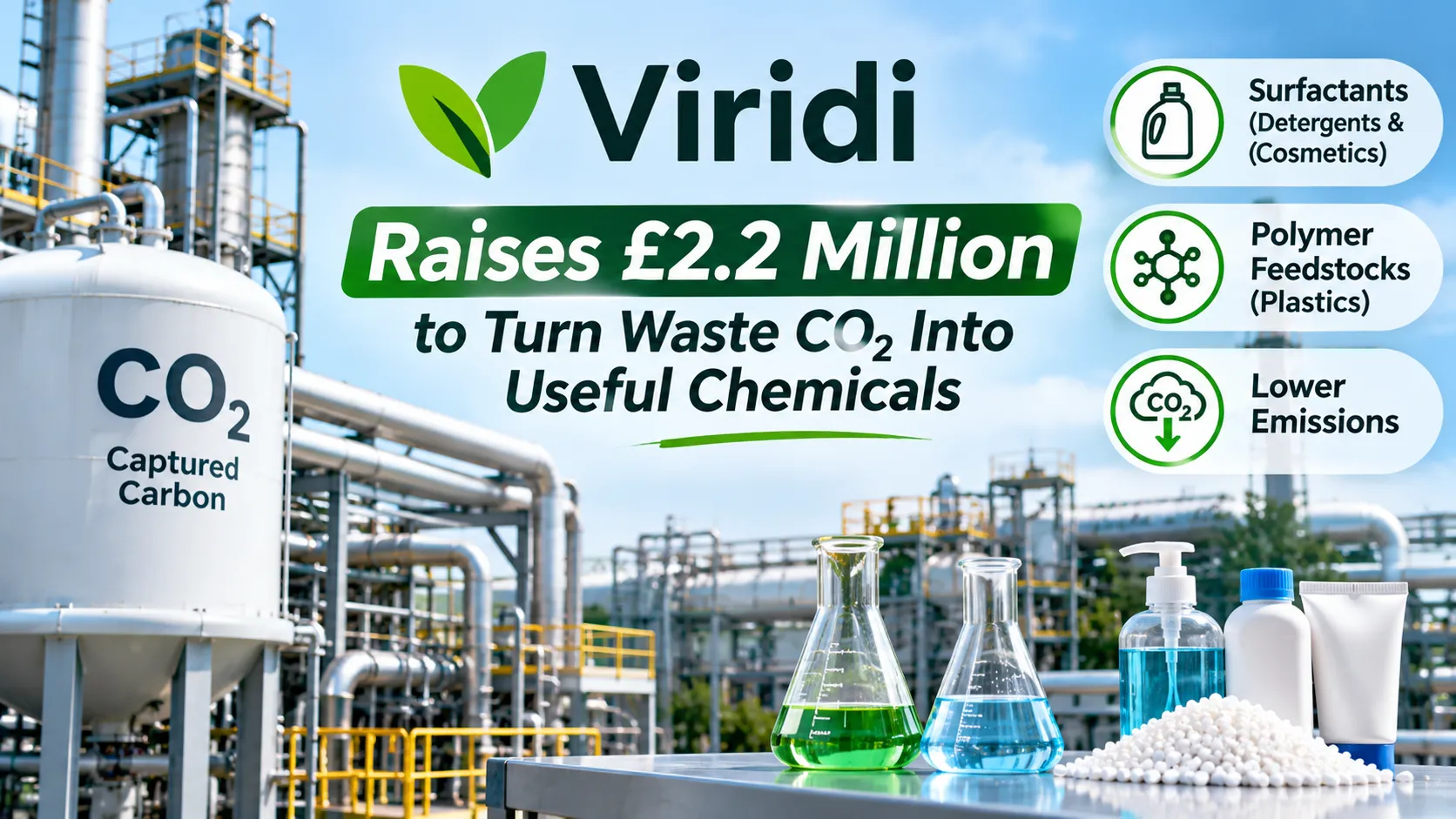
Viridi, a Southampton-based climate technology company that turns waste carbon dioxide into useful chemicals, has raised £2.2 million in new funding, according to venture capital news site FinSMEs, which reported the deal on November 3.
The company provides a catalyst platform for converting CO2 into chemicals. The technology is designed to help chemical manufacturers replace part of the fossil-fuel-derived feedstocks they rely on with carbon dioxide captured from their own emissions or other sources.
The round is modest in size compared with the multimillion-dollar rounds raised by AI startups. But it targets one of the most stubborn problems in the energy transition: how to decarbonise heavy industries whose products are themselves made from fossil carbon.
From a university lab to industry
Viridi traces its roots to research at the University of Southampton's School of Chemistry. The underlying technology emerged from the doctoral research of co-founder Dr Daniel Stewart, working with Professor Robert Raja. The pair developed a patented hybrid catalyst platform capable of efficiently converting carbon dioxide into high-value chemical products.
The venture, originally known as ViridiCO2, spun out of the university in November 2021. Its early development was supported by research funding from the Engineering and Physical Sciences Research Council (EPSRC), follow-on support from Innovate UK, and angel investors, many of them Southampton alumni. In 2020, the technology won the Royal Society of Chemistry's Emerging Technologies Competition, an early sign of recognition from the scientific community.
In 2023, the company raised a £3 million seed round led by EQT Ventures to accelerate development and commercialisation. The latest £2.2 million round adds further capital as it moves towards industrial deployment.
How the technology works
Carbon dioxide is a very stable molecule, which makes it difficult and energy-intensive to convert into other substances. That has been a fundamental barrier to carbon capture and utilisation (CCU), the idea of using captured CO2 as a raw material rather than simply storing it underground.
Viridi's solution is a solid catalyst that "activates" CO2 so that it can react with other chemicals under more practical conditions. The company has said its technology can be retrofitted into existing chemical processes, allowing manufacturers to use CO2 in place of part of their petrochemical feedstock without rebuilding entire plants.
The products include surfactants, the active ingredients in detergents, shampoos and many cosmetics, as well as polymer feedstocks used to make plastics and a range of smaller molecules. The company has previously said its approach could reduce manufacturing costs by up to 30% for some processes, partly by lowering energy requirements, while cutting emissions. These are company claims that will need to be proven at commercial scale.
The vision is a circular one. A chemical plant captures CO2 from its own waste gas, converts it into ingredients for consumer products, and in doing so reduces both its emissions and its purchases of oil-derived raw materials.
Why chemicals are so hard to decarbonise
The chemicals industry is one of the largest industrial sources of greenhouse gas emissions in the world. Unlike sectors such as power generation, where renewables can directly replace coal and gas, the chemicals sector faces a double challenge. It uses large amounts of energy, much of it from fossil fuels, to drive reactions. And many of its products are made from carbon atoms that come from oil and gas.
Cleaning up the energy supply only solves part of the problem. To make plastics, detergents and other carbon-based products without fossil fuels, manufacturers need alternative sources of carbon: biomass, recycled materials, or captured CO2.
That is why CCU technologies like Viridi's attract attention from investors, governments and chemical companies. If captured carbon can be turned into valuable products at competitive cost, it creates an economic incentive for capture that does not rely solely on carbon prices or regulation.
The challenges ahead
Climate technology startups in heavy industry face a well-known "valley of death" between lab-scale success and commercial deployment. Building pilot and demonstration plants is expensive, chemical companies are conservative about changing proven processes, and customers often want to see years of reliable operation before committing.
The economics of CCU also depend on factors beyond the technology itself: the cost of capturing CO2, energy prices, the market value of the end products, and the extent to which governments reward low-carbon products through regulation, procurement or carbon pricing. Critics of CCU note that some products made from captured CO2 eventually release that carbon again, such as when a detergent breaks down, so the climate benefit depends on careful life-cycle accounting.
Funding for climate technology has also become more selective. After the boom of 2021 and 2022, venture investment in climate tech cooled as interest rates rose and investors grew wary of capital-intensive businesses with long paths to revenue. Industrial decarbonisation startups now have to show clearer evidence of customer demand, offtake agreements or partnerships with established manufacturers to secure new rounds. Against that backdrop, each round raised by a deep-science climate company is a vote of confidence that its technology has a credible route to market.
The global and Indian context
Viridi's raise comes as governments and corporations worldwide look for credible routes to cut industrial emissions. Europe has introduced carbon border adjustments and emissions trading that raise the cost of carbon-intensive production. Consumer goods companies have set targets to reduce emissions across their supply chains, creating demand for lower-carbon ingredients.
For India, which has one of the world's fastest-growing chemicals industries and has committed to net-zero emissions by 2070, technologies like Viridi's are directly relevant. Indian chemical makers export heavily to Europe and the United States, where buyers are increasingly scrutinising carbon footprints. India's own research institutions and startups are also working on carbon capture and utilisation. Partnerships between Indian manufacturers and international technology developers could accelerate adoption.
For now, Viridi's £2.2 million round is a small but meaningful step. It shows that investors continue to back scientific founders tackling the hardest parts of the climate challenge. They may be less glamorous than consumer apps, but they are essential if the world is to reach net zero.