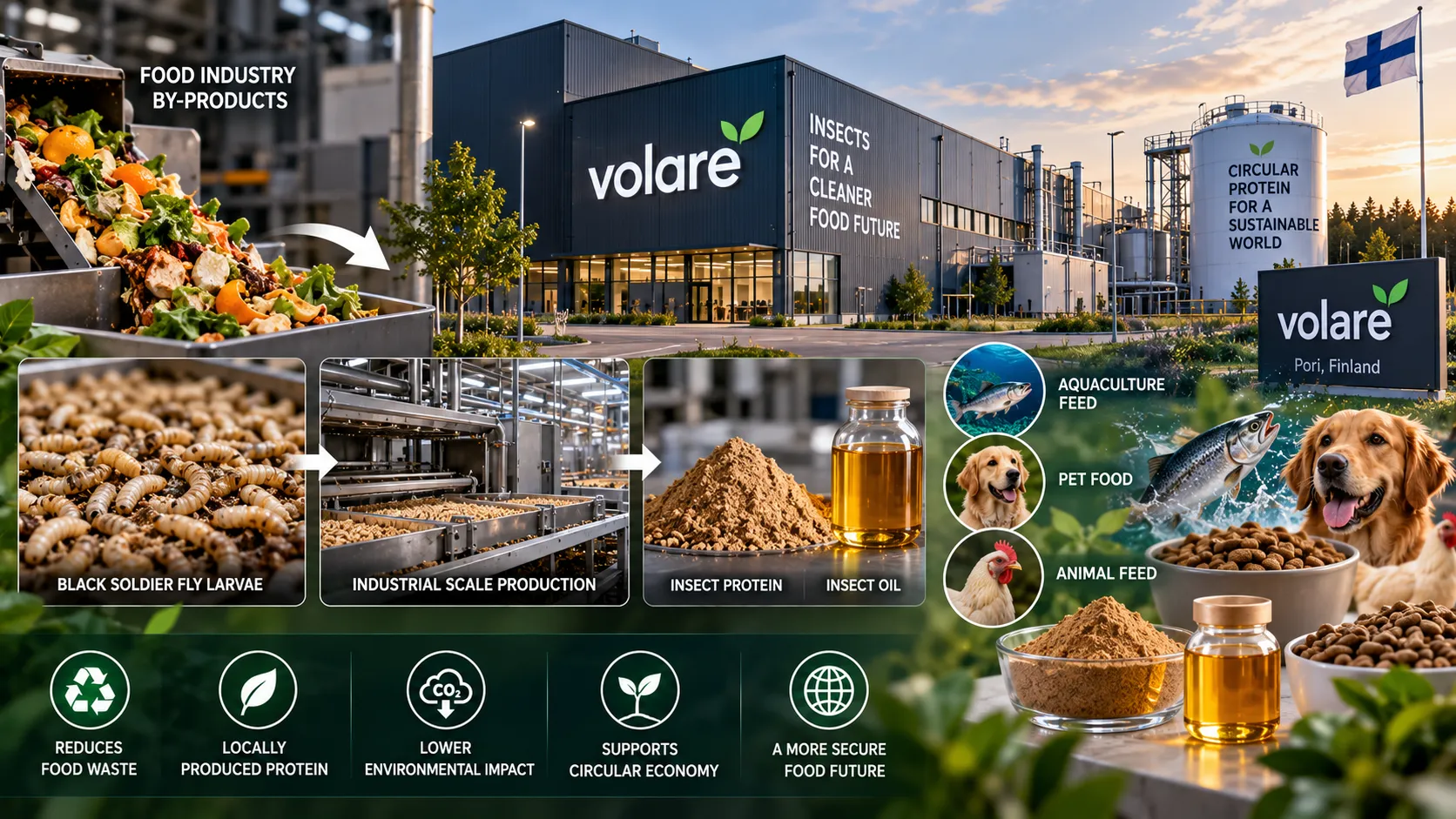
Volare, a Finnish company that turns food-industry by-products into protein using insects, has raised €7.1 million in new funding and opened its first industrial-scale factory, marking a milestone for Europe's emerging insect protein industry.
The round, announced on 26 October, was led by Springvest, with participation from new and existing investors, including venture capital firm Maki.vc. The money will finance a second factory and wider European expansion.
The company's first plant, Volare 01, is located in Pori, on Finland's west coast. Built in a former newspaper printing hall covering 10,000 square metres, it was delivered on schedule and within its €15 million budget and is designed to produce up to 5,000 tonnes of insect protein and 2,000 tonnes of insect oil each year.
A Woman Leading Industrial Food Tech
Volare was founded in 2021 by Jarna Hyvönen, Tuure Parviainen and Matti Tähtinen as a spin-off from VTT Technical Research Centre of Finland, the country's leading state-owned research institute. Hyvönen serves as chief executive.
The company's technology has deeper roots: work on its process began at VTT in 2014, illustrating the long development timelines typical of deep-tech and industrial biotechnology ventures.
"Volare 01 proves that our technology and production model work at industrial scale," Hyvönen said. Moving from laboratory and pilot production to an industrial plant is one of the most difficult steps for food technology companies, and many have struggled to make the transition on time and on budget.
Hyvönen's leadership of an industrial food-tech venture is notable in a sector where women remain under-represented among founders and chief executives, particularly in capital-intensive manufacturing businesses.
How It Works
Volare uses the larvae of the black soldier fly, an insect that can consume a wide range of organic material. The larvae are fed side streams from the food industry, by-products that might otherwise be discarded or used for low-value purposes, and convert them into protein and fat within about a week.
The company says its process covers the full chain, from rearing larvae to producing finished protein and oil ingredients, and generates no process wastewater. The resulting protein can be used in animal feed, including fish feed and pet food.
Customers Lined Up
Volare has secured significant commercial commitments. Skretting, one of the world's largest producers of aquaculture feed, has agreed offtake contracts covering a significant share of the Pori plant's capacity.
The company's protein has been used commercially since 2022, including in insect-based dog treats with Alvar Pet, cat food under the Dagsmark brand of Vafo Group, and rainbow trout feed with Alltech Fennoaqua.
Why Insect Protein Matters
The global food system faces growing pressure to produce more protein with fewer environmental impacts. Aquaculture and livestock feed rely heavily on soy, much of it imported from South America, where its cultivation has been linked to deforestation, and on fishmeal made from wild-caught fish, which places pressure on ocean ecosystems.
Insect protein offers an alternative. Insects can be reared on organic by-products, require relatively little land and water, and convert feed into protein efficiently. By using food-industry side streams, insect production can also contribute to a circular economy, turning waste into valuable products.