
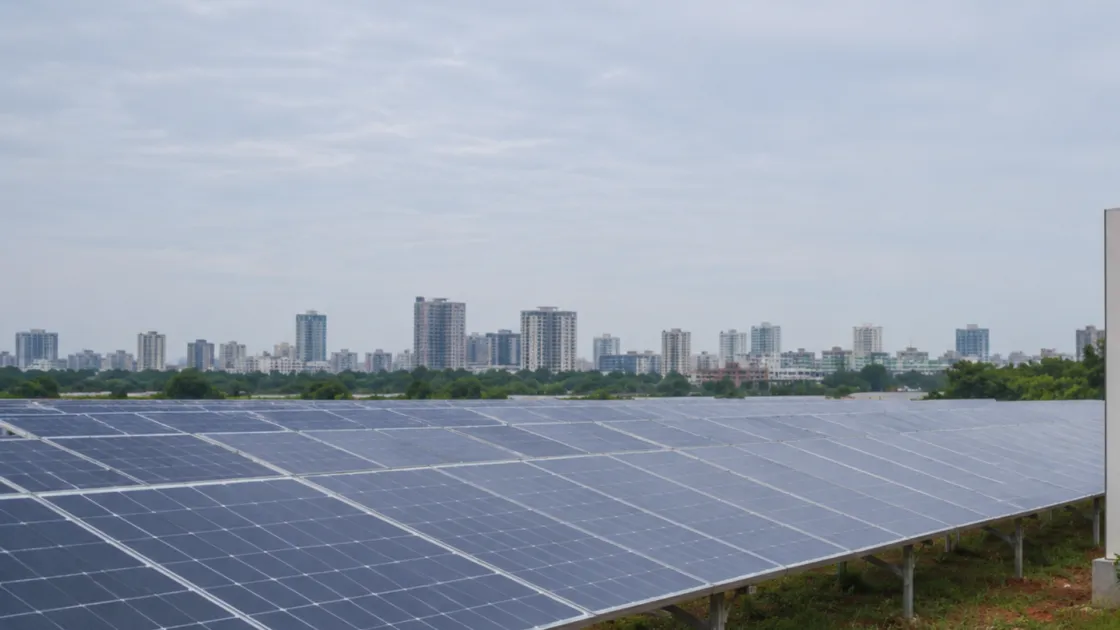
WeWork India Management Limited has announced plans to develop a 10 megawatt-peak, direct current, ground-mounted solar power plant in Karnataka, marking one of the more concrete renewable energy commitments to emerge from India's flexible workspace sector. The project reflects a broader trend among commercial real estate and coworking operators to address the energy footprint of large office portfolios that have historically relied heavily on grid electricity, much of it still generated from fossil fuel sources in several Indian states.
Flexible workspace operators occupy a somewhat unusual position within the broader real estate decarbonisation conversation, since they typically operate leased rather than owned buildings, limiting their direct control over a property's core infrastructure, but retain significant influence over energy procurement decisions, tenant-facing sustainability commitments and, increasingly, direct investment in renewable generation capacity of their own.
The announcement also reflects growing pressure across India's commercial real estate sector to demonstrate concrete decarbonisation progress, as both domestic and international corporate tenants increasingly incorporate landlord and workspace provider sustainability credentials into their own environmental, social and governance reporting requirements, particularly for multinational tenants operating under global net-zero commitments.
Real estate professionals note that commercial tenants increasingly negotiate sustainability performance clauses directly into lease agreements, a shift that has made landlord and workspace provider renewable energy credentials a matter of direct commercial consequence rather than purely reputational positioning, giving WeWork India's solar investment tangible relevance to ongoing and future tenant negotiations across its broader Indian portfolio beyond the specific Karnataka facility involved in this particular project.
A dedicated ground-mounted solar facility of this scale represents a meaningful commitment relative to typical corporate renewable energy investments in the flexible workspace category, where sustainability efforts have more commonly centred on smaller-scale interventions such as energy-efficient lighting retrofits, waste management programmes or green building certifications rather than direct generation capacity ownership.
The Karnataka location is notable given the state's relatively favourable solar irradiance profile and its established position as one of India's more advanced renewable energy markets, with a regulatory and grid infrastructure environment that has historically been more accommodating to corporate open-access solar projects than several other Indian states.
Ground-mounted solar installations of this scale typically require securing suitable land parcels, navigating state-specific renewable energy regulatory approvals, and establishing power transmission or open-access arrangements that allow generated electricity to be delivered to the intended commercial consumption points, a process considerably more complex than simply installing rooftop solar panels on existing office buildings.
India's overall installed solar capacity has grown substantially over the past decade, driven predominantly by large utility-scale projects, but corporate and commercial open-access solar, the category WeWork India's project falls under, has emerged as an increasingly significant complementary growth segment as companies seek more direct control over their energy sourcing and cost structures.
For WeWork India, the solar investment also carries commercial logic beyond pure sustainability positioning. Corporate tenants across India, particularly multinational companies with global net-zero commitments, increasingly factor a landlord or workspace provider's renewable energy credentials into vendor selection decisions, making demonstrable clean energy investment a competitive differentiator in commercial real estate procurement processes that have grown considerably more sustainability-conscious over the past several years.
The broader Indian commercial real estate sector has faced growing pressure to decarbonise, given that buildings and construction collectively account for a substantial share of the country's overall energy consumption and carbon emissions, a dynamic that has pushed both developers and occupiers toward more ambitious clean energy procurement strategies than were common even five years ago.
Karnataka's regulatory environment for open-access solar projects has been considered comparatively favourable within India, with the state having implemented policies that make it easier for commercial and industrial consumers to procure renewable electricity directly from dedicated generation projects rather than relying solely on the local electricity distribution utility's overall power mix.
For business leaders and institutional investors evaluating India's commercial real estate sector, WeWork India's solar investment offers a useful benchmark for the kind of direct renewable energy commitment that tenant companies with their own sustainability targets are increasingly likely to expect from workspace and property providers as a baseline expectation rather than a differentiating extra.
As the project moves from announcement to construction and eventual commissioning, its success will offer a useful reference point for other flexible workspace and commercial real estate operators considering similar direct investment in renewable generation capacity, rather than relying solely on renewable energy certificates or third-party power purchase agreements to meet their sustainability commitments.
More broadly, the announcement adds to a steady stream of corporate solar investment commitments emerging from India's services and real estate sectors in 2026, reinforcing a pattern in which companies with large, distributed physical footprints are increasingly treating direct renewable generation ownership as core infrastructure strategy rather than a peripheral sustainability initiative.
As more Indian commercial real estate operators consider similar direct renewable energy investments, the sector's overall approach to decarbonisation is likely to continue evolving from indirect measures such as purchasing renewable energy certificates toward direct ownership of generation assets, a shift that offers both stronger sustainability credentials and, over the long term, potentially more predictable and lower electricity costs than continued reliance on conventional grid power.
Policymakers focused on India's renewable energy transition are likely to welcome the announcement as further evidence that corporate open-access solar policies, particularly in states like Karnataka with more favourable regulatory frameworks, are succeeding in mobilising private commercial investment into distributed renewable generation capacity beyond the large utility-scale projects that have historically dominated India's solar capacity additions.
The bottom line for TIGI's readers: WeWork India's solar commitment shows commercial real estate operators moving from sustainability messaging to direct renewable energy ownership, a shift likely to become the industry norm rather than the exception.
Sustainability consultants advising India's commercial real estate sector expect direct renewable generation investment of this kind to become an increasingly standard expectation within corporate leasing negotiations over the next several years, rather than remaining a differentiating feature reserved for a handful of leading operators. As the Karnataka facility moves from announcement toward construction, its commissioning timeline and eventual output performance will offer a concrete benchmark other flexible workspace operators can reference when evaluating similar direct investment in renewable generation assets.