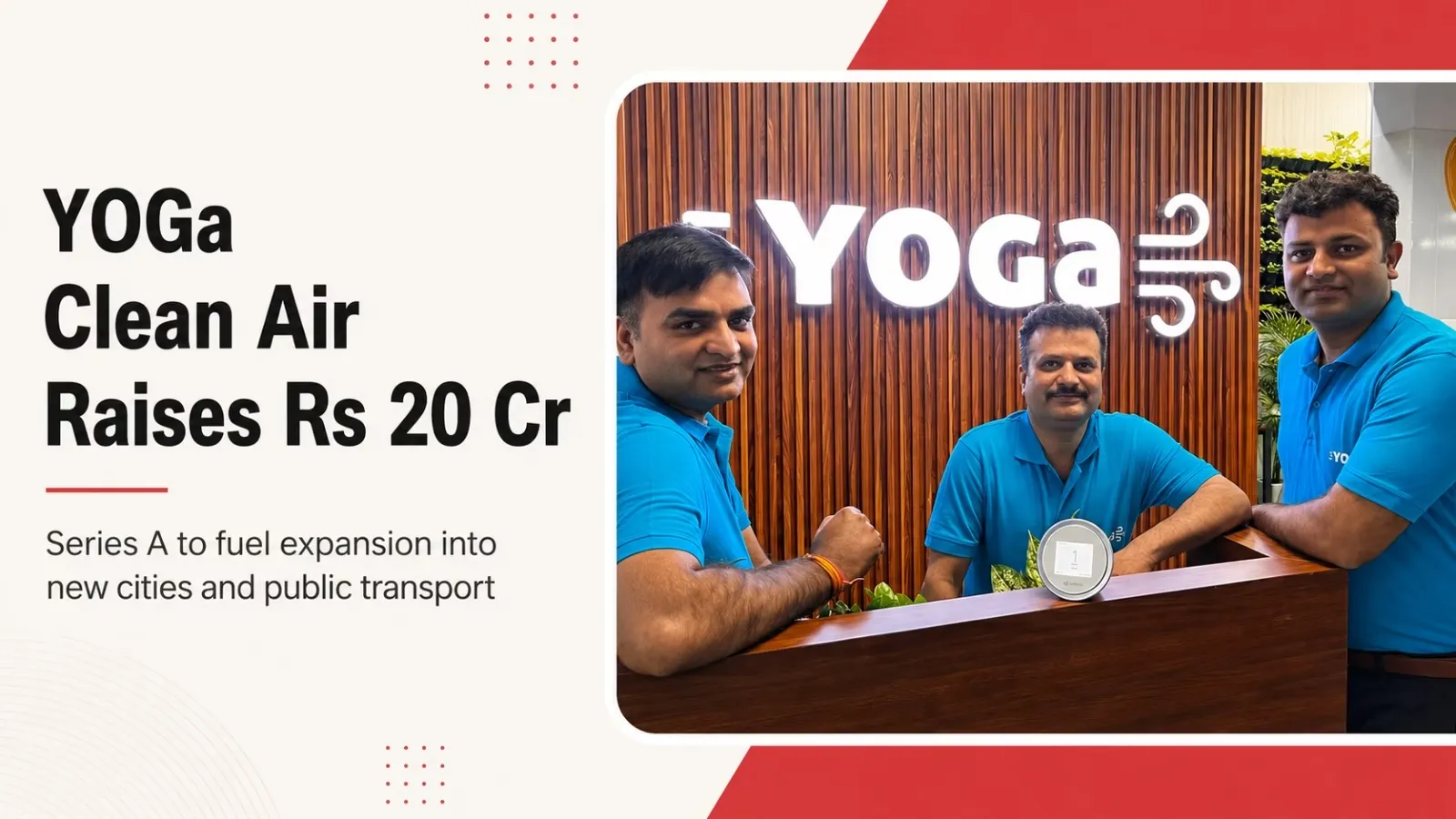
Indian air-quality technology company YOGa Clean Air has raised ₹20 crore, approximately $2.1 million, in Series A funding led by Info Edge Ventures, the company announced on August 31 — marking its first external capital raise since founding. Eternal founder Deepinder Goyal and Three Words Capital also participated in the round, lending significant industry credibility to a startup tackling one of urban India's most persistent public-health challenges.
YOGa develops indoor air-quality systems built around what the company calls its Clean Air Bubble technology, which filters incoming air while maintaining positive pressure inside enclosed environments — an approach designed to actively reduce the infiltration of polluted outdoor air rather than simply filtering air already inside a space. The company says its systems are already operating across multiple Indian cities, deployed in homes, schools, hospitals, offices and other buildings where air quality has become an increasingly pressing concern.
India's chronic urban air-pollution crisis, particularly acute across northern cities during winter months, has created sustained demand for both consumer and institutional air-purification solutions. However, most existing products on the market remain standalone appliances designed for individual rooms, limiting their effectiveness at addressing air quality across entire buildings or larger enclosed spaces. YOGa's positioning as an installed infrastructure solution rather than a consumer appliance represents a strategic bet that the addressable market extends far beyond individual purifier sales.
The involvement of Deepinder Goyal, one of India's most prominent startup founders and a figure closely associated with the country's consumer-technology success stories, adds considerable visibility to YOGa's fundraising milestone. His participation as an individual investor, alongside institutional backing from Info Edge Ventures — one of India's most established venture-capital firms with a long track record in consumer and enterprise technology — signals strong conviction in the startup's underlying technology and commercial trajectory.
Climate-tech and environmental-health startups have increasingly attracted investor interest across India as public awareness of air pollution's health impacts has grown, alongside rising demand from institutional buyers such as schools, hospitals and corporate offices seeking to provide healthier indoor environments for employees, students and patients. YOGa's institutional-first deployment strategy positions the company to capture this demand more directly than consumer-appliance competitors.
With the fresh capital, YOGa is expected to accelerate its expansion across additional Indian cities while further developing its Clean Air Bubble technology platform. The funding round adds the company to a growing cohort of Indian climate-tech startups addressing environmental and public-health challenges through technology-driven infrastructure solutions, reflecting a broader shift in investor appetite toward ventures that combine clear social impact with defensible, scalable business models.
As India continues to grapple with some of the world's worst urban air quality, startups like YOGa are increasingly positioned not merely as environmental ventures but as essential infrastructure providers — a reframing that is likely to shape how investors evaluate climate-adjacent health-technology startups across the Indian market in the years ahead.
The public-health economics underpinning YOGa's business case are substantial. Multiple independent studies have linked chronic exposure to India's urban particulate pollution with elevated rates of respiratory illness, cardiovascular disease and reduced cognitive performance, particularly among children — costs that increasingly factor into how institutional buyers such as schools and hospitals evaluate long-term facility investments. Positioning air-quality infrastructure as a preventative health expenditure, rather than a discretionary comfort upgrade, has proven an effective framing for winning institutional procurement conversations.
YOGa's Series A also arrives amid growing scrutiny of the effectiveness gap between standalone consumer air purifiers and genuine building-level air-quality management, with several independent efficacy studies suggesting single-room purifiers often deliver limited real-world benefit in spaces with poor sealing or high occupant turnover. Companies that can demonstrate rigorously measured air-quality improvements at the building level, rather than relying on manufacturer specifications alone, are likely to hold a meaningful credibility advantage as institutional buyers grow more sophisticated in evaluating competing air-quality solutions.
YOGa's institutional sales cycle, which typically involves engaging facilities managers, procurement teams and sometimes public-health officials rather than individual consumers, requires a fundamentally different go-to-market approach than the direct-to-consumer marketing strategies most household air-purifier brands rely on. Building this institutional sales capability represents a significant organisational investment for an early-stage company, and the Series A funding is likely to be directed substantially toward building out the enterprise sales and technical-support functions needed to close and service larger institutional contracts effectively.
The broader climate-adjacent health-technology category that YOGa occupies has attracted growing attention from impact-oriented investors globally, who increasingly view air-quality infrastructure as a measurable, quantifiable social-impact investment given the well-documented health outcomes associated with pollution exposure reduction. This framing has helped companies like YOGa access a broader pool of capital than a purely commercial climate-tech or consumer-hardware narrative might otherwise attract, blending impact-investment and conventional venture-capital funding sources in ways that are becoming increasingly common across India's environmental health-technology sector.
As YOGa scales its institutional deployments, the company's long-term success will likely hinge on its ability to produce independently verifiable air-quality outcome data that can withstand scrutiny from increasingly sophisticated institutional buyers, positioning rigorous measurement and transparent reporting as a core differentiator rather than a secondary consideration relative to the underlying filtration technology itself.
For India's institutional buyers evaluating competing air-quality vendors, independently audited performance data is likely to become an increasingly decisive factor, favouring companies willing to open their systems to third-party verification over those relying solely on internal efficacy claims.
The company's next fundraising milestone will likely hinge on demonstrating measurable expansion of its installed base beyond its current metro footprint into India's broader tier-two urban markets, where air-quality challenges are increasingly acute but institutional purchasing power remains comparatively less developed.