
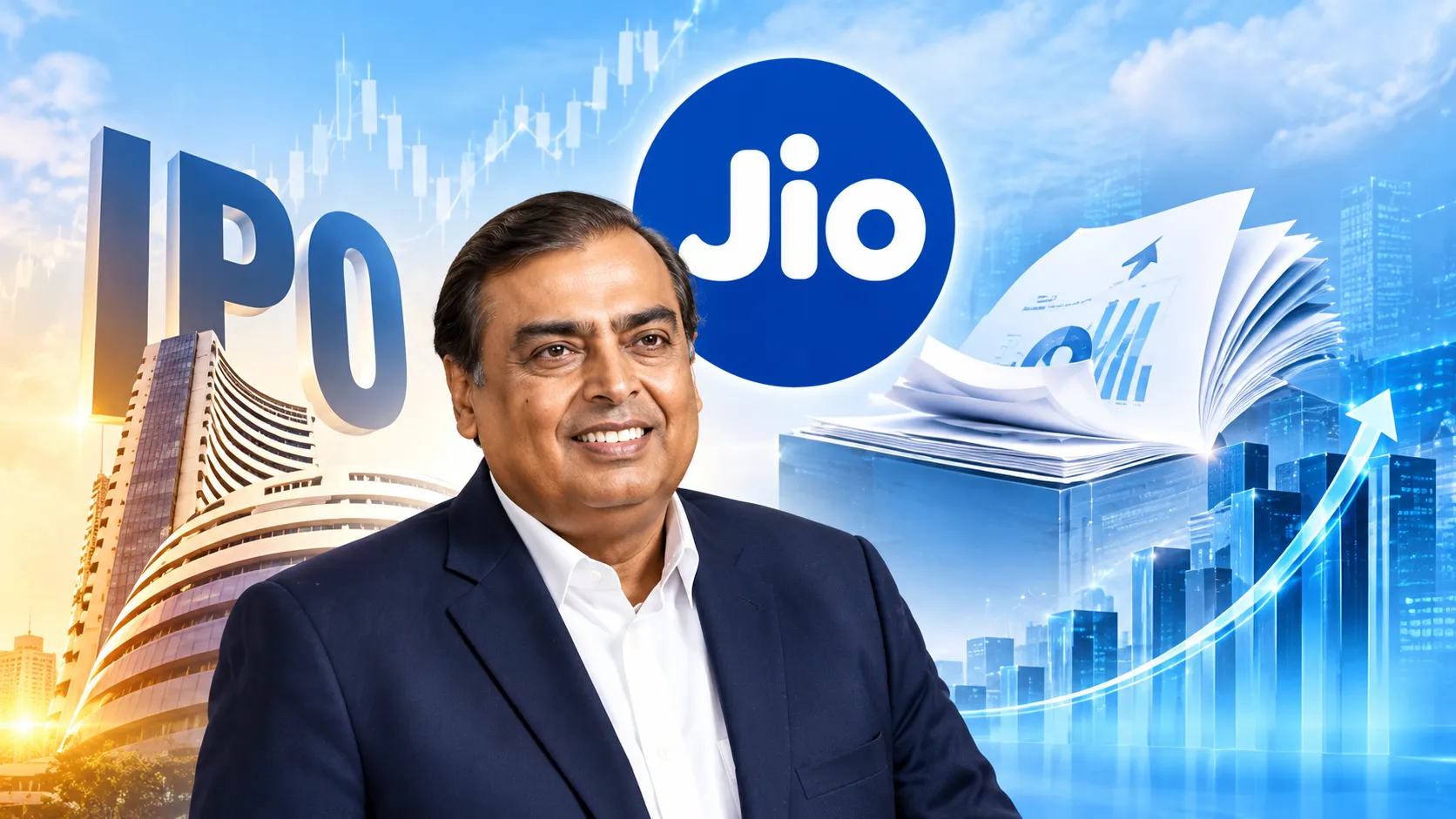
Jio Platforms raised ₹8,110 crore from anchor investors at ₹1,119 a share after institutional bids topped ₹2.5 trillion, more than 30 times the shares on offer. LIC, Capital Group, GIC, BlackRock and leading Indian mutual funds took allocations ahead of the ₹30,213 crore IPO, which opens on October 21.
<p>India's largest-ever initial public offering has cleared its first test with room to spare. Jio Platforms, the digital and telecom arm of Mukesh Ambani's Reliance Industries, raised ₹8,110 crore from anchor investors on Monday, October 19, after the anchor book attracted institutional bids worth more than ₹2.5 trillion, according to bankers involved in the deal.</p><p>That level of demand, more than 30 times the shares set aside for anchors, is being described by bankers as a record for an Indian IPO. Jio allocated 72.4 million shares to anchor investors at ₹1,119 apiece ahead of the opening of the ₹30,213 crore public offer on Wednesday, October 21. The issue closes on October 23.</p><p>The response from global and domestic institutions offers an early signal that the offering, expected to value Jio at more than ₹10 trillion, can attract serious money even at a time when foreign portfolio investors have been pulling record sums out of Indian equities.</p><h2>Who bought in</h2><p>The anchor list reads like a directory of the world's largest pools of capital. Life Insurance Corporation of India took the biggest single allocation of ₹500 crore, or 6.17% of the anchor book. Capital Group's New World Fund received ₹486.2 crore, and the Government of Singapore about ₹341 crore.</p><p>Capital International, GIC, BlackRock, Fidelity's FMR, SBI Mutual Fund, HDFC Mutual Fund and ICICI Prudential Mutual Fund each received about ₹425 crore. Capital World and Aditya Birla Sun Life Mutual Fund took ₹300 crore each, and Schroders ₹293 crore. Entities linked to the Abu Dhabi Investment Authority, already an investor in Jio, were allotted about ₹239 crore.</p><p>Further down the list came Nippon, Kotak and Ninety-One Global with ₹200 crore each, JP Morgan asset management funds with ₹182 crore, and a long tail of insurers, pension funds and asset managers including Allianz Global, Franklin Templeton, HDFC Life, SBI Life, Norway's Government Pension Fund Global, T. Rowe Price, Morgan Stanley, Janus Henderson and Motilal Oswal. Family offices associated with HCL, the Premji family and Zerodha's Rainmatter Investments also featured, according to the reported allocations.</p><p>The breadth of participation, spanning sovereign wealth funds, US mutual fund complexes, European asset managers and India's largest domestic institutions, matters as much as the headline number. It suggests that long-term investors are willing to take sizeable positions in Jio from day one.</p><img src="/api/files/1792495427895-56ca5145ee4742a3ffa9b3cf.webp" alt="9e703282-4358-4b99-8306-93bbd4d27af8.png"><h2>Reading the ₹2.5 trillion figure carefully</h2><p>Not everyone is taking the headline demand at face value. Apurva Sheth of Samco Securities cautioned that "anchor demand of ₹2.5 trillion against an ₹8,110 crore book reflects indicative bids, not committed capital." Institutions often bid for far more than they expect to receive in heavily oversubscribed books, knowing allocations will be scaled back.</p><p>Even so, analysts say the strength of interest bodes well for the public offer. Abhay Agarwal of Piper Serica said he expects the IPO to break the record for IPO collections in India, and that retail investors are likely to participate in large numbers, drawn by an active grey market premium and the prospect of listing gains.</p><h2>The business behind the valuation</h2><p>Jio arrives on the market as the dominant force in Indian telecom. It has more than 533 million subscribers and carries more than 60% of India's wireless data traffic. In the 2025-26 financial year, it reported revenue of ₹1.47 trillion and EBITDA of ₹73,380 crore, an operating margin of about 50%. Revenue has grown at a compound annual rate of 15.8% over the past two years.</p><p>Its parent, Reliance Industries, holds 66.43% of the company. Global technology and private equity investors, including Meta, Google, KKR, Silver Lake and General Atlantic, together own 30.89%, a legacy of the roughly $20 billion they invested in 2020. Meta holds 9.98% and Google 7.73%.</p><p>According to reports, the issue is entirely a fresh issue of shares, with existing strategic investors not selling. That distinguishes it from many recent large IPOs in India, which have been dominated by offers for sale from existing shareholders.</p><p>At an implied market capitalisation of about ₹10.3 trillion, by Motilal Oswal's estimate, Jio would immediately rank alongside India's most valuable listed companies. For comparison, Bharti Airtel, its main rival, is valued at about ₹11.69 trillion, HDFC Bank at about ₹10.97 trillion and ICICI Bank at about ₹9.92 trillion.</p><h2>Why the listing matters</h2><p>The Jio IPO has been years in the making. At Reliance's annual general meeting in 2019, Mukesh Ambani said Jio and Reliance Retail would be listed within five years. The pandemic and geopolitical tensions delayed those plans, and no timeline has yet been given for Reliance Retail.</p><p>The listing also lands in a difficult market. Foreign portfolio investors have withdrawn more than ₹3 trillion from Indian equities in 2026, the Sensex has struggled with volatile earnings and high oil prices, and global technology stocks have been shaken by doubts about the economics of artificial intelligence. A successful offering would provide a major vote of confidence in Indian assets.</p><p>For the broader primary market, the stakes are high. A strong debut could encourage other large companies to bring forward listing plans, while a disappointing one could chill appetite. Several technology and consumer companies are in the pipeline, and investors will be watching how the market absorbs a deal of this size.</p><h2>What investors should weigh</h2><p>Telecom remains a capital-intensive business. Jio must continue investing in 5G networks, fibre broadband, data centres and new services while keeping tariffs affordable for Indian consumers. Its average revenue per user, which has risen steadily through tariff increases, is still lower than that of Bharti Airtel, and future price rises are sensitive both politically and competitively.</p><p>At the same time, Jio is positioning itself as more than a telecom operator. Its businesses span enterprise connectivity, cloud services, smart home devices, digital platforms and artificial intelligence, and it has stakes in satellite broadband through Jio Satellite Communications. The company's prospectus projects continued growth in revenue per user over the next five years.</p><p>Investors will also consider governance and related-party dealings within the Reliance group, the concentration of ownership and the valuation relative to global telecom peers.</p><h2>What happens next</h2><p>The public offer opens on October 21 and closes on October 23. Retail and institutional subscription figures over those three days will show whether the anchor book's enthusiasm carries through to the wider market.</p><p>For India's capital markets, the Jio IPO is a milestone in its own right: a homegrown digital company, built over a decade, coming to market at a scale that rivals the largest technology listings in the world. The anchor book suggests that global investors are paying attention. The coming week will reveal how deep that appetite truly runs.</p>
“We are witnessing the birth of ‘Statist Silicon’—where the location of a transistor’s manufacture is as important as its clock speed.”
The Rise of Regional Fabric
