
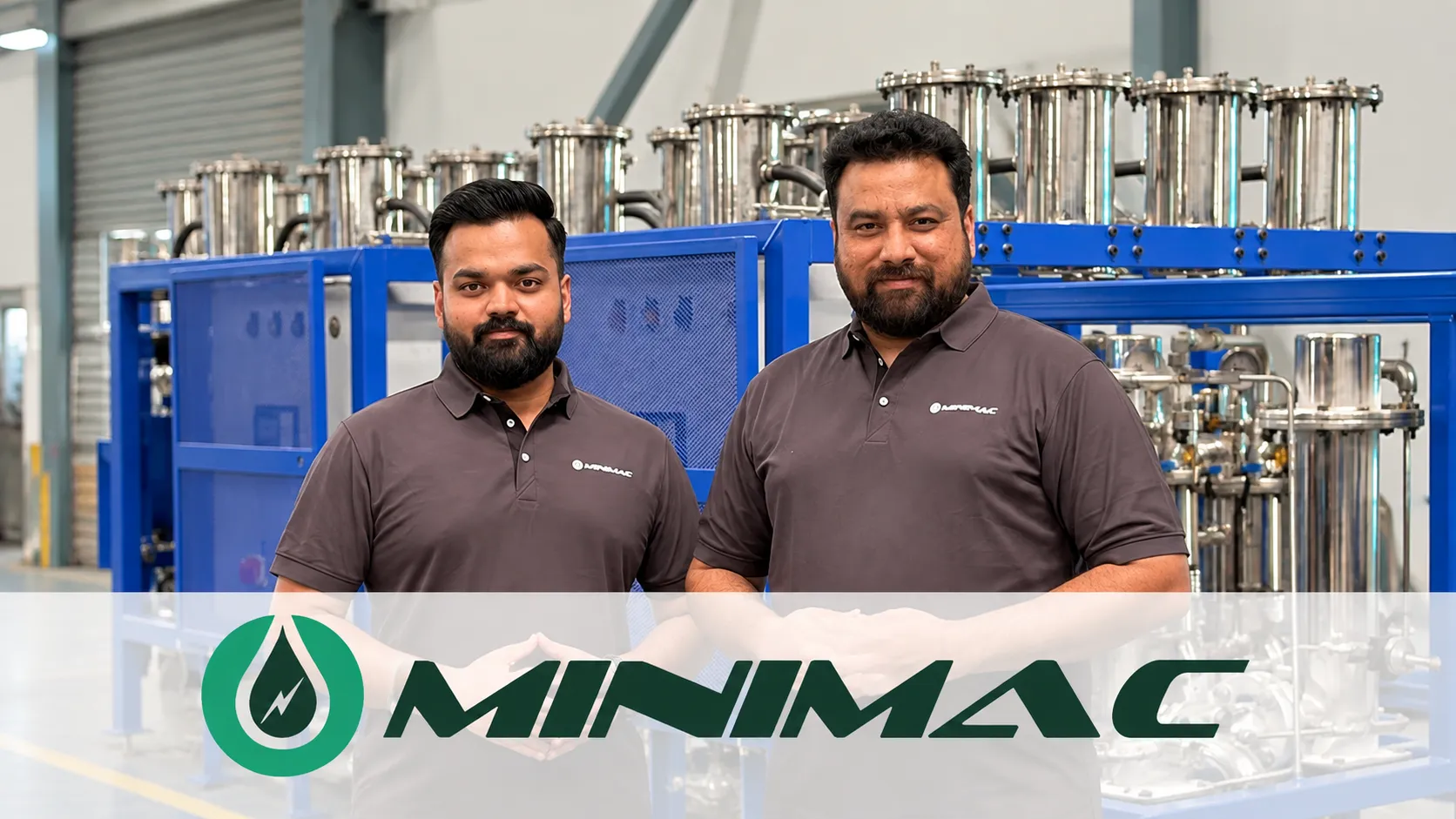
Pune-based industrial deep-tech firm Minimac Systems has raised INR 30 crore led by Rainmatter by Zerodha to scale its miniaturised water treatment infrastructure and Recycling on Wheels hubs.
<p>Minimac Systems, a Pune-based industrial deep-tech company focused on miniaturised water treatment infrastructure, has raised INR 30 crore in a funding round led by Rainmatter by Zerodha, with participation from select venture capital firms. The company will use the capital to expand research and development in miniaturised treatment infrastructure and fluid analytics, while scaling its network of Recycling on Wheels hubs, a mobile approach to industrial water recycling that the company believes can meaningfully reduce freshwater consumption across decentralised industrial sites.</p><p>Rainmatter, Zerodha's climate and sustainability-focused investment arm, has built a portfolio concentrated on companies working across renewable energy, circular economy infrastructure and resource efficiency, positioning its investment in Minimac Systems as a natural extension of that thesis into industrial water management, a category that has historically received less venture attention than energy-focused climate technology despite its critical importance to India's manufacturing and agricultural sectors.</p><p>The Recycling on Wheels concept addresses a specific structural challenge in India's industrial water treatment landscape: many small and medium manufacturing units lack the capital or physical space to install permanent, large-scale water treatment infrastructure, yet still generate significant volumes of wastewater requiring treatment before discharge or reuse. By deploying mobile, modular treatment units that can service multiple industrial sites on a rotating basis, Minimac Systems is attempting to bring water recycling capability to businesses that would otherwise be priced out of compliance-grade treatment solutions.</p><p>India's industrial sector faces mounting pressure around water usage and wastewater discharge, driven by both tightening regulatory enforcement and growing physical water scarcity in several of the country's key manufacturing clusters. Companies operating in water-stressed regions increasingly face operational risk tied to water availability, making efficient recycling and reuse technology not merely an environmental compliance matter but an operational resilience imperative for manufacturers dependent on consistent water access.</p><p>Minimac Systems' focus on miniaturisation and fluid analytics reflects a broader trend within industrial climate technology: rather than pursuing large, capital-intensive centralised infrastructure projects, a growing cohort of startups are building smaller, more flexible systems that can be deployed incrementally and adapted to the specific needs of individual industrial sites. This approach lowers the capital barrier for smaller manufacturers to adopt water recycling technology, expanding the addressable market well beyond the large industrial conglomerates that have traditionally been the primary customers for water treatment infrastructure.</p><p>The fresh funding will also support continued investment in the company's fluid analytics capabilities, technology that allows industrial customers to monitor water quality and treatment efficiency in real time, generating data that can both optimise treatment processes and support regulatory compliance reporting. As Indian regulators continue to tighten enforcement around industrial effluent discharge, analytics-driven compliance tools are likely to become an increasingly important differentiator for water technology providers.</p><p>For Rainmatter, the investment continues a pattern of backing infrastructure-level climate technology companies addressing structural resource constraints in India's industrial economy, rather than consumer-facing sustainability products. This infrastructure-first approach reflects a view, increasingly shared across India's climate tech investing community, that meaningful emissions and resource-use reductions will require deep investment in the physical systems underpinning industrial production, not solely in consumer behaviour change.</p><p>As Minimac Systems scales its Recycling on Wheels network across additional industrial clusters, the company's ability to demonstrate measurable water savings and treatment cost efficiency for its manufacturing customers will be critical to sustaining both commercial growth and continued investor confidence. The company's trajectory offers a useful test case for whether mobile, modular water treatment infrastructure can meaningfully expand recycling adoption among India's vast base of small and medium manufacturers.</p><p></p><img src="/api/files/1788507152652-85cf0726662669aa2b745a97.webp" alt="image.png"><p>Water technology investors note that India's industrial water crisis has historically received considerably less venture capital attention than energy transition technology, despite carrying comparable, and in several regions more acute, operational risk implications for manufacturers, making Minimac Systems' funding round a notable data point in what may be a gradually broadening climate tech investment thesis within India.</p><p>The company's mobile, modular approach to water treatment infrastructure also offers a potential template for addressing similar resource-constraint challenges across other industrial input categories, suggesting that successful execution of the Recycling on Wheels model could inform how future infrastructure-focused climate tech startups approach decentralised deployment strategies for capital-constrained small and medium manufacturing customers.</p><p>As Indian regulators continue tightening enforcement around industrial effluent discharge standards, demand for accessible, cost-effective water recycling technology is likely to grow substantially, positioning companies like Minimac Systems that have already built both the physical infrastructure and analytics capability to serve this compliance-driven demand favourably for continued growth.</p><p>Looking ahead, Minimac Systems has indicated plans to expand its Recycling on Wheels network into additional industrial clusters across western and southern India over the coming year, betting that its currently modest scale can grow into a genuinely national infrastructure network as awareness of both regulatory compliance requirements and water scarcity risk continues to rise among the country's small and medium manufacturing base.</p><p>For India's climate tech investors, Minimac Systems' raise highlights an underappreciated but structurally important category: industrial water management infrastructure that, unlike more visible renewable energy investments, directly addresses operational risk for the millions of small manufacturers who form the backbone of India's industrial economy.</p><p>It is also worth noting that Rainmatter's continued investment in infrastructure-level climate technology, spanning energy, water and circular economy categories, reflects a broader thesis increasingly shared across India's climate investing community: that meaningful environmental and resource-efficiency gains will require sustained capital deployment into unglamorous, infrastructure-heavy categories, not solely the more visible consumer-facing sustainability products that have historically captured greater public attention.</p><p>Ultimately, Minimac Systems' raise reflects a broader recognition within India's climate investing community that industrial resource efficiency, spanning water, energy and materials, represents as significant an investment opportunity as more headline-grabbing renewable energy categories. As the company scales its Recycling on Wheels network, its experience will offer valuable insight into how effectively mobile, modular infrastructure models can address structural resource constraints facing India's vast base of small and medium manufacturers.</p><p>Its progress will be watched closely by a broader community of Indian founders and investors working to prove that industrial climate infrastructure can be both commercially viable and environmentally consequential.</p>
“We are witnessing the birth of ‘Statist Silicon’—where the location of a transistor’s manufacture is as important as its clock speed.”
The Rise of Regional Fabric
