
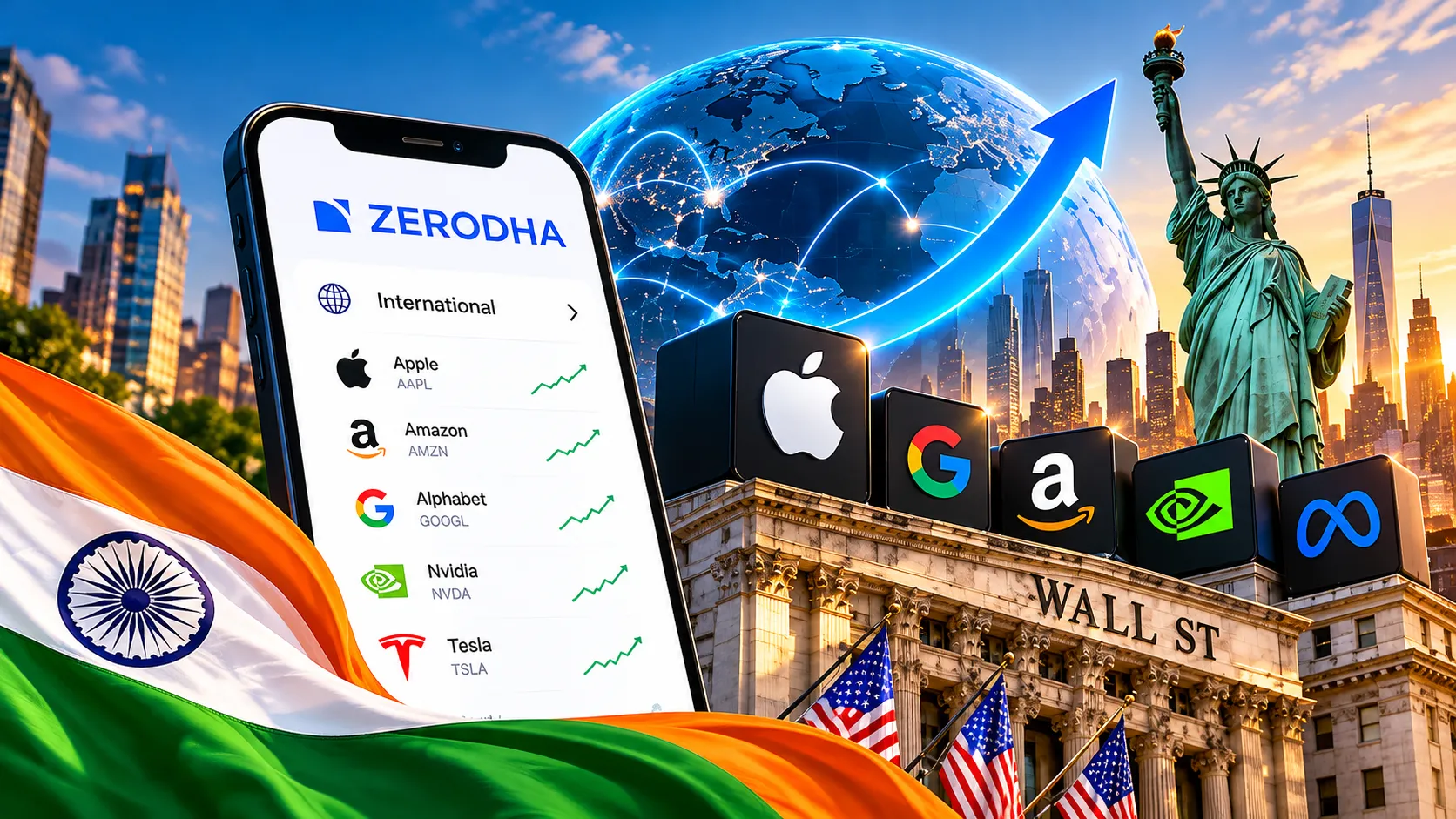
Zerodha has launched US stock investing in beta on its Kite platform, giving resident Indians access to about 2,000 US-listed companies and 1,000 ETFs through BSE's India INX Global Access in GIFT City. Fractional investing starts at $1, with brokerage of 0.1% capped at $10, as rivals Groww and Upstox race into the same market.
<p>Zerodha, India's best-known discount stockbroker, has opened a direct route to Wall Street for its millions of customers. The Bengaluru-based firm has launched US stock investing in beta on its Kite trading platform, allowing resident Indian individuals to buy shares of US-listed companies and exchange-traded funds, according to a report by Inc42 on October 19.</p><p>Users can invest in up to 2,000 US-listed companies and about 1,000 ETFs, with fractional investing starting at just $1. That means an investor can buy a small fraction of a high-priced share, such as those of large US technology companies, without needing to purchase a whole share.</p><p>The launch marks a significant expansion for a company that built its business on Indian equities and derivatives, and it intensifies competition among Indian brokers to capture growing demand for global diversification.</p><h2>How it works</h2><p>Zerodha's US investing service is routed through BSE's India INX Global Access platform at GIFT City, India's international financial services centre in Gujarat. The US securities are held through a US brokerage partner rather than in an Indian demat account.</p><p>Customers can activate an international segment within Kite without opening a separate demat account. Money moves from a linked Indian bank account into a dollar-denominated wallet. At launch, wallets can be funded only through netbanking from supported Indian banks; UPI, debit cards and credit cards are not supported.</p><p>The service supports long-term delivery investing, fractional ownership and systematic investment plans (SIPs) in eligible US stocks. It does not support intraday trading, margin trading or participation in US IPOs, reflecting a focus on long-term investing rather than speculation.</p><p>Investments made by resident Indians in overseas securities fall under the Reserve Bank of India's Liberalised Remittance Scheme, which caps total overseas remittances per individual each financial year.</p><h2>What it costs</h2><p>Zerodha charges brokerage of 0.1% of trade value, with a minimum of $0.01 and a maximum of $10 per executed order, plus 18% goods and services tax on brokerage. A turnover fee of 0.005% of trade value is levied by the International Financial Services Centres Authority (IFSCA), and US regulatory transaction fees apply to sell orders.</p><p>Currency conversion is another cost. According to Zerodha's guide, investors pay a negotiated bank markup of 0.5% to 1.2% over the RBI reference rate when converting rupees to dollars. For small, frequent investors, conversion costs can be as significant as brokerage, so investors are likely to compare total costs carefully across platforms.</p><h2>A crowded race to Wall Street</h2><p>Zerodha is not alone. In June, IFSCA approved Zerodha, Groww, Angel One and Upstox to offer international and US stocks through GIFT City. Groww launched its offering in September in partnership with Alpaca Securities, giving access to more than 10,000 US stocks and ETFs with fractional investing. Upstox also launched in September, offering more than 8,000 US-listed stocks and over 2,000 ETFs, with fractional investing from $1. INDmoney and HDFC Securities already offer US investing.</p><p>Zerodha's initial selection of 2,000 companies is narrower than some rivals, but it covers the large and well-known US companies that most Indian investors are likely to want. The firm's advantage lies in its vast existing customer base and its reputation for low costs and a clean user experience, which could allow it to win share quickly despite arriving later than some competitors.</p><img src="/api/files/1792494473787-a7ae98881b3638f79a9a5e3e.webp" alt="c0b21a89-d510-4cd8-ba88-b56e854579f4.png"><h2>Why Indians want US stocks</h2><p>Interest in US equities among Indian investors has grown rapidly over the past several years. Many want exposure to global technology giants such as Apple, Microsoft, Nvidia, Alphabet, Amazon and Meta, which have no direct equivalents in Indian markets. Others see US stocks as a way to diversify risk away from a single economy and currency.</p><p>The weakness of the rupee in 2026, which has traded near record lows of around 95 per dollar, has reinforced the case for dollar-denominated assets. When the rupee falls, the value of US investments rises in rupee terms, providing a natural hedge for Indian investors.</p><p>At the same time, global investing carries its own risks. US technology stocks have been volatile this month amid concerns about the economics of artificial intelligence, with chip stocks suffering their longest losing streak since 2008 before rebounding. Investors also face currency risk in the other direction if the rupee strengthens, as well as different tax treatment for overseas investments.</p><h2>GIFT City's growing role</h2><p>The launch is a boost for GIFT City, which the government has been developing as India's answer to offshore financial centres such as Singapore and Dubai. By channelling US stock investing through GIFT City's exchanges, regulators aim to bring activity that might otherwise flow to foreign platforms within India's regulatory perimeter, improving oversight and generating business for domestic institutions.</p><p>For the Indian diaspora and globally minded professionals, the expansion of GIFT City-based services is part of a broader opening of India's financial system to international markets.</p><h2>Taxes and paperwork</h2><p>Investing abroad also brings tax considerations. Gains on foreign shares held by Indian residents are taxed under Indian law, and dividends from US companies are typically subject to withholding tax in the United States, which can be credited against Indian tax under the double taxation avoidance agreement between the two countries. Remittances under the Liberalised Remittance Scheme above certain thresholds attract tax collected at source, which can be adjusted against final tax liability.</p><p>Indian investors with overseas assets must also disclose them in their income tax returns. Brokers offering US investing typically provide statements to help with compliance, but investors are advised to understand the rules before allocating significant sums abroad. For many first-time global investors, these practical details may matter as much as the choice of stocks.</p><h2>What comes next</h2><p>As a beta service, Zerodha's US investing will likely evolve in the coming months, with possible additions to the stock list, more funding options and new features. How quickly Zerodha's customers adopt the service, and whether it can compete on cost and choice with Groww and Upstox, will be watched closely.</p><p>For Indian retail investors, the message is clear: investing in the world's largest stock market is becoming cheaper, simpler and more accessible than ever. Whether that leads to better-diversified portfolios or simply to more speculation in popular US technology names will depend on how investors use the new access.</p>
“We are witnessing the birth of ‘Statist Silicon’—where the location of a transistor’s manufacture is as important as its clock speed.”
The Rise of Regional Fabric
