
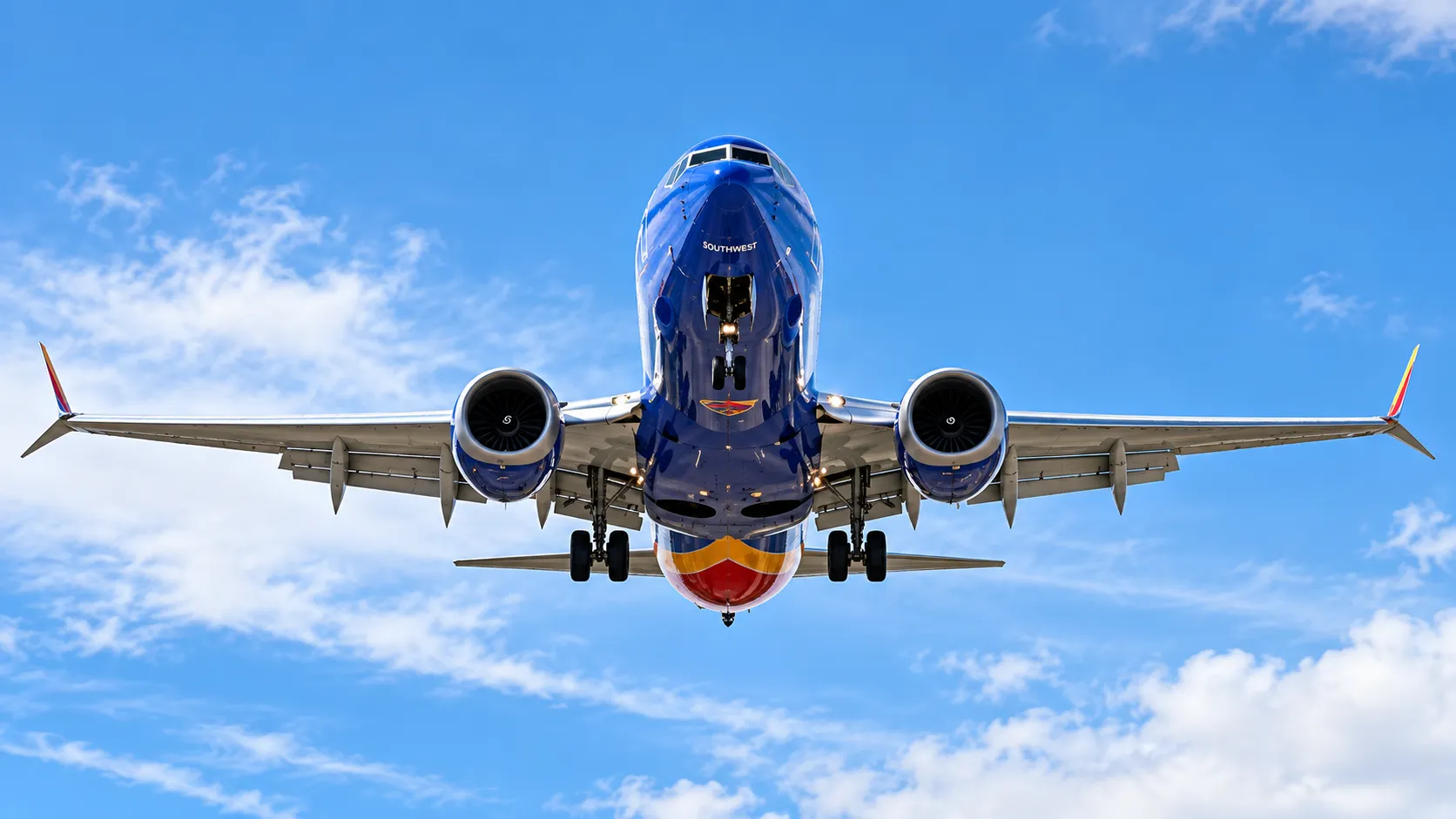
US Transportation Secretary Sean Duffy is expected to announce FAA certification of Boeing's 737 MAX 10 on October 20 at the planemaker's Everett factory, Reuters reported. The largest MAX variant accounts for nearly 1,500 orders, about 30% of Boeing's 737 backlog, after a certification delayed by crashes, a door-plug blowout and an engine anti-ice issue.
<p>Boeing is on the verge of a milestone it has waited more than six years to reach. The US Federal Aviation Administration is set to certify the 737 MAX 10, the largest version of Boeing's best-selling narrowbody jet, with Transportation Secretary Sean Duffy expected to announce the approval on Tuesday, October 20, at the company's factory in Everett, Washington, Reuters reported, citing sources briefed on the plans.</p><p>The FAA did not immediately comment, and Boeing referred questions to the agency. On Friday, the FAA's Type Certification Board, made up of senior agency managers, conducted its review, the final step before the agency decides whether to certify an aircraft.</p><p>Certification would allow Boeing to begin delivering an aircraft that airlines have ordered in large numbers. Carriers have ordered nearly 1,500 MAX 10s, which account for about 30% of Boeing's outstanding 737 backlog. Boeing has already built a handful of the jets, which are awaiting delivery.</p><h2>A long and troubled road</h2><p>Boeing originally planned to begin delivering the MAX 10 in 2020. The programme was caught up in the broader crisis surrounding the 737 MAX family after two fatal crashes, of Lion Air in October 2018 and Ethiopian Airlines in March 2019, killed 346 people. The crashes, linked to flawed flight-control software, led to a worldwide grounding of the MAX and a sweeping overhaul of how the FAA certifies new aircraft.</p><p>Further scrutiny followed in January 2024, when a door plug blew out of an Alaska Airlines 737 MAX 9 in mid-flight. No one was killed, but the incident exposed quality-control problems in Boeing's manufacturing and led the FAA to cap MAX production while the company addressed safety and quality concerns.</p><p>A separate technical issue added to the delays. A problem with the anti-ice system on the engines of MAX aircraft, which emerged in 2023, held up certification of both the MAX 7 and MAX 10 while Boeing developed a fix. The FAA approved the smaller MAX 7 in August, after more than eight years of review.</p><p>In late September, Boeing disclosed a navigation software glitch on the MAX 10. The FAA determined that it was not a safety concern and did not require a fix as a condition of certification.</p><img src="/api/files/1792480925104-c32d9cec9a45ab0d42897fac.webp" alt="be2ea843-f884-433c-b13c-59d645ef508b.png"><h2>Who is waiting for the MAX 10</h2><p>The MAX 10 is designed to compete with the Airbus A321neo, which has dominated the market for large single-aisle jets and helped Airbus pull ahead of Boeing in narrowbody orders. Customers for the MAX 10 include United Airlines, Alaska Airlines, Ryanair, Delta Air Lines and American Airlines, among others.</p><p>For these airlines, the delays have been costly. Some have had to adjust fleet plans, lease additional aircraft or extend the life of older jets. United, one of the largest MAX 10 customers, has at times shifted orders to other models and leased Airbus aircraft to fill the gap.</p><p>In India, Akasa Air has ordered MAX 10 aircraft as part of its large Boeing order book, and Air India has also placed substantial Boeing orders as part of its fleet modernisation. The availability of larger narrowbody jets matters for Indian carriers operating on busy domestic routes and to destinations in the Gulf and Southeast Asia, where airport slots are constrained and higher-capacity aircraft can carry more passengers per flight.</p><h2>Production and the certification debate</h2><p>Boeing opened a new production line for the MAX at Everett in July to expand output. It also assembles the MAX at its Renton factory. Ramping up production while maintaining quality is critical to Boeing's recovery, both financially and reputationally.</p><p>The certification also comes amid a broader debate about how the FAA certifies aircraft. Duffy met aerospace industry chief executives in Georgia the previous week to discuss improving the certification process. The industry has argued that reviews have become too slow, while safety advocates have warned against loosening oversight after the MAX crashes.</p><h2>Boeing's other unfinished business</h2><p>The MAX 10 is not Boeing's only delayed programme. The 777-9, the newest version of its long-haul widebody jet, is still awaiting certification and is now six years behind schedule. Boeing expects certification and first deliveries in 2027. Airlines including Emirates, Lufthansa and Air India have ordered the 777X family.</p><p>Boeing has also faced financial strain in recent years, including losses, a machinists' strike in 2024 and the costs of addressing quality problems. Steady deliveries of the MAX family, its most important source of cash, are central to its turnaround.</p><h2>What it means for the aviation market</h2><p>Certification of the MAX 10 would ease pressure on a global aviation industry that has struggled with aircraft shortages. Airlines worldwide have faced delays in receiving new jets from both Boeing and Airbus, constrained by supply chain problems, engine issues and production limits. That has pushed up lease rates and limited capacity growth, contributing to higher airfares.</p><p>For Indian aviation, one of the world's fastest-growing markets, more aircraft availability would help carriers expand capacity to meet rising demand. Indian airlines have placed some of the largest aircraft orders in history in recent years, and timely deliveries are essential to their growth plans.</p><h2>The duopoly and its discontents</h2><p>The commercial aircraft market is dominated by Boeing and Airbus, which together supply nearly all large passenger jets. Airlines often split orders between the two to maintain bargaining power and reduce dependence on a single supplier. When one manufacturer struggles, as Boeing has in recent years, airlines can face shortages, delays and higher costs, with limited alternatives.</p><p>China's COMAC has developed the C919 narrowbody jet as a potential competitor, but it has so far been delivered mainly to Chinese airlines and does not yet have certification from US or European regulators. Brazil's Embraer makes smaller regional jets. For airlines worldwide, Boeing's ability to deliver aircraft reliably is therefore critical to their growth plans.</p><h2>What to watch</h2><p>If the certification goes ahead as expected, attention will shift to the pace of MAX 10 deliveries and Boeing's ability to increase production without compromising quality. Airlines will be watching closely to see how quickly they can integrate the new jets into their fleets.</p><p>For Boeing, the MAX 10 approval is less a triumph than the removal of a long-standing obstacle. The company's recovery will depend on delivering aircraft reliably, safely and on schedule, something it has struggled to do for much of the past decade.</p>
“We are witnessing the birth of ‘Statist Silicon’—where the location of a transistor’s manufacture is as important as its clock speed.”
The Rise of Regional Fabric
