
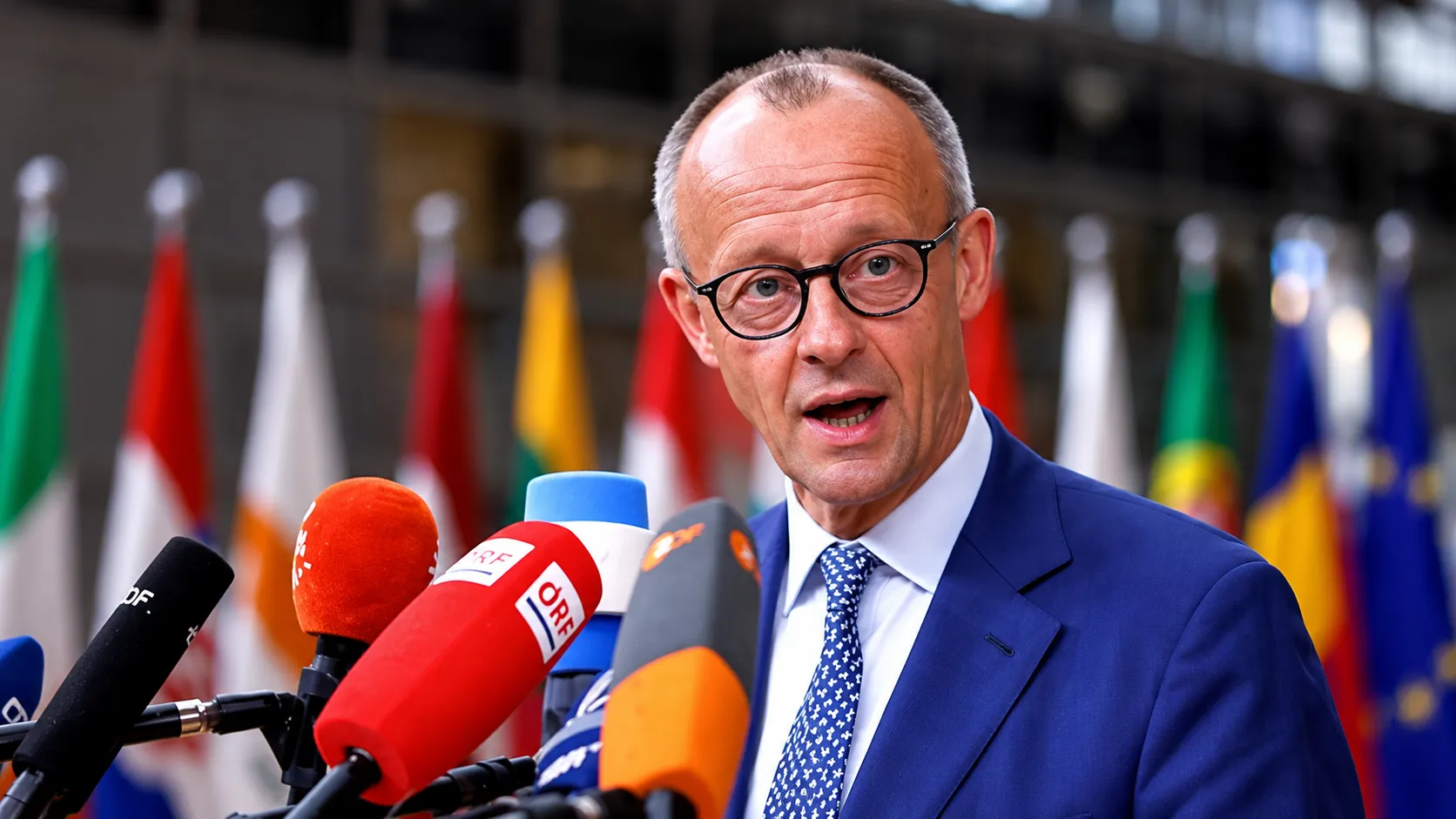
A coalition of 147 companies and investors behind the Made for Germany initiative says Germany could unlock €2.9 trillion to €4.1 trillion of investment by 2035. At the Invest in Germany Summit in Berlin on October 19, Chancellor Friedrich Merz urged businesses to adopt AI as Germany prepared an industrial AI partnership with Nvidia.
<p>Germany, Europe's largest economy, is trying to convince global investors that its long period of stagnation is ending. At the Invest in Germany Summit in Berlin on Monday, October 19, Chancellor Friedrich Merz urged German businesses to embrace artificial intelligence, as a coalition of the country's biggest companies set out a vision of trillions of euros in potential investment.</p><p>The Made for Germany initiative, a cross-industry group of 147 companies and investors, said in a new report that Germany could unlock €2.9 trillion to €4.1 trillion, or $3.3 trillion to $4.6 trillion, of investment by 2035, according to Reuters. The report was to be presented to Economy Minister Katherina Reiche by the chief executives of Deutsche Bank and Siemens.</p><p>The summit, which runs on October 19 and 20, also set the stage for a partnership between Germany and US chipmaker Nvidia to promote AI in German industry.</p><h2>Merz's AI appeal</h2><p>Speaking at the opening event alongside Nvidia chief executive Jensen Huang, Merz described the moment as pivotal. "We are in the midst of a fundamental economic and technological transformation," he said, pointing to the rapid progress of AI.</p><p>He made a direct appeal to German companies, many of which have been cautious about sharing data and adopting new technologies. "Please open your doors for AI to make use of your data," he told business leaders. Merz said cooperation with Nvidia is key to Germany's future success.</p><p>Germany and Nvidia are expected to announce a partnership at the summit to advance AI in robotics, industrial manufacturing and autonomous driving. About a dozen German companies, including Siemens, Audi and AI startup Black Forest Labs, are expected to participate. The German economy ministry has signed a memorandum of understanding with Nvidia, although the government has not given further details.</p><p>Huang pointed to Nvidia's existing work with German carmakers, including Mercedes-Benz, which is developing premium robotaxis using Nvidia software.</p><h2>Five areas for growth</h2><p>The Made for Germany report identifies five areas for investment: artificial intelligence; industrial transformation and next-generation technologies; resilient energy systems; core infrastructure; and security and defence.</p><p>Members of the initiative plan to invest more than €850 billion through 2028, after investing more than €200 billion in 2025. The group has invited more companies and investors to join.</p><p>The report acknowledges that high costs and regulatory burdens continue to weigh on growth. But it argues that initial reforms, combined with political and legal stability, a strong research base, a skilled workforce, industrial depth and access to the European Union's single market, could attract long-term capital. It called on policymakers to implement reforms consistently to turn investor interest into real projects.</p><p>Merz said the summit was about more than money. "This is not just about the many hundreds of billions of euros flowing into projects in Germany," he said.</p><h2>Why Germany needs a reset</h2><p>Germany's economy has struggled for several years. Its industrial model, built on manufacturing, exports and cheap Russian energy, was shaken by Russia's invasion of Ukraine in 2022, which sent energy prices soaring. Competition from China in cars, machinery and green technology has intensified, and US tariffs have added further pressure on exporters.</p><p>German industry has also been criticised for lagging in digital technology and AI adoption compared with the United States and China. Bureaucracy, slow permitting, high energy costs and a shortage of skilled workers have been cited as obstacles to investment.</p><p>Merz's government has sought to respond with a combination of fiscal stimulus, including a large infrastructure and defence spending programme enabled by changes to Germany's constitutional debt brake, and reforms to cut red tape and lower energy costs.</p><img src="/api/files/1792479937632-012a5bbfebfeb211cd16c131.webp" alt="e5004655-c5e3-4aba-8648-16daa1613fdf.png"><h2>The industrial AI opportunity</h2><p>For Germany, AI offers a chance to strengthen its core industrial strengths rather than compete head-on with US consumer technology giants. Industrial AI, which applies machine learning to manufacturing, logistics, engineering and robotics, could boost productivity in sectors where German companies are world leaders, from automotive and chemicals to machinery and industrial automation.</p><p>Nvidia has been expanding its presence in Europe. The company has backed several European AI startups and said it plans to invest billions more in the continent. Partnerships with governments and industrial companies help Nvidia sell its chips and software while supporting European ambitions for "sovereign AI," computing capacity under European control.</p><h2>What it means for India</h2><p>Germany is one of India's most important economic partners in Europe and a major source of foreign direct investment, particularly in engineering, automotive, chemicals and renewable energy. German companies such as Siemens, Bosch and Mercedes-Benz have large operations in India, including research and development centres that employ thousands of Indian engineers.</p><p>A revival of German investment, especially in AI and industrial technology, could create opportunities for Indian IT services companies, engineering firms and startups. India and the European Union have also been negotiating a free trade agreement, which would further deepen economic ties.</p><p>Germany's skills shortage is another link. The country has been recruiting skilled workers from India, including in IT, engineering and healthcare, and the Indian diaspora in Germany has grown rapidly.</p><h2>The summit as a signal</h2><p>Investment summits are partly about symbolism. By bringing together the chancellor, leading German executives and the head of the world's most valuable chipmaker, the Invest in Germany Summit aimed to send a message to global investors that Germany is open for business and determined to compete in the technologies of the future.</p><p>The presence of Jensen Huang was particularly significant. Nvidia has become a central player in national AI strategies around the world, partnering with governments in Europe, the Middle East and Asia to build computing capacity. A formal partnership with Germany would place Europe's largest economy among the countries working most closely with Nvidia to develop industrial and sovereign AI capabilities.</p><h2>What to watch</h2><p>The details of the Nvidia partnership and any specific investment commitments announced at the summit will indicate how much substance lies behind the ambitious figures. The Made for Germany estimate is a private-sector projection of potential, not a commitment, and turning it into real investment will depend on sustained reform.</p><p>For now, Germany is sending a clear message: it wants to be a destination for long-term capital and a leader in industrial AI. Whether that message persuades investors will depend on whether Berlin can deliver lower costs, faster approvals and political stability in the years ahead.</p>
“We are witnessing the birth of ‘Statist Silicon’—where the location of a transistor’s manufacture is as important as its clock speed.”
The Rise of Regional Fabric
