
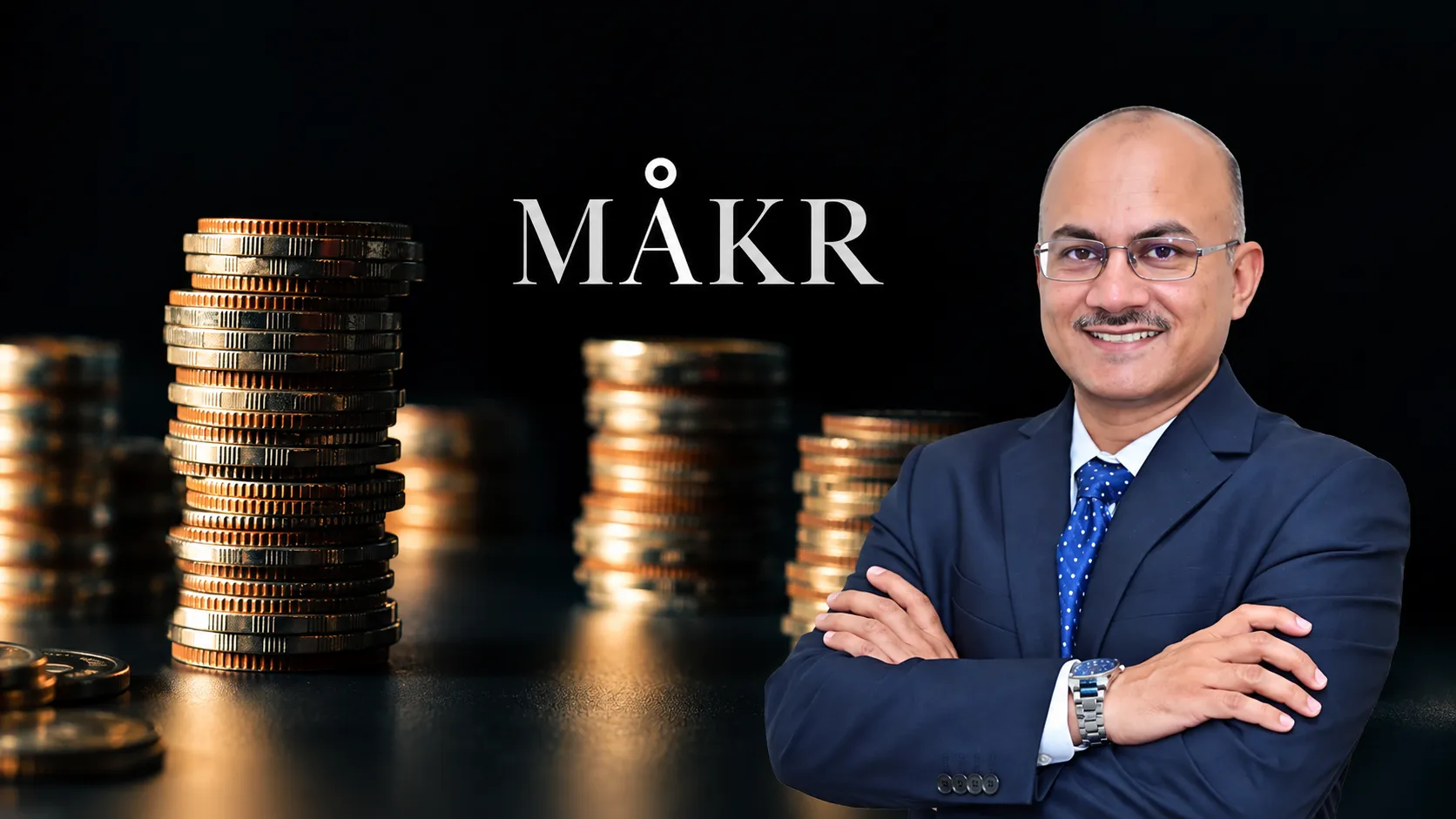
Bengaluru-based Makr Microsystems has raised INR 10.2 crore in a seed round led by Bluehill VC, with Artha Venture Fund participating, to develop nanoscale 3D subsurface metrology technology for chipmakers.
<p>Makr Microsystems, a Bengaluru-based deep-tech startup working on nanoscale subsurface metrology for the semiconductor industry, has raised INR 10.2 crore in a seed funding round led by Bluehill VC, with participation from Artha Venture Fund. The round positions the company as one of a small but growing cohort of Indian deep-tech startups attempting to build genuinely novel intellectual property for the global chip supply chain, rather than downstream software or services layered on top of it.</p><p>Founded by Ashwin Lal, Makr Microsystems is developing technology that allows chipmakers to see and measure hidden structures and defects beneath the surface of a semiconductor wafer without physically damaging the chip in the process. The company's approach combines three distinct measurement techniques: acoustic atomic force microscopy, optical tomography, and three-dimensional data analytics, fused into a single non-destructive inspection platform. That combination is intended to give semiconductor manufacturers a level of visibility into sub-surface defects that current inspection tools struggle to provide economically at scale.</p><p>The proceeds from the seed round will be directed toward three core priorities: further technology development to refine the accuracy and throughput of the measurement platform, customer validation programmes with early semiconductor manufacturing partners, and the initial steps toward commercialisation. Early target applications for the technology include advanced packaging, hybrid bonding processes, and defect detection during chip fabrication, all of which have become increasingly critical as chipmakers push toward smaller process nodes and more complex three-dimensional packaging architectures.</p><p>The timing of the raise is notable. Global semiconductor supply chains have been under sustained scrutiny over the past several years, prompting renewed investment in domestic and allied manufacturing capability across multiple geographies, including India's own Semicon programme. As advanced packaging becomes a central battleground for chip performance gains, given that traditional transistor scaling has slowed, tools that can inspect three-dimensional stacked structures without destructive testing are becoming increasingly valuable to fabs and outsourced semiconductor assembly and test providers alike.</p><p>Bluehill VC's decision to lead the round reflects a broader pattern among India-focused early-stage investors: a willingness to back scientifically ambitious, IP-heavy deep-tech bets that require longer development timelines but offer the potential for outsized returns if the underlying technology proves commercially viable. Artha Venture Fund's participation adds further institutional validation to a company that, by its own admission, is still in the technology-development and customer-validation phase rather than full commercial deployment.</p><p>For India's broader deep-tech ecosystem, Makr Microsystems' raise adds to a growing list of hardware and materials-science startups attracting early capital, even as software-first startups continue to dominate headline funding numbers. Founders in this category frequently cite the difficulty of raising patient capital domestically, given the multi-year R&D cycles typical of semiconductor and materials innovation, making seed rounds of this size a meaningful signal of investor appetite.</p><p>Semiconductor metrology as a discipline has traditionally been dominated by a handful of established global equipment makers, leaving relatively little room for new entrants. Makr Microsystems' strategy of combining multiple measurement modalities into a single platform is intended to differentiate its offering on both cost and capability, rather than competing head-on with incumbents on a single measurement technique alone.</p><p>Company leadership has indicated that the next twelve to eighteen months will be focused on deepening relationships with prospective semiconductor manufacturing customers, both in India and internationally, as the technology moves from laboratory validation toward pilot deployments. Success in securing even a small number of reference customers in advanced packaging could meaningfully de-risk the company's path to a larger follow-on round.</p><p></p><img src="/api/files/1788508391814-4e476fb72ee48d9d02cbf77f.webp" alt="image.png"><p>As India continues to position itself as an emerging node in the global semiconductor value chain, deep-tech companies like Makr Microsystems represent an attempt to move beyond design and engineering services toward proprietary, exportable technology. Whether the company can convert early investor confidence into sustained commercial traction will be closely watched as a marker of how far India's homegrown semiconductor tooling ambitions have progressed.</p><p>Deep-tech investors tracking the semiconductor equipment space note that customer validation cycles in this industry are notoriously long, often spanning eighteen months or more between initial technical engagement and a confirmed purchase order, given the rigorous qualification processes chipmakers apply to any new inspection or metrology tool entering their production lines. Makr Microsystems' seed-stage funding is explicitly structured to carry the company through this extended validation period.</p><p>The company's Bengaluru base places it within India's most established technology hub, offering access to a deep pool of semiconductor and materials science engineering talent, even as the country's own chip fabrication ecosystem remains at a comparatively early stage of development relative to established hubs in Taiwan, South Korea and the United States. Makr Microsystems' technology, targeted at global rather than solely domestic customers, is not directly dependent on India's own fab capacity scaling up.</p><p>As global semiconductor supply chains continue to diversify and advanced packaging becomes an increasingly central lever for chip performance improvement, tool providers capable of offering genuinely differentiated inspection capability, rather than incremental improvements on existing techniques, are likely to find receptive customers among chipmakers seeking every available edge in yield and defect reduction across increasingly complex, three-dimensional chip architectures.</p><p>Looking further out, Makr Microsystems' founders have signalled ambitions that extend beyond India's own borders, targeting global semiconductor manufacturing hubs as primary customers for its inspection technology, rather than positioning the company narrowly around India's still-nascent domestic fabrication capacity. Whether the company can convert its seed-stage technical promise into signed commercial contracts with established chipmakers over the next funding cycle will determine how quickly it can scale from a promising deep-tech bet into a genuinely revenue-generating semiconductor tooling business.</p><p>For investors and policymakers focused on India's semiconductor ambitions, Makr Microsystems represents exactly the kind of narrow, IP-defensible deep-tech bet that the country's broader Semicon strategy will need many more of if it hopes to move beyond assembly and testing toward genuine technology leadership. The company's progress over the coming funding cycle will offer an early, closely watched signal of how well India's emerging deep-tech investor base can support the long development timelines this category inherently requires.</p><p>It is worth noting, too, that India's semiconductor tooling gap has long been identified by policymakers as one of the more structurally difficult pieces of the country's broader chip ambitions to solve, given that equipment and materials science expertise typically takes far longer to develop domestically than design or fabrication capacity. Makr Microsystems' emergence, however early-stage, is precisely the kind of company that industry bodies have said India needs more of if it hopes to build a genuinely full-stack semiconductor ecosystem rather than remaining reliant on imported inspection and metrology equipment indefinitely.</p>
“We are witnessing the birth of ‘Statist Silicon’—where the location of a transistor’s manufacture is as important as its clock speed.”
The Rise of Regional Fabric
