
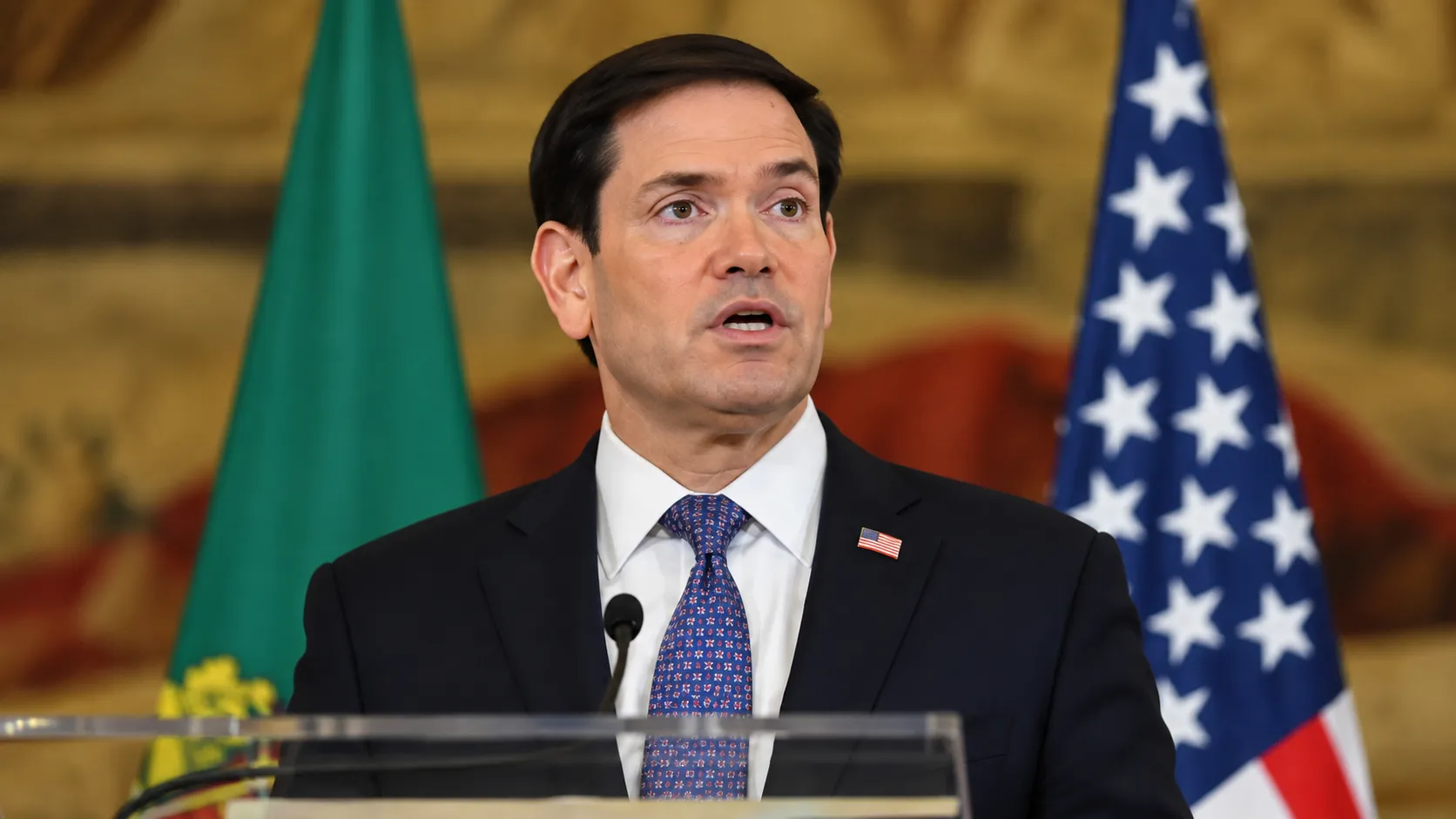
US Secretary of State Marco Rubio began a two-day visit to Mumbai and Jamnagar on October 20 after saying Washington is "very close" to finalising a trade deal with India. He appeared to accept India's reasons for buying Russian oil, days after President Trump waived tariffs of up to 100% on top buyers of Russian crude.
<p>The United States and India are on the verge of concluding a long-awaited trade agreement, according to US Secretary of State Marco Rubio, who arrived in India on Tuesday, October 20, for a two-day visit that could reshape economic relations between the world's largest and most populous democracies.</p><p>"We're trying to finalise the trade deal with India right now. We're very close to doing that," Rubio told reporters on Monday in Samarkand, Uzbekistan, where he had been meeting Central Asian leaders, according to PTI. He flew to Mumbai and is due to visit Jamnagar in Gujarat, home to Reliance Industries' giant refining complex.</p><p>Rubio is scheduled to meet External Affairs Minister S. Jaishankar and business leaders, including Reliance chairman Mukesh Ambani. Reuters reported that the comprehensive trade deal could be signed during the visit. The agenda also covers energy, defence, critical and emerging technologies and other areas of cooperation.</p><h2>Russian oil at the heart of the talks</h2><p>The visit follows a turbulent period in which India's purchases of Russian oil threatened to derail the relationship. In September, President Donald Trump signed the Sanctioning Russia and Iran Act, which allows his administration to impose tariffs of up to 100% on the top five importers of Russian oil. India is the second-largest buyer, after China.</p><p>Last Friday, Trump waived all substantive provisions of that legislation, a move that drew criticism from both Democrats and Republicans who want more economic pressure on Moscow over the war in Ukraine. Rubio has described the waiver as the start of a 60-day review to decide which new tariffs, if any, to impose. Trump also delayed tariffs on US imports from India just before the visit.</p><p>Rubio's comments in Samarkand suggested Washington has come to accept India's position. "You also can't unravel the economy of other countries because of one central issue," he said. "That's not an excuse, but all of that has to be balanced when you make foreign policy." He said US foreign policy considers the Russia-Ukraine war but is not driven solely by it, and he linked the waiver decision to progress on the trade deal.</p><h2>Why India needs Russian crude</h2><p>India imports more than 85% of its crude oil. Since Russia's invasion of Ukraine in 2022, Indian refiners have dramatically increased purchases of discounted Russian crude, which has become one of the country's largest sources of supply. Indian refiners are expected to import around 1.8 million to 1.9 million barrels a day of Russian oil in October.</p><p>The issue has dominated discussions between Rubio and Jaishankar. According to reports, Jaishankar explained that Indian refineries are configured mainly for medium sour crude, the type produced in the Middle East and Russia. Venezuelan crude is heavier, while US crude is lighter and would need to be blended. With Middle East supplies disrupted by conflict involving Iran and attacks on shipping in the Strait of Hormuz, India has relied heavily on Russian barrels to keep its economy running.</p><p>Rubio acknowledged the constraints. "You've got countries like India, for example, that have voluntarily diversified their energy portfolio," he said. "Geography is real. For some countries, it's very difficult to acquire energy from alternative sources."</p><h2>What a trade deal could deliver</h2><p>Negotiations on a bilateral trade agreement have stretched over more than a year, marked by tariff threats, counter-proposals and repeated rounds of talks. The United States is India's largest export market, buying everything from pharmaceuticals, gems and jewellery and textiles to engineering goods and IT services. India, in turn, is a growing market for American energy, aircraft, defence equipment and technology.</p><p>Key issues have included US access to Indian agricultural and dairy markets, tariffs on industrial goods, digital trade rules, and Indian demands for relief from US tariffs on steel, aluminium and other products. Both sides have also discussed supply-chain cooperation in semiconductors, critical minerals and clean energy.</p><p>A comprehensive deal would provide certainty for exporters on both sides after a period of volatility. Indian exporters, particularly in labour-intensive sectors such as textiles, footwear and jewellery, have been hit by uncertainty over US tariffs. A settlement could also encourage American companies to deepen investment in India as they diversify supply chains away from China.</p><h2>The Jamnagar symbolism</h2><p>Rubio's decision to visit Jamnagar is notable. The Reliance refinery complex there is the world's largest single-site refinery and a major processor of Russian crude, as well as an exporter of fuels to markets including Europe and the United States. Indian refiners' fuel exports to Western countries have risen sharply this year, supported by processing discounted Russian oil.</p><p>The visit also comes as Reliance prepares for the listing of Jio Platforms, India's largest-ever IPO, which opens on October 21. Meetings with Ambani underline the importance Washington places on India's largest private-sector companies in areas such as energy, digital infrastructure and technology.</p><img src="/api/files/1792494847271-8799078b080aea3bf89b0401.webp" alt="0d056a37-e4e0-4956-896b-f5aa41fc49dc.png"><h2>Markets and the rupee</h2><p>For financial markets, a trade deal and the removal of tariff threats would be welcome news. Foreign portfolio investors have withdrawn record sums from Indian equities in 2026, citing high US interest rates, the strong dollar, expensive oil and geopolitical uncertainty. The rupee has traded near record lows, around 95 per dollar, although it has recovered in recent sessions. Indian markets were closed on October 20 for Dussehra.</p><p>A deal that reduces tariff risks and secures India's energy supplies could improve sentiment towards Indian assets, although analysts caution that details will matter, including which sectors gain market access and how disputes are resolved.</p><h2>A relationship with deep roots</h2><p>Trade and investment ties between India and the United States have grown steadily for two decades. Bilateral trade in goods and services has grown to roughly $200 billion a year, and American companies are among the largest investors in India's technology, manufacturing and services sectors. Indian companies, in turn, have expanded in the United States, particularly in IT services, pharmaceuticals and manufacturing.</p><p>Defence and technology cooperation have deepened as well, through joint exercises, arms sales and initiatives on critical and emerging technologies such as semiconductors, artificial intelligence and space. A trade deal would provide an economic foundation for a partnership that both governments describe as strategic, and would reduce the risk that disputes over tariffs or energy purchases spill over into other areas of cooperation.</p><h2>What to watch</h2><p>The coming two days will show whether the two governments can turn Rubio's optimism into a signed agreement. Key signals will include any joint statement on trade, announcements on energy and defence cooperation, and clarity on how the US will treat India's continued purchases of Russian oil during and after the 60-day review.</p><p>For the Indian diaspora in the United States, numbering more than five million people, and for the many businesses that operate across both economies, the outcome carries real stakes. After months of friction, the US-India relationship appears to be moving back towards partnership. Whether that shift is sealed in Mumbai this week remains to be seen.</p>
“We are witnessing the birth of ‘Statist Silicon’—where the location of a transistor’s manufacture is as important as its clock speed.”
The Rise of Regional Fabric
