
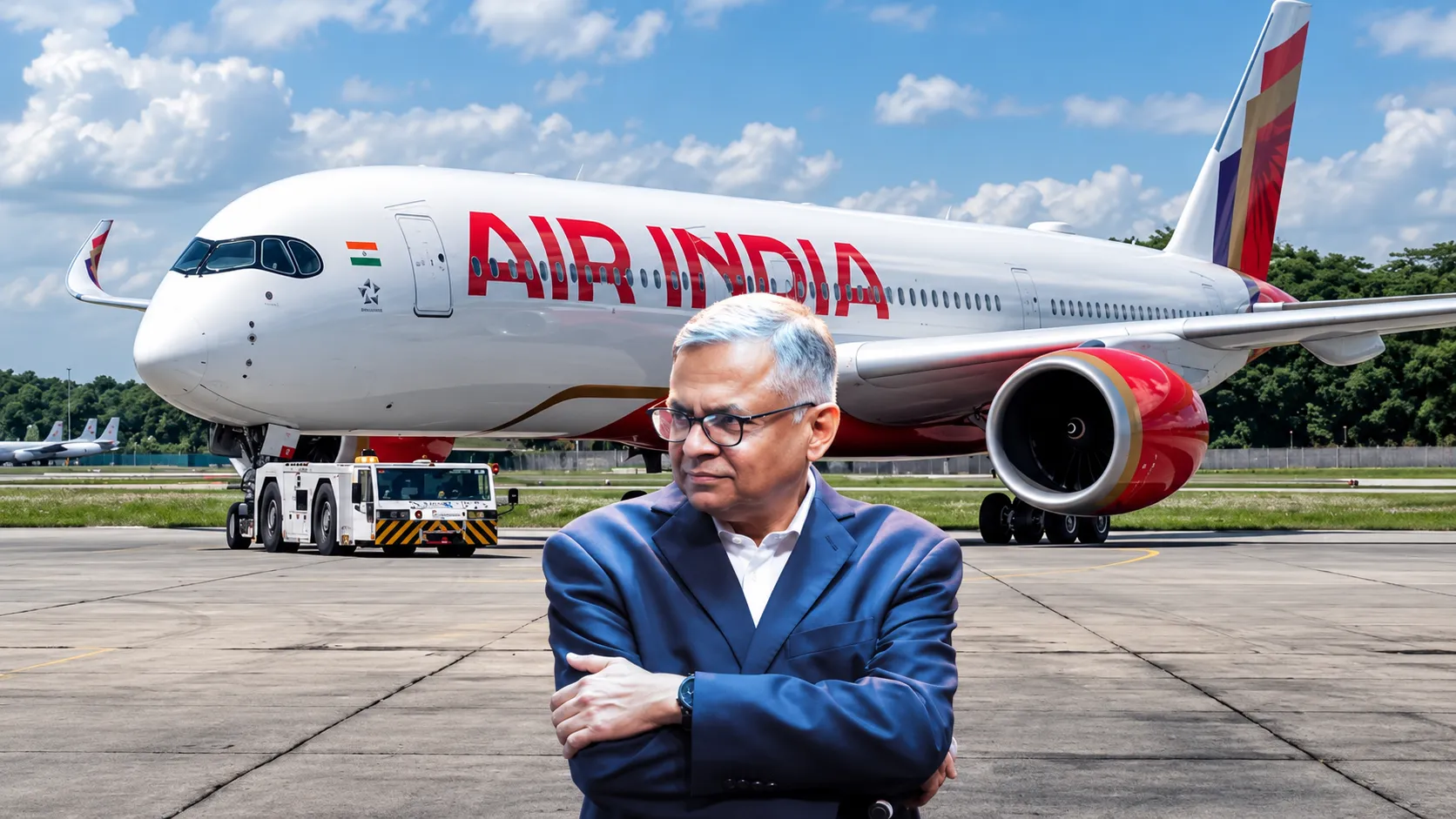
Tata Sons has cleared an investment of over INR 10,000 crore in Air India, subject to conditions requiring thorough business justification for future financial infusions, as the airline continues its turnaround.
<p>Tata Sons has cleared an investment of more than INR 10,000 crore into Air India, subject to significant conditions that call for thorough business justification for any future financial infusions into the national carrier. The commitment comes as Air India continues to seek fresh equity capital to fund its ongoing turnaround, a process that has spanned several years since the Tata Group reacquired the airline through a competitive privatisation process, ending the carrier's decades under government ownership.</p><p>The scale of the fresh commitment underscores the continued financial demands of integrating and modernising Air India, an airline that required extensive fleet renewal, service quality improvements and operational restructuring following decades of underinvestment during its period as a government-owned enterprise. Tata Sons' willingness to commit capital at this scale reflects both confidence in the airline's long-term strategic value to the broader Tata Group portfolio and recognition that a multi-year, capital-intensive turnaround remains far from complete.</p><p>The conditions attached to the investment, requiring detailed business justification for future capital infusions, signal a more disciplined approach to Air India's ongoing capital needs compared to earlier phases of the turnaround. This shift suggests that Tata Sons is moving from a phase of broad, foundational investment toward a more targeted, accountability-driven capital allocation framework as the airline's operational metrics mature and specific investment priorities become clearer.</p><p>Air India's turnaround has involved a complex set of parallel initiatives, spanning fleet modernisation through large aircraft orders, the integration of erstwhile Air India Express and Vistara operations, technology upgrades to customer-facing systems, and sustained efforts to improve on-time performance and service consistency metrics that had deteriorated significantly during the airline's final years under government ownership. Each of these workstreams carries substantial capital requirements, explaining the scale of ongoing investment needed even years into the Tata Group's ownership.</p><p>For the Tata Group, Air India represents both a significant capital commitment and a strategically important asset within its broader conglomerate structure, given the airline's role in India's aviation infrastructure and its symbolic significance as one of the country's most recognised legacy brands returning to private, domestic ownership. The group's willingness to continue committing substantial capital, even while tightening the conditions around future infusions, reflects a long-term view of the investment rather than an expectation of near-term returns.</p><p>India's aviation sector more broadly continues to expand rapidly, driven by rising air travel demand across both domestic and international routes, positioning Air India's turnaround within a favourable macro environment even as execution challenges around service quality and operational consistency persist. The airline's ability to convert Tata Sons' sustained capital commitment into measurable improvements in profitability and customer satisfaction will be closely watched as a barometer of the broader turnaround's ultimate success.</p><p>Analysts covering India's aviation sector note that airline turnarounds of this scale typically require sustained capital commitment over many years before profitability stabilises, given the industry's inherently thin margins and high fixed-cost structure. Tata Sons' latest commitment, while substantial, is unlikely to be the final capital infusion required, making the newly introduced conditions around business justification for future funding an important signal of how the group intends to manage the balance between continued investment and financial discipline going forward.</p><p></p><img src="/api/files/1788507671706-97815119069bd620a9984ce0.webp" alt="image.png"><p>As Air India progresses further into its multi-year transformation, the latest capital commitment from Tata Sons offers both continued runway for the airline's operational improvements and a clearer framework for how future investment decisions will be evaluated. The coming fiscal periods will provide a clearer picture of whether the turnaround's foundational investments are beginning to translate into the sustained operational and financial improvements that justify the scale of capital committed to date.</p><p>Aviation finance specialists note that airline turnarounds of Air India's scale typically require multiple distinct phases of capital investment, moving from initial fleet and service quality stabilisation toward subsequent phases focused on network optimisation and cost discipline, with each phase carrying materially different capital intensity and expected return profiles for the parent group.</p><p>The specific conditions attached to Tata Sons' latest commitment, requiring detailed business justification for future capital infusions, may also reflect lessons learned from the airline's earlier turnaround phases, where the scale and pace of required investment likely exceeded initial expectations given the depth of operational and service quality challenges inherited from the airline's government-owned era.</p><p>For India's broader aviation sector, Air India's continued access to substantial parent-company capital support provides an important source of stability within a highly capital-intensive industry where several competitors have faced their own significant financial and operational challenges, positioning Air India's ultimate turnaround trajectory as an important bellwether for the broader competitive dynamics of India's rapidly growing aviation market.</p><p>Looking ahead, Air India's ability to convert Tata Sons' sustained capital commitment into demonstrable improvements in operational metrics, from on-time performance to customer satisfaction scores, will shape both public perception of the turnaround's progress and the specific terms under which future capital infusions are evaluated under the newly introduced business-justification framework.</p><p>For readers tracking India's aviation sector, Tata Sons' continued, if now more conditional, capital support for Air India offers a useful window into how India's largest conglomerates approach long-horizon, capital-intensive turnaround investments, balancing strategic commitment with an increasingly disciplined approach to capital allocation as individual business units mature.</p><p>It is also worth noting that Air India's turnaround has unfolded against a backdrop of robust overall demand growth across India's aviation sector, driven by rising middle-class travel spending and expanding international connectivity, providing a broadly favourable revenue environment even as the airline continues working through its own specific operational and service quality challenges inherited from its earlier government-owned era.</p><p>Ultimately, Tata Sons' continued capital commitment to Air India, now paired with more disciplined conditions for future investment, illustrates the delicate balance India's largest conglomerates must strike between long-term strategic commitment and increasingly rigorous capital allocation discipline. As Air India's turnaround progresses into its next phase, the airline's ability to convert sustained investment into measurable operational improvement will be closely watched across India's broader aviation and investment communities.</p><p>The scale of continued investment required also underscores just how capital-intensive full-service airline turnarounds remain, even for a conglomerate with the balance sheet strength and patience of the Tata Group.</p>
“We are witnessing the birth of ‘Statist Silicon’—where the location of a transistor’s manufacture is as important as its clock speed.”
The Rise of Regional Fabric
